
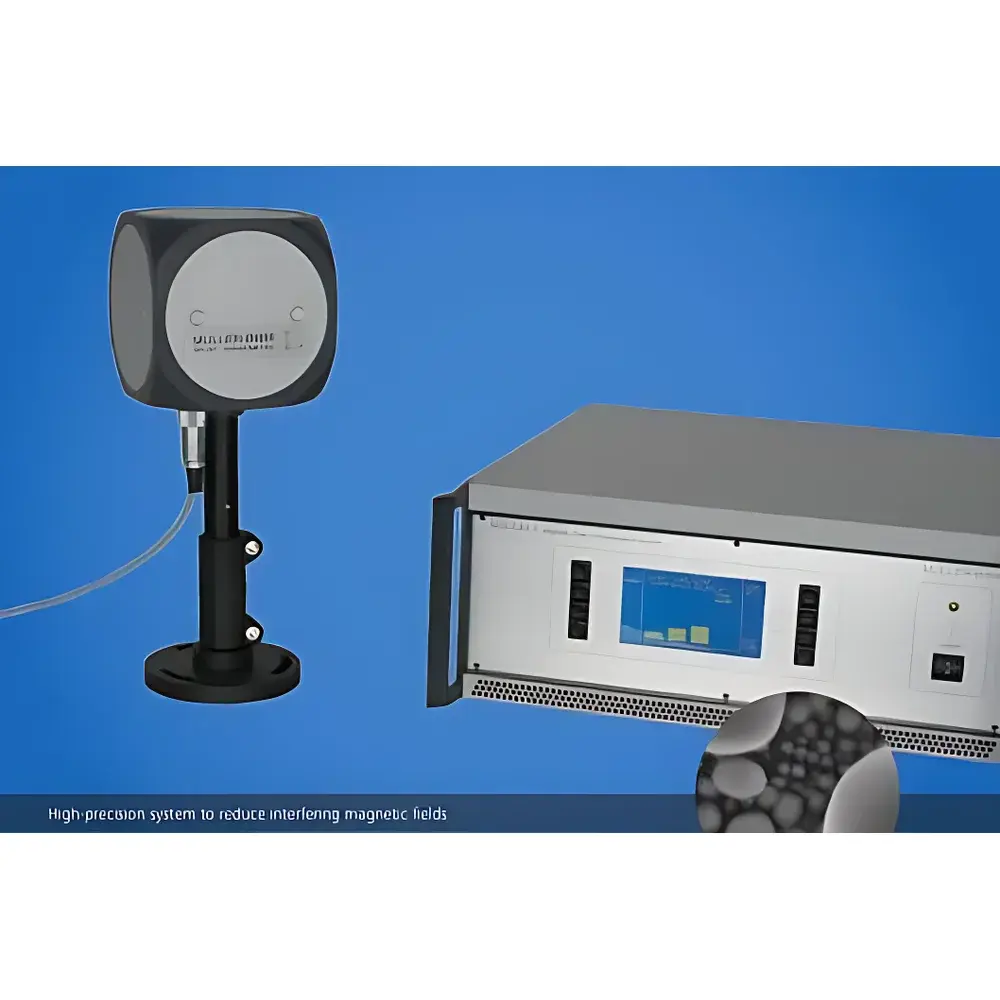
MULLER-BBM MACOM II® Active Magnetic Field Compensation System
| Brand | MULLER-BBM |
|---|---|
| Origin | Germany |
| Model | MACOM II® |
| Frequency Range | 0 Hz to 50 kHz |
| Operating Axes | 3-axis (X, Y, Z) |
| Interface | RS-232 serial + Ethernet (TCP/IP) |
| Display | Integrated LCD for real-time monitoring and parameter adjustment |
| Control | Local front-panel + remote via LAN/internet |
| Maintenance | Maintenance-free after commissioning |
| Compliance | Designed for GLP/GMP-adjacent environments |
Overview
The MULLER-BBM MACOM II® Active Magnetic Field Compensation System is an engineered solution for achieving ultra-stable ambient magnetic fields in high-sensitivity electron-optical and quantum measurement environments. Unlike passive shielding methods—which rely on high-permeability alloys or mu-metal enclosures—the MACOM II® employs real-time active compensation based on closed-loop vector field control. It continuously measures the ambient DC and AC magnetic field components across three orthogonal axes (X, Y, Z) using proprietary patented fluxgate sensors, then drives precisely calibrated compensation coils to generate counteracting magnetic fields of equal magnitude and opposite direction. This principle—rooted in superposition of magnetic vector fields—enables dynamic cancellation of both quasi-static disturbances (e.g., from elevators, moving steel structures, or tramway currents) and high-frequency transients (e.g., switching noise from building power distribution at 50 Hz and its harmonics up to 50 kHz). The system is specifically designed for integration into electron microscopy facilities where even sub-microtesla-level field drifts can induce beam deflection, image distortion, or resolution degradation—particularly critical in transmission electron microscopes (TEM), scanning electron microscopes (SEM), and electron beam lithography (EBL) tools.
Key Features
- Three-axis real-time magnetic field sensing and compensation with integrated fluxgate sensor array (patented design)
- Wideband operational range: 0 Hz (DC) to 50 kHz—capable of suppressing both slow geomagnetic drift and fast switching transients
- Self-calibrating architecture with automatic gain and offset adaptation during initial commissioning
- Integrated LCD display showing residual field magnitude per axis (nT) and real-time coil drive current (mA)
- Dual communication interface: RS-232 serial port and Ethernet (TCP/IP) for local and remote configuration, monitoring, and diagnostics
- Fully autonomous operation post-commissioning—no routine maintenance or recalibration required under stable environmental conditions
- Modular coil driver units compatible with custom installation in standard laboratories, Faraday cages, or multi-layer metal-shielded rooms (e.g., steel-clad TEM suites)
Sample Compatibility & Compliance
The MACOM II® is not a sample-handling device but a facility-level infrastructure component. Its compatibility is defined by spatial integration requirements rather than sample type: it supports all electron-optical instruments requiring <100 nT RMS magnetic field stability over time, including high-resolution TEMs (e.g., Thermo Fisher Titan, JEOL ARM series), SEMs with sub-nanometer resolution (e.g., Zeiss Gemini, Hitachi SU series), EBL systems (e.g., Raith eLINE, Vistec EBPG), and MRI pre-polarization setups. Installation adheres to IEC 61000-4-8 (power frequency magnetic field immunity) and aligns with ISO 14644-1 Class 5 cleanroom-compatible electromagnetic environment specifications. While not a medical device itself, its use in MRI development labs supports compliance with IEC 62471 (photobiological safety) and FDA 21 CFR Part 11–aligned data logging when paired with validated networked control software.
Software & Data Management
The MACOM II® operates without embedded operating system dependencies. Configuration and monitoring are performed via a lightweight, cross-platform web interface served directly from the unit’s onboard Ethernet controller. Logged data—including timestamped residual field vectors, coil currents, and system status flags—is exportable as CSV for traceability. Optional firmware extensions support Syslog forwarding and SNMP v3 integration into centralized facility monitoring platforms (e.g., Nagios, PRTG). For regulated environments, optional audit trail modules provide immutable event logs compliant with ISO/IEC 17025 clause 7.9 (result reporting) and GLP Annex III (instrument qualification records), including user login timestamps, parameter changes, and alarm acknowledgements.
Applications
- Stabilization of TEM/SEM imaging chambers against urban magnetic noise (e.g., subway lines, HVAC systems, nearby transformers)
- Enabling atomic-resolution imaging in non-dedicated shielded rooms—reducing capital cost vs. full mu-metal enclosure
- Supporting electron holography and off-axis electron interferometry where phase stability depends on field homogeneity
- Maintaining beam focus fidelity in multi-beam EBL systems during long-exposure patterning sequences
- Providing background field control for SQUID-based magnetometers and NV-center diamond quantum sensors
- Facilitating reproducible magnetic domain imaging in Lorentz TEM applications
FAQ
Does the MACOM II® require periodic recalibration?
No—once commissioned in situ with factory-provided calibration routines, the system maintains accuracy without scheduled recalibration. Drift compensation is handled autonomously via internal reference stabilization.
Can it be installed inside an existing mu-metal room?
Yes. The MACOM II® is routinely deployed in hybrid configurations: passive shielding handles broadband attenuation, while active compensation corrects low-frequency residuals and dynamic perturbations that penetrate shielding.
Is remote diagnostics supported out-of-the-box?
Yes. Ethernet connectivity enables secure remote access via SSH or HTTPS. Müller-BBM offers optional 24/7 remote support contracts with encrypted telemetry and firmware update capabilities.
What is the typical installation lead time?
Standard commissioning requires one on-site day for sensor placement, coil orientation verification, and baseline field mapping—followed by automated adaptive tuning.
Does it comply with electromagnetic compatibility (EMC) directives for lab equipment?
The unit meets EN 61326-1:2013 (industrial EMC) and EN 61000-6-3:2011 (emission limits), ensuring no interference with adjacent instrumentation such as lock-in amplifiers or cryogenic controllers.





