
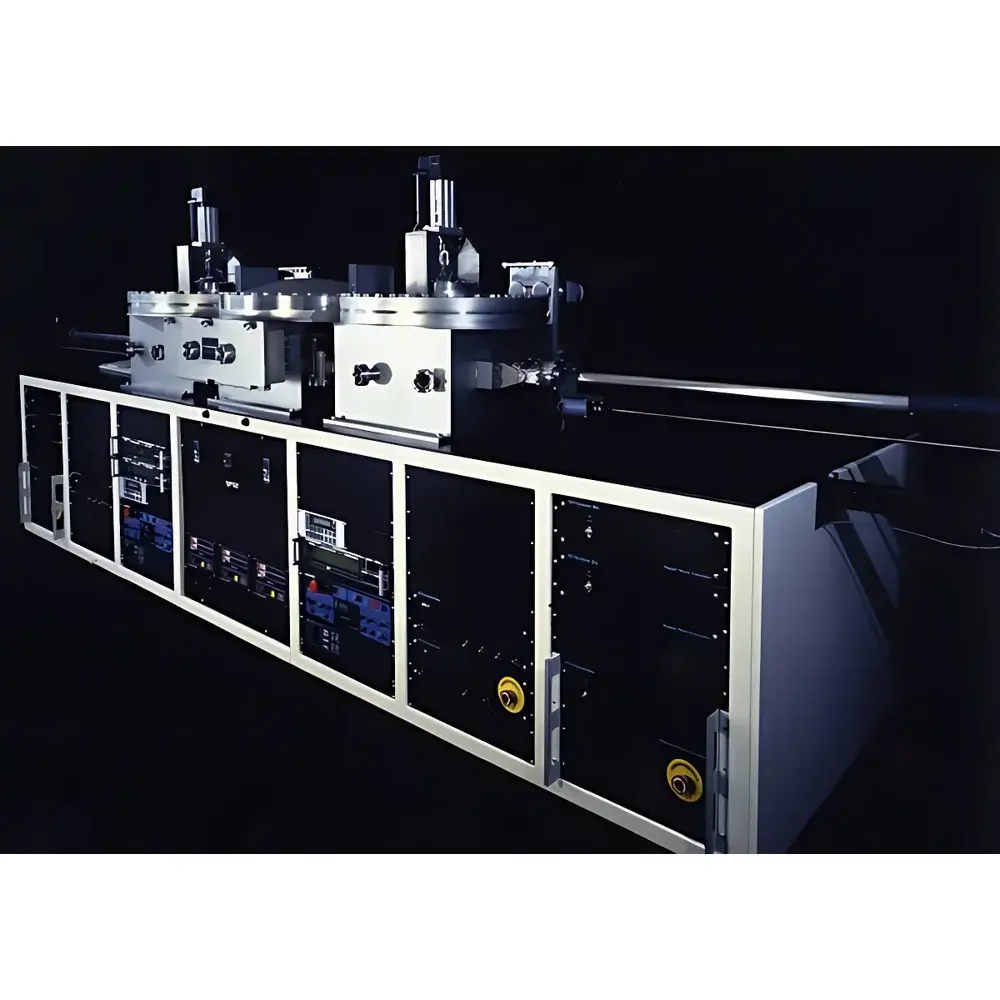
MVSystems MVS Series Ion Sputter Coater
| Brand | MVSystems |
|---|---|
| Origin | USA |
| Manufacturer Type | Authorized Distributor |
| Import Status | Imported |
| Model | MVS-Sputter |
| Target Material Options | Single or Multi-Target Configuration |
| Target Diameter | Standard 2-inch (50.8 mm) or Custom (e.g., 3-inch, 4-inch) |
| Control Interface | Manual Knob + Analog Metering or Optional Digital PID Controller with RS-232/USB Output |
| Chamber Dimensions (W×D×H) | 180 × 180 × 220 mm (7.1 × 7.1 × 8.7 in) |
| Sample Stage Diameter | 100 mm (3.9 in), Adjustable Height & Tilt |
| Sputtering Gas Compatibility | Argon (Ar), Gold (Au), Platinum (Pt), Palladium (Pd), Chromium (Cr), Iridium (Ir), and Reactive Gases (e.g., O₂, N₂) for Oxide/Nitride Coating |
| Base Pressure | ≤5 × 10⁻⁶ Torr (achieved via dual-stage vacuum system: rotary vane pump + turbomolecular pump) |
| Deposition Uniformity | ±5% across 100 mm substrate (measured by quartz crystal microbalance and profilometry) |
| Film Thickness Control | Real-time monitoring via integrated quartz crystal thickness monitor (QCM), resolution: 0.1 Å |
Overview
The MVSystems MVS Series Ion Sputter Coater is a high-vacuum, benchtop physical vapor deposition (PVD) system engineered for reproducible, nanoscale conductive and semi-conductive thin-film coating of electron microscopy (EM) specimens and functional device substrates. Based on DC or RF magnetron sputtering principles, the MVS platform utilizes controlled ion bombardment of solid target materials in an inert (typically Ar) or reactive gas atmosphere to eject atoms that condense uniformly onto grounded or biased substrates. Designed and refined over three decades by MVSystems, Inc.—a U.S.-based R&D-driven manufacturer founded in 1989 by Dr. Arun Madan—the MVS coater integrates robust vacuum architecture, modular target configuration, and process repeatability critical for both routine SEM sample preparation and advanced optoelectronic thin-film development (e.g., ITO, AZO, SnO₂:F).
Key Features
- High-reliability dual-stage vacuum system: Rotary vane backing pump coupled with a 300 L/s turbomolecular pump enables base pressures ≤5 × 10⁻⁶ Torr—essential for low-contamination, high-purity sputtered films.
- Modular target mounting: Supports single-target (standard) or multi-target (up to 4-port) configurations with quick-change flange design; compatible with metallic (Au, Pt, Cr, Ir), ceramic (ITO, AZO), and compound targets.
- Precision sample stage: 100 mm diameter stage with ±5° tilt adjustment and vertical lift mechanism ensures optimal shadow-free coverage and angle-dependent deposition control.
- Integrated quartz crystal microbalance (QCM): Real-time thickness monitoring with 0.1 Å resolution and automatic endpoint triggering for sub-nanometer film control.
- Digital process logging: Optional digital controller with RS-232/USB interface provides timestamped records of pressure, current, voltage, time, and thickness—supporting GLP/GMP-compliant documentation.
- Compact footprint & safety interlocks: Fully enclosed chamber with electromagnetic door lock, over-pressure relief valve, and emergency stop circuitry compliant with IEC 61010-1.
Sample Compatibility & Compliance
The MVS accommodates standard EM stubs (12.7–25.4 mm), silicon wafers (up to 100 mm), glass slides, polymer foils, and flexible substrates. Its low-energy sputtering regime minimizes beam damage to beam-sensitive biological or polymeric samples. All vacuum components meet ASTM F2787 (Standard Practice for Vacuum System Integrity Testing) and ISO 27428 (Vacuum Technology — Vocabulary). The system is designed to operate within Class 1000 cleanroom environments and supports validation protocols aligned with ISO/IEC 17025 for calibration traceability of QCM sensors and pressure gauges.
Software & Data Management
While the base MVS-Sputter operates via analog front-panel controls, the optional MVControl™ digital interface enables full remote operation via Windows-based software. This includes programmable deposition recipes (gas flow, power ramping, dwell time), automated sequence execution, audit-trail generation per FDA 21 CFR Part 11 requirements (user authentication, electronic signatures, immutable logs), and export to CSV or XML for LIMS integration. Raw sensor data—including chamber pressure, target current/voltage, and QCM frequency shift—is timestamped and stored locally with configurable retention policies.
Applications
- SEM/TEM sample preparation: Conductive Au/Pt coatings for charge dissipation without altering surface topography.
- Transparent conductive oxide (TCO) R&D: Controlled deposition of ITO, AZO, and fluorine-doped SnO₂ for photovoltaic electrodes, touch sensors, and OLED anodes.
- Functional thin-film prototyping: Reactive sputtering of SiO₂, TiO₂, or Al₂O₃ dielectrics for memristor or capacitor stacks.
- Calibration standards fabrication: Reproducible metal film thickness standards traceable to NIST SRM references.
- Flexible electronics development: Low-temperature sputtering on PET, PI, or PEN substrates using optimized plasma parameters.
FAQ
What vacuum level is required for stable sputtering of ITO targets?
Stable reactive sputtering of ITO requires a base pressure ≤1 × 10⁻⁵ Torr and process pressure between 3–8 mTorr Ar/O₂ mixture; the MVS achieves this routinely with its turbomolecular pumping configuration.
Can the MVS be integrated into an existing cluster tool?
Yes—MVSystems offers custom CF-100 or KF-40 port adapters and electrical feedthroughs for direct integration into star- or linear-type cluster systems supporting PECVD, HWCVD, or ALD modules.
Is ozone generation a concern during reactive sputtering with oxygen?
No—ozone formation is negligible at the low O₂ partial pressures (<15%) and discharge powers (<100 W) used in MVS configurations; all exhaust is routed through activated carbon filtration per OSHA Z-1.1 guidelines.
How often must the turbomolecular pump oil be changed?
The oil-free turbomolecular pump requires no oil changes; only periodic inspection of bearings and cooling fans per 12-month preventive maintenance schedule.
Does MVSystems provide installation qualification (IQ) and operational qualification (OQ) documentation?
Yes—factory-verified IQ/OQ protocols are available upon request, including vacuum leak rate verification, pressure gauge calibration certificates, and sputter uniformity mapping reports.



