
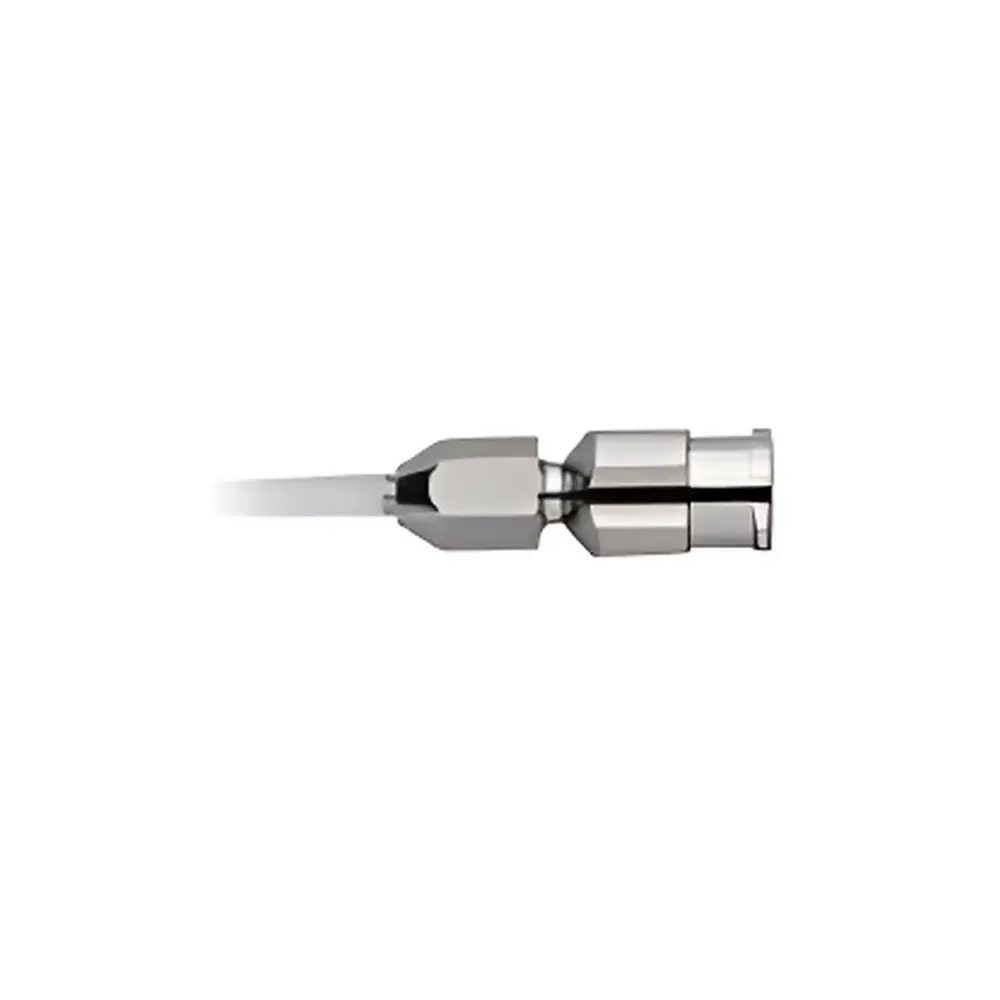
NARISHIGE CI-1 Tubing Connector for Microinjection Systems
| Brand | NARISHIGE |
|---|---|
| Origin | Japan |
| Model | CI-1 |
| Dimensions | 20 mm (W) × 7 mm (D) × 6 mm (H) |
| Weight | 2 g |
| Material | Stainless Steel |
| Seal Type | Integrated High-Performance Elastomeric Gasket |
| Compatible Tubing | PTFE Capillary Tubing (ID 0.1–0.5 mm) |
| Application | Secure Connection Between Micropipette and PTFE Tubing in Microinjection & Electrophysiology Setups |
Overview
The NARISHIGE CI-1 Tubing Connector is a precision-engineered mechanical interface designed specifically for microscale fluidic coupling in life science instrumentation. It functions as a low-dead-volume, leak-tight transition component between glass or quartz micropipettes (typically pulled to tip diameters <10 µm) and flexible polytetrafluoroethylene (PTFE) capillary tubing—commonly used in intracellular microinjection, patch-clamp electrophysiology, microfluidic perfusion, and single-cell manipulation systems. Unlike generic compression fittings, the CI-1 employs a proprietary coaxial clamping geometry that applies uniform radial force without inducing torsional stress on fragile pipette shafts. Its operation relies on mechanical interference fit rather than adhesive bonding or thermal sealing, ensuring full reversibility and compatibility with sterilization protocols including autoclaving (up to 121°C, 20 min) and ethanol immersion. The connector’s compact footprint (20 × 7 × 6 mm) and minimal mass (2 g) prevent mechanical loading on delicate micromanipulator stages, preserving positional stability during long-duration experiments.
Key Features
- Stainless steel construction (AISI 316 grade) for high corrosion resistance against saline buffers, enzyme solutions, and organic solvents commonly used in cell biology workflows
- Integrated elastomeric sealing gasket engineered for repeated mating cycles (>500 insertions) without loss of sealing integrity under pressures up to 100 kPa
- No-tool installation: achieves secure connection via hand-tightened knurled collar—no torque wrench or calibration required
- Zero dead volume design minimizes sample carryover and reduces dispersion in serial injection protocols
- Optimized inner bore geometry prevents tubing kinking and maintains laminar flow profile across ID ranges from 0.1 mm to 0.5 mm
- Compliant with ISO 8536-4 (infusion equipment) dimensional reference standards for interchangeability with standard microinjection accessories
Sample Compatibility & Compliance
The CI-1 is validated for use with borosilicate and aluminosilicate glass micropipettes (OD 1.0–1.5 mm), fused silica capillaries, and medical-grade PTFE tubing (e.g., Zeus Microbore™, Saint-Gobain TYGON® LTX). It supports both positive-pressure delivery (e.g., pressure ejection of dyes, plasmids, or CRISPR RNP complexes) and negative-pressure aspiration (e.g., whole-cell patch clamp, cytoplasmic extraction). The device conforms to biocompatibility requirements per ISO 10993-5 (cytotoxicity) and ISO 10993-10 (irritation/sensitization) when used within specified temperature and chemical exposure limits. While not classified as an IVD device under EU IVDR or FDA 21 CFR Part 809, its material traceability and manufacturing documentation support GLP-compliant experimental recordkeeping.
Software & Data Management
As a passive mechanical component, the CI-1 does not incorporate embedded electronics, firmware, or digital interfaces. However, it is fully compatible with third-party microinjection control platforms—including NARISHIGE IM-300/IM-400 pneumatic injectors, Eppendorf FemtoJet series, and Sutter MPPI-2 pressure controllers—enabling synchronized timing of fluid delivery events with electrophysiological recordings or time-lapse imaging. When integrated into automated microinjection rigs (e.g., those employing motorized micromanipulators and machine vision alignment), the CI-1’s consistent connection repeatability contributes directly to inter-run coefficient of variation (CV) reduction in delivered volume (<3% CV at 10 nL injections, n=50).
Applications
- Transgenic embryo microinjection (zebrafish, mouse, C. elegans)
- Intracellular delivery of siRNA, mRNA, or fluorescent tracers in primary neuronal cultures
- High-fidelity pressure-controlled perfusion in dual-patch voltage-clamp configurations
- Microfluidic interfacing between microfabricated chips and conventional micropipette-based recording systems
- Reproducible loading of microelectrodes for extracellular field potential mapping
FAQ
Can the CI-1 be used with silicone or PVC tubing?
No. The clamping mechanism and gasket material are optimized exclusively for PTFE’s hardness, thermal contraction profile, and surface energy. Silicone or PVC will deform under clamping force and compromise seal integrity.
Is the CI-1 autoclavable?
Yes—stainless steel body and fluorocarbon gasket tolerate standard laboratory autoclave cycles (121°C, 103 kPa, 20 min). Avoid prolonged exposure to saturated steam above 134°C.
What is the maximum recommended operating pressure?
100 kPa (14.5 psi) for continuous use; short-term pulses up to 200 kPa are permissible if duration remains below 500 ms.
Does NARISHIGE provide replacement gaskets?
Yes—gasket kits (Part No. CI-GSKT-10) are available separately and rated for 100 mating cycles per set.
How does the CI-1 compare to epoxy-based or heat-shrink tubing joints?
Unlike irreversible adhesive or thermal bonds, the CI-1 enables rapid reconfiguration, eliminates solvent residue risks, and preserves pipette optical clarity—critical for DIC or infrared differential interference contrast imaging.




