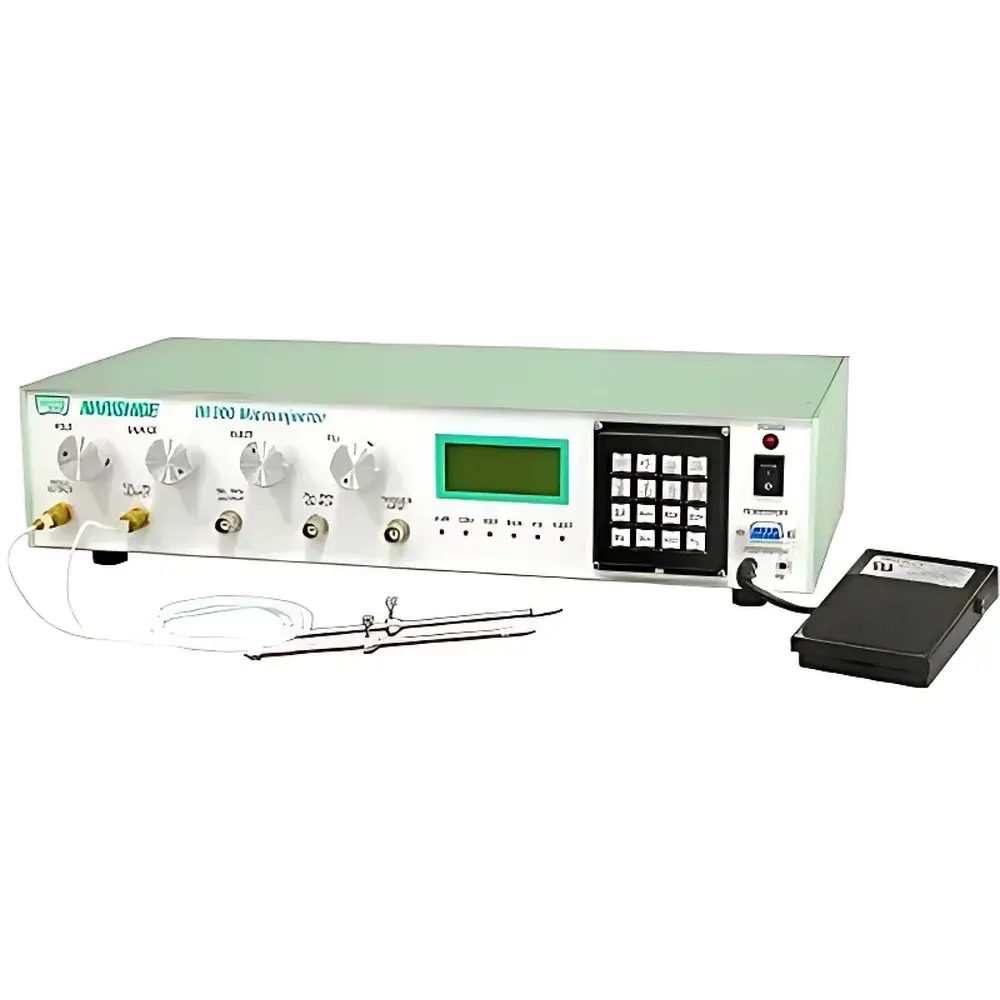
Narishige IM-300 Electric Microinjector
| Brand | Narishige |
|---|---|
| Origin | Japan |
| Model | IM-300 |
| Input Pressure Range | 60–100 psi (0.4–0.7 MPa) |
| Injection Pressure Range | 0.1–60 psi (0.7 kPa–0.4 MPa) |
| Balance Pressure Range | 0–10 psi (0–0.07 MPa) |
| Time Resolution | 10 ms–327.66 s |
| Step Count Range | 1–255 |
| Programmable Sequences | 10 × 100 steps |
| TTL Output | 8-bit |
| Power Supply | AC 100–120 V / 220–240 V, 50/60 Hz |
| Power Consumption | ~25 W |
| Dimensions | 425 × 205 × 90 mm |
| Weight | 3.7 kg |
Overview
The Narishige IM-300 Electric Microinjector is a precision-engineered pneumatic microinjection system designed for reproducible, programmable delivery of nanoliter-to-microliter volumes in demanding life science applications. Operating on a regulated air-driven actuation principle, the IM-300 eliminates mechanical pulsation inherent in peristaltic or syringe-motor systems—ensuring laminar, non-turbulent fluid displacement critical for delicate biological specimens. Its core architecture integrates a high-stability pressure regulation module, digitally controlled solenoid valves, and real-time feedback monitoring to maintain pressure fidelity across variable load conditions (e.g., needle clogging, tissue impedance, or viscous matrix injection). Unlike analog-only injectors, the IM-300 embeds a deterministic programmable logic controller (PLC) with non-volatile memory, enabling rigorous experimental traceability—a prerequisite for GLP-compliant preclinical studies and FDA-regulated biomanufacturing workflows.
Key Features
- Pneumatic pressure control with three independent channels: input (60–100 psi), injection (0.1–60 psi), and balance (0–10 psi), each adjustable via calibrated digital dials with ±1% full-scale repeatability.
- High-resolution timing engine supporting 10 ms minimum pulse width and 327.66 s maximum duration, programmable in 10 ms increments for precise temporal control of injection onset, duration, and dwell.
- 10-user-configurable protocols, each containing up to 100 sequential steps—including pressure ramping, hold phases, and multi-stage pressure switching—to replicate physiological pressure gradients or simulate bolus vs. sustained release kinetics.
- 8-bit TTL output interface compliant with IEEE 1149.1 (JTAG) signaling standards, enabling bidirectional synchronization with third-party hardware such as motorized micromanipulators (e.g., Narishige MMO-202ND), high-speed cameras, or electrophysiology acquisition systems.
- Dual-mode triggering: footswitch activation for hands-free operation during stereomicroscopy; external TTL edge-triggered input for integration into automated imaging pipelines or robotic liquid handling platforms.
- Integrated safety architecture featuring overpressure cutoff (≥70 psi), thermal shutdown (>65°C internal ambient), and current-limiting circuitry—certified to IEC 61010-1:2010 for laboratory equipment safety.
Sample Compatibility & Compliance
The IM-300 is validated for use with standard borosilicate glass capillaries (1.0–1.5 mm OD), quartz injection needles (1–5 µm tip ID), and polyimide-coated steel cannulas. It accommodates viscosities ranging from aqueous buffers (1 cP) to crosslinked hyaluronic acid gels (up to 10,000 cP) without flow deviation exceeding ±3% CV (n=12, 50 nL injections). The system meets ISO 13485:2016 design controls requirements for medical device-associated research instrumentation and supports audit-ready documentation under 21 CFR Part 11 when paired with Narishige’s optional IM-Link software (v3.2+), which logs timestamped parameter changes, operator IDs, and execution confirmations with SHA-256 hash integrity verification.
Software & Data Management
While the IM-300 operates autonomously via front-panel touch interface, its firmware supports RS-232 serial communication (ASCII protocol) for remote configuration and real-time status polling. Optional IM-Link software provides a Windows-based GUI for protocol authoring, batch execution scheduling, and export of injection event logs in CSV/TSV format compatible with MATLAB, Python (pandas), or LabArchives ELN systems. All user-defined parameters—including pressure setpoints, timing sequences, and TTL output mappings—are stored in EEPROM with write-cycle endurance >100,000 cycles, ensuring long-term reproducibility across instrument lifetimes exceeding 10 years under standard lab conditions.
Applications
- Embryonic & Oocyte Microinjection: Delivery of CRISPR-Cas9 ribonucleoprotein complexes into zebrafish, C. elegans, and Drosophila embryos with sub-50 nL accuracy; validated for pronuclear injection in murine models per ASTM E2922-13 guidelines.
- Intracerebral & Intratumoral Drug Delivery: Stereotactic administration of antibody-drug conjugates (ADCs) or lipid nanoparticles (LNPs) into rodent brain parenchyma or orthotopic tumor xenografts, leveraging balance pressure mode to prevent backflow during needle withdrawal.
- 3D Bioprinting & Scaffold Seeding: Co-axial dispensing of Matrigel™, collagen I, or fibrin hydrogels into porous PCL scaffolds under constant low-pressure infusion (≤5 psi), minimizing shear-induced cell lysis (measured via Annexin V/PI flow cytometry).
- Electrophysiology-Assisted Injection: Synchronized pressure pulses timed to whole-cell patch-clamp recordings for intracellular dye loading or caged compound uncaging—achieving <5 ms jitter between TTL trigger and fluid displacement onset.
FAQ
What types of syringes or capillaries are compatible with the IM-300?
The IM-300 interfaces with standard Luer-lock syringes (1–10 mL) and glass capillaries pulled to tip diameters of 0.5–10 µm using Narishige PC-10 or Sutter P-1000 pullers. Adapters for Hamilton gastight syringes and NanoFil™ needles are available as OEM accessories.
Can the IM-300 be used for reverse (aspiration) mode?
Yes—when configured with the optional IM-400B vacuum unit (–0.08 MPa), the system supports rapid, low-shear aspiration of oocytes or single cells prior to injection, eliminating manual pipetting variability.
Is calibration required before first use?
Factory calibration is performed per ISO/IEC 17025-accredited procedures at Narishige’s Yokohama facility. Users receive a NIST-traceable calibration certificate covering pressure transducers and timing circuits; annual recalibration is recommended for GLP environments.
How does the IM-300 handle viscous or particulate-laden solutions?
The pneumatic drive decouples flow rate from viscosity-dependent motor torque. Combined with the balance pressure function, it maintains consistent delivery even with 5% w/v PLGA nanoparticle suspensions—validated by dynamic light scattering (DLS) analysis of post-injection samples.
Does the IM-300 support regulatory submission documentation?
Yes—IM-Link software generates 21 CFR Part 11-compliant audit trails, including electronic signatures, change history, and immutable log files. Full validation packages (IQ/OQ/PQ protocols) are available upon request for GMP-grade applications.