
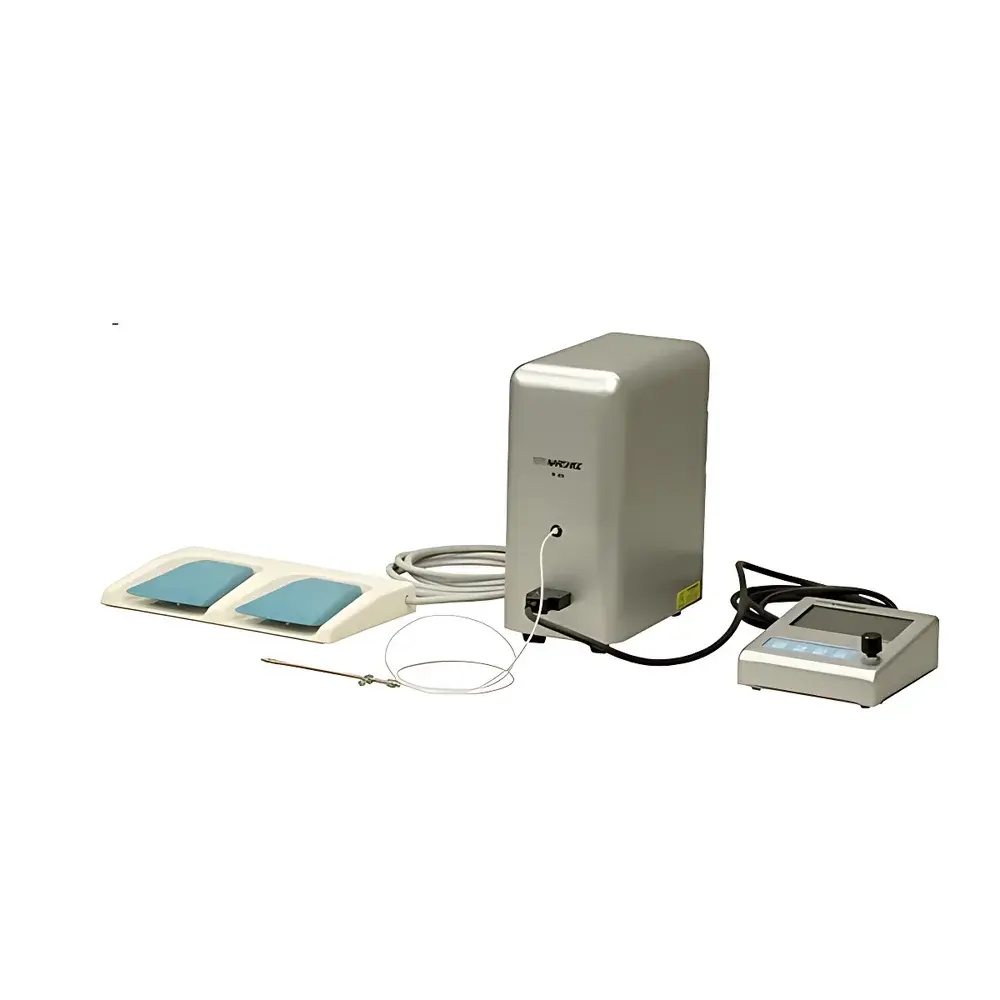
Narishige IM-400 Electronic Micromanipulator for Precision Microinjection
| Brand | Narishige |
|---|---|
| Model | IM-400 |
| Origin | Japan |
| Detection Time | 10 s (manual focusing) or 15 s (autofocusing) at ~1,000,000 cells/mL |
| Cell Concentration Range | 5×10⁴–10⁷ cells/mL |
| Sample Volume | 10 µL |
| Throughput | 50,000 cells |
| Detectable Cell Diameter | 1–60 µm |
| Operating Gas Pressure (Injection/Balance) | 0–0.5 MPa |
| Supply Pressure Range | 0.4–0.7 MPa |
| Power Input | AC 100–240 V, 50/60 Hz |
| Power Consumption | 15 W |
| Control Unit Dimensions | 120 × 211 × 264 mm, 3.1 kg |
| Manipulator Unit Dimensions | 130 × 153 × 61.5 mm, 780 g |
Overview
The Narishige IM-400 Electronic Micromanipulator is a high-precision, programmable microinjection system engineered for reproducible, quantitative delivery of picoliter- to microliter-scale volumes into single cells and early-stage biological specimens. Unlike conventional mechanical or pneumatic injectors, the IM-400 employs digitally regulated gas pressure control with real-time feedback stabilization, enabling consistent injection volume across extended operation cycles—critical for applications requiring high inter-experimental fidelity, such as transgenic line generation, CRISPR-Cas9 editing, and functional RNAi screening. Its design adheres to core principles of fluidic actuation in microscale biological environments: pressure-driven flow through calibrated capillaries, where volumetric output is determined by injection duration, regulated pressure differential, and capillary geometry. The system is optimized for use with standard borosilicate or quartz micropipettes (e.g., Narishige CT-4), supporting both transient and sustained infusion modes under user-defined temporal profiles.
Key Features
- Dual-mode focusing interface: Manual fine-focus adjustment and motorized autofocusing with sub-micron repeatability for rapid target acquisition on live specimens.
- Programmable pressure-time protocol engine: Enables storage and recall of up to 10 independent injection sequences—including pre-injection balance, pulse injection, continuous infusion, and post-injection rinse phases—each with independently adjustable pressure setpoints (0–0.5 MPa) and timing resolution down to 10 ms.
- Integrated touch-panel controller: Intuitive graphical interface with on-screen calibration wizard, real-time pressure monitoring, and system status diagnostics; supports multi-language UI (English, Japanese, German, French).
- Modular pneumatic architecture: Quick-connect fittings (6 mm OD inlet, 2 mm OD outlet) compliant with ISO 8573-1 Class 4 compressed air standards; includes integrated safety T-junction with pressure relief valve (max. 0.7 MPa).
- Low thermal drift electronics: Temperature-compensated pressure transducers and PID-controlled solenoid valves ensure ±0.5% full-scale stability over 8-hour continuous operation at ambient 20–25°C.
- Compact dual-unit configuration: Separated control box (3.1 kg) and lightweight manipulator head (780 g) minimize vibration coupling and facilitate integration with inverted microscopes and motorized stages.
Sample Compatibility & Compliance
The IM-400 accommodates a broad spectrum of delicate biological targets without compromising viability: mammalian somatic and stem cells (e.g., HEK293, CHO, iPSCs), zebrafish and Xenopus embryos (1–512-cell stage), Drosophila oocytes and larvae, C. elegans L1–L4 stages, and insect Sf9/S2 cells. Injection compatibility extends to viscous payloads including plasmid DNA (0.1–10 µg/µL), modified mRNA (5′ cap, poly-A tail), fluorescent dyes (e.g., Alexa Fluor 488-dextran), recombinant proteins (up to 200 kDa), and lipid nanoparticles. All fluid-contact components meet USP Class VI biocompatibility requirements. The system supports GLP-compliant workflows via audit-trail-enabled parameter logging (timestamped pressure/time profiles, operator ID, session ID), aligning with FDA 21 CFR Part 11 data integrity expectations when paired with Narishige’s optional DataLogger Pro software.
Software & Data Management
While the IM-400 operates autonomously via its embedded controller, optional connectivity enables advanced data governance. USB 2.0 and RS-232 interfaces allow synchronization with third-party acquisition platforms (e.g., MetaMorph, NIS-Elements) for time-correlated imaging-injection events. The Narishige DataLogger Pro (v3.2+) provides encrypted binary logging of all operational parameters—including actual delivered volume (calculated from pressure-duration integral), ambient temperature, and system error codes—with CSV export for statistical analysis in MATLAB or Python (Pandas). Audit trails include digital signatures, immutable timestamps, and role-based access controls (admin/operator modes), satisfying ISO/IEC 17025 clause 7.5.2 for instrument calibration traceability.
Applications
- Genome editing: Delivery of Cas9 ribonucleoprotein complexes into zygotes for founder line establishment.
- Functional genomics: High-efficiency siRNA/miRNA transfection in primary neurons with minimal cytotoxicity.
- Developmental biology: Cytoplasmic or pronuclear injection of lineage tracers into blastomeres for fate mapping studies.
- Virology & vaccine development: Intracellular delivery of viral pseudotypes or antigen-encoding mRNA into dendritic cells.
- Toxicology screening: Controlled dosing of nanomaterial suspensions into hepatocyte spheroids for 3D metabolic response profiling.
- Neuroscience: Axonal or dendritic microinjection of calcium indicators (e.g., Fluo-4 dextran) in acute brain slices.
FAQ
What pipette types are compatible with the IM-400?
Standard Narishige CT-series glass capillaries (e.g., CT-4, CT-5) and custom-pulled quartz needles (outer diameter 1.0–2.0 mm) with conical or beveled tips.
Can the IM-400 perform pressure-controlled perfusion in addition to injection?
Yes—the balance pressure mode maintains constant hydrostatic pressure across the pipette tip, enabling stable whole-cell patch-clamp configurations or gentle cytoplasmic loading without membrane rupture.
Is calibration required before each experiment?
A one-time volumetric calibration using fluorescent microbeads (1 µm) and epifluorescence quantification is recommended per pipette batch; subsequent runs retain calibration within ±3% volume accuracy under identical pressure/duration settings.
Does the system support multi-position automated injection?
When integrated with Narishige MMO-202ND motorized micromanipulators and STO-1000 specimen stage controllers, the IM-400 accepts coordinate-triggered injection commands via TTL or serial command protocol.
What maintenance intervals are specified for long-term reliability?
Gas filter replacement every 6 months; O-ring inspection and silicone grease reapplication on quick-connect ports every 12 months; annual verification of pressure transducer linearity against NIST-traceable reference standards.






