NARISHIGE IMS-3 Microinjector
| Brand | NARISHIGE |
|---|---|
| Origin | Japan |
| Model | IMS-3 |
| Syringe Travel Range | 5–10 mm |
| Plunger Displacement per Full Knob Rotation | 500 µm |
| Dimensions (W×D×H) | 50 × 30 × 120 mm |
| Weight | 115 g |
| Injection Volume Control via Interchangeable Syringes (Bore Diameter | 5–10 mm) |
| Accuracy | ±0.5% |
Overview
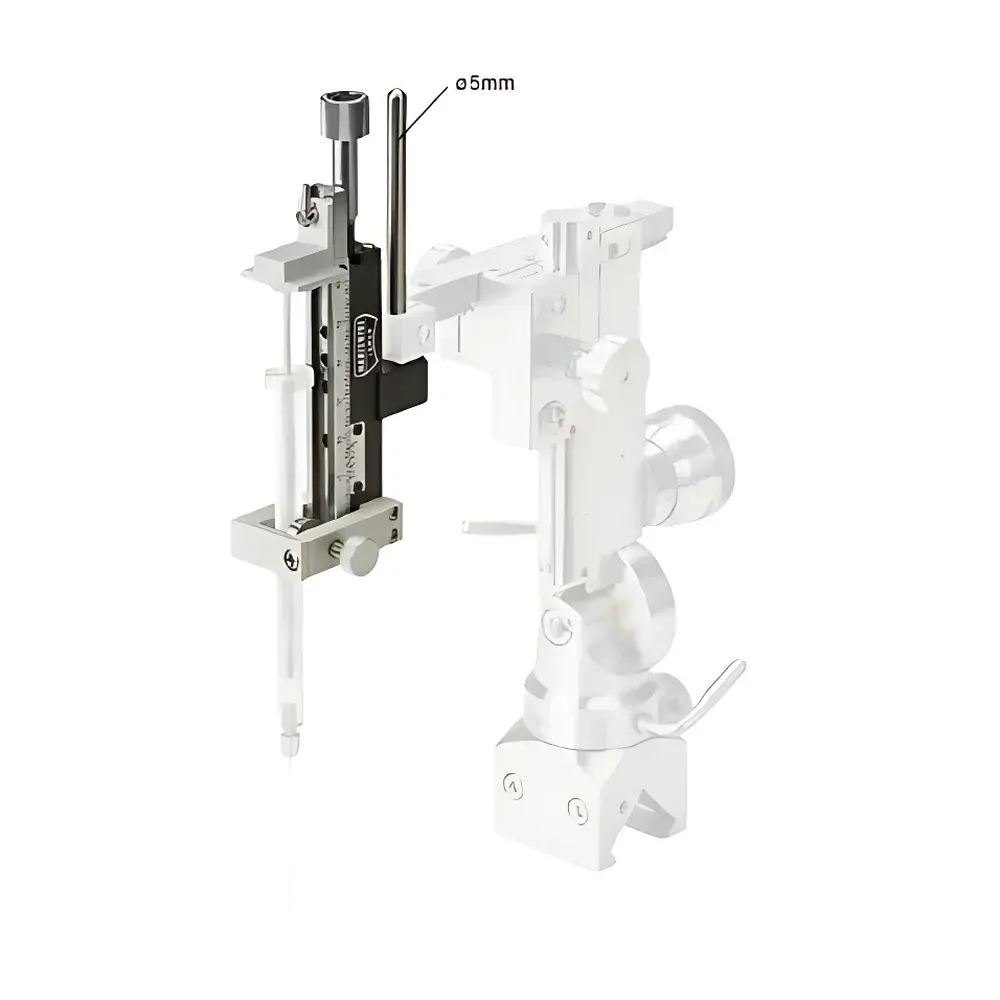
The NARISHIGE IMS-3 Microinjector is a precision mechanical microinjection device engineered for controlled, repeatable delivery of nanoliter- to microliter-scale volumes in neuroscience, developmental biology, and single-cell manipulation applications. Unlike motorized or pressure-driven injection systems, the IMS-3 operates on a purely mechanical principle—translating fine rotational motion of an ergonomic knurled knob into linear displacement of the syringe plunger via a high-ratio lead-screw mechanism. This design eliminates electronic drift, pneumatic latency, and fluid compressibility artifacts, ensuring deterministic volume delivery under varying viscosity and backpressure conditions. Its primary use case is stereotactic intracerebral injection in rodent models when mounted on NARISHIGE SM-15R or SM-15L stereotaxic micromanipulators, enabling targeted delivery to anatomically defined brain regions with sub-millimeter spatial fidelity.
Key Features
- Mechanically actuated plunger drive with 500 µm linear displacement per full 360° knob rotation—enabling precise, stepwise volume control without reliance on external power or calibration routines.
- Interchangeable syringe compatibility: accepts glass or metal syringes with inner diameters ranging from 5 mm to 10 mm, allowing users to select optimal volume range and resolution (e.g., 5 mm bore yields higher resolution for sub-µL injections; 10 mm bore supports rapid bulk delivery).
- Compact, low-profile housing (50 × 30 × 120 mm) and lightweight construction (115 g) minimize inertia and vibration coupling when integrated into multi-axis stereotaxic setups.
- Direct manual plunger engagement—no intermediate levers or linkages—ensures immediate tactile feedback and real-time adjustment during live injection procedures.
- Robust aluminum alloy chassis with corrosion-resistant surface treatment ensures long-term dimensional stability and compatibility with ethanol, isopropanol, and standard laboratory disinfectants.
Sample Compatibility & Compliance
The IMS-3 is designed for use with standard borosilicate glass capillary syringes (e.g., Drummond Nanoject-type), stainless-steel Hamilton-style syringes, and custom-fabricated injection needles (e.g., pulled quartz or tungsten). It imposes no intrinsic chemical restrictions beyond those of the selected syringe material and seal configuration. While the device itself carries no CE or FDA clearance (as it functions as a Class I non-powered accessory under IEC 61010-1), its integration into GLP-compliant electrophysiology or behavioral neuroscience workflows aligns with ISO/IEC 17025 requirements for measurement traceability—provided syringe calibration certificates (e.g., gravimetric or volumetric verification per ASTM E542) are maintained. The ±0.5% volumetric accuracy specification assumes proper syringe selection, consistent operator technique, and ambient temperature stabilization (20–25°C).
Software & Data Management
The IMS-3 is a standalone analog instrument with no embedded electronics, firmware, or digital interface. Consequently, it does not generate raw data logs, require driver installation, or support USB/Ethernet connectivity. This architecture eliminates cybersecurity concerns, software validation overhead, and obsolescence risks associated with firmware-dependent devices. Volume delivery is documented manually or synchronized with external acquisition systems (e.g., via TTL trigger output from compatible manipulator controllers or electrophysiology amplifiers). For audit-trail compliance in regulated environments, users are advised to record injection parameters—including syringe ID, bore diameter, number of knob rotations, and timestamp—in bound laboratory notebooks or validated electronic lab notebook (ELN) platforms compliant with 21 CFR Part 11.
Applications
- Stereotactic delivery of viral vectors (AAV, lentivirus), tracers (fluoro-gold, biotinylated dextran), or pharmacological agents into discrete murine or rat brain nuclei (e.g., hippocampus, striatum, ventral tegmental area).
- Cytoplasmic or pronuclear microinjection in zebrafish, Xenopus, or mouse embryos during transgenic line generation.
- Localized drug infusion studies requiring temporal control and dose reproducibility across cohorts (e.g., chronic intracerebroventricular administration in neurodegeneration models).
- Combined use with patch-clamp rigs for simultaneous intracellular perfusion and electrophysiological recording.
- Calibration reference tool for validating pressure-based or piezoelectric microinjectors where mechanical displacement serves as a first-principles benchmark.
FAQ
Is the IMS-3 compatible with non-NARISHIGE stereotaxic frames?
Yes—mechanical mounting relies on standardized M4 threaded holes; adapters are available for David Kopf, Stoelting, and other major frames.
Can the IMS-3 be used for viscous solutions (e.g., agarose, collagen gels)?
It is suitable for viscosities up to ~100 mPa·s at room temperature; for higher viscosities, pre-warming the syringe or using larger-bore syringes is recommended to maintain plunger linearity.
Does the ±0.5% accuracy apply across all syringe sizes?
Accuracy is syringe-dependent; it reflects plunger displacement repeatability—not absolute volume—and assumes correct bore diameter input during calculation.
Is sterilization possible?
The main body may be wiped with 70% ethanol; syringes and needles must be autoclaved or gas-sterilized separately per manufacturer guidelines.
What maintenance is required?
Annual inspection of lead-screw lubrication and knob torque consistency is recommended; no scheduled recalibration is necessary due to its passive mechanical design.