
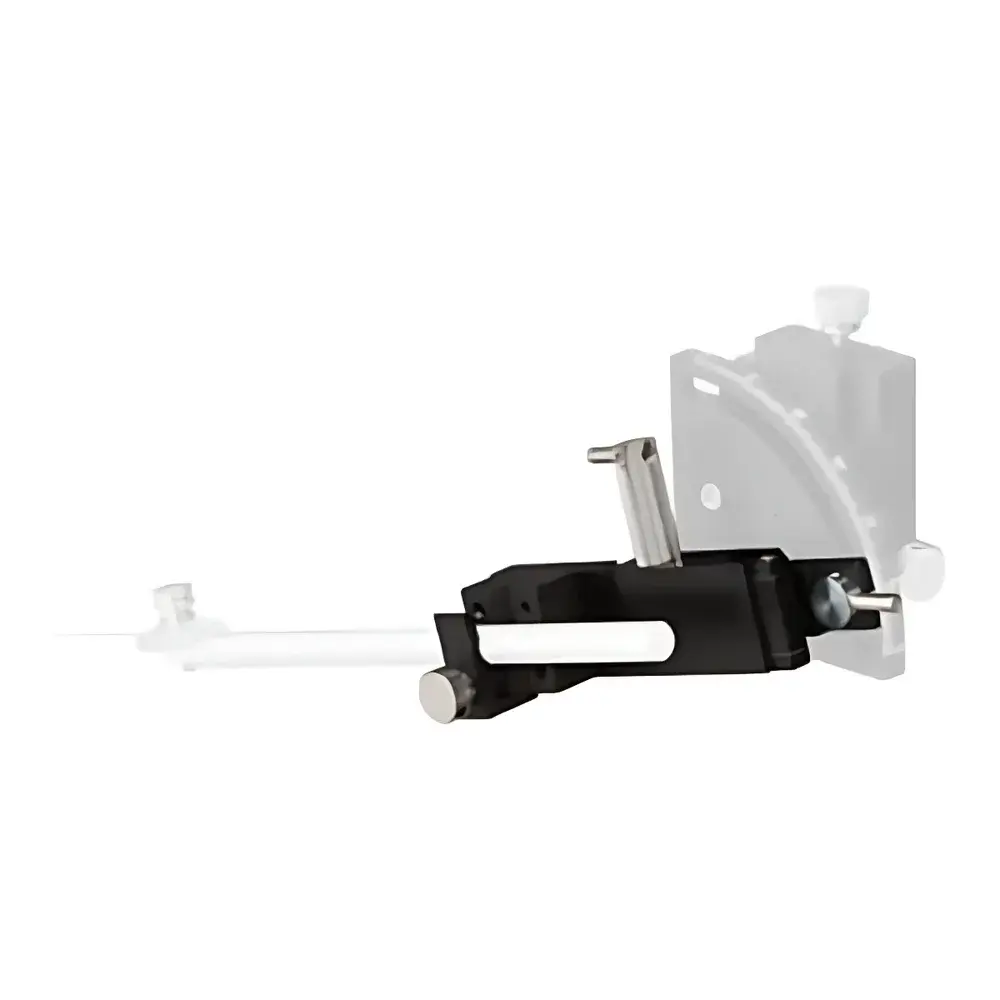
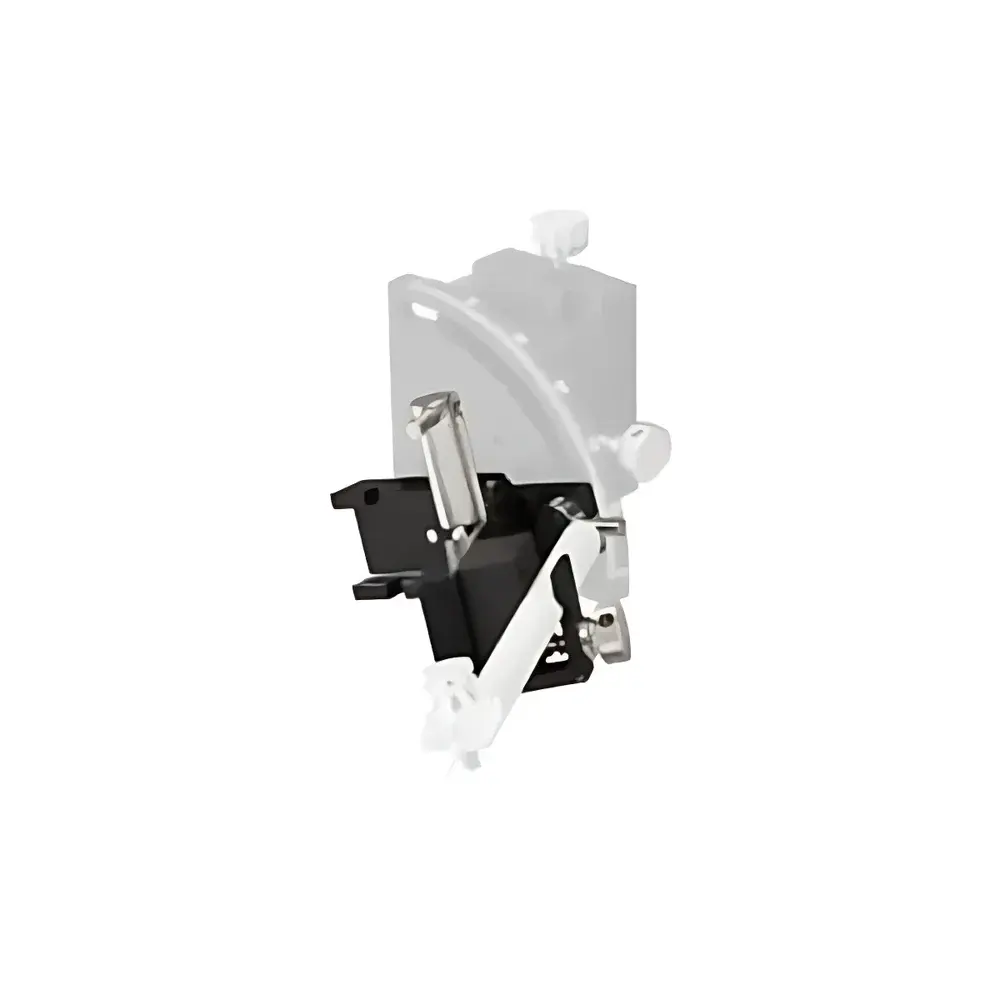
NARISHIGE UST-3A Universal Joint Mounting Adapter
| Brand | NARISHIGE |
|---|---|
| Origin | Japan |
| Model | UST-3A |
| Dimensions | 70 × 42 × 35 mm (W × D × H) |
| Weight | 55 g |
| Compatibility | Designed for UST-3 universal joint base and EMM2/NMN-21 micromanipulator electrodes |
Overview
The NARISHIGE UST-3A Universal Joint Mounting Adapter is a precision-machined mechanical interface component engineered to enhance the structural integrity and operational flexibility of NARISHIGE’s UST-3 universal joint mounting system. It functions as a dedicated bracket adapter that secures the UST-3 base to front-mounted optical or electrophysiological rigs—particularly within upright or inverted microscope workstations used in patch-clamp, intracellular recording, and microinjection applications. Unlike generic mounting solutions, the UST-3A integrates a dual-point pivot-and-fixation architecture: one axis allows controlled angular articulation for fine-tuning electrode approach angles, while the second provides rigid axial locking to suppress parasitic vibration and thermal drift. This mechanical design adheres to the principles of kinematic constraint—minimizing degrees of freedom without over-constraining—thereby preserving both positional repeatability and manual dexterity during micromanipulation tasks.
Key Features
- Dual-support kinematic mount: Combines a precision-ground pivot point with a secondary clamping surface to deliver stable articulation while maintaining rigidity under lateral load.
- Optimized ergonomics for electrode exchange: Enables rapid, tool-assisted replacement of EMM2 and NMN-21 micromanipulator electrodes without realignment of the entire UST-3 base assembly.
- Compact footprint and low mass: Dimensions of 70 × 42 × 35 mm and total weight of only 55 g minimize inertial coupling and reduce stage loading in vibration-sensitive setups.
- Integrated fastening hardware: Supplied with two M2.5 hex socket cap screws and a matching 1.5 mm hex key—both compliant with ISO 4762 and JIS B 1176 standards for torque consistency and thread integrity.
- Material and finish: Machined from high-purity anodized aluminum alloy (A6061-T6), offering corrosion resistance, non-magnetic performance, and compatibility with cleanroom and electrophysiology-grade environments.
Sample Compatibility & Compliance
The UST-3A is not a standalone measurement instrument but a certified mechanical subassembly within NARISHIGE’s validated micromanipulation ecosystem. It is fully compatible with the UST-3 universal joint base and all first-party electrodes—including EMM2 electromechanical manipulators and NMN-21 hydraulic microinjectors. As a passive mechanical adapter, it imposes no electromagnetic interference and exhibits negligible dielectric loss (<0.002 tan δ at 1 kHz), ensuring signal fidelity in high-impedance electrophysiological recordings. While not subject to IEC 61000-4 immunity testing per se, its construction meets the mechanical robustness requirements outlined in ISO 13849-1 for Category 1 safety-related parts of control systems—particularly relevant when integrated into automated patch-clamp platforms requiring GLP-compliant documentation of hardware traceability.
Software & Data Management
The UST-3A operates independently of software control and does not incorporate embedded electronics, firmware, or data interfaces. Its function is purely mechanical; therefore, no drivers, SDKs, or calibration files are required. However, when deployed in regulated environments (e.g., academic core facilities operating under NIH-funded protocols or contract research organizations supporting FDA-submitted preclinical data), the adapter is included in equipment logs as a traceable component—assigned a unique serial identifier via NARISHIGE’s global part-numbering scheme (UST-3A-XXXXX). Maintenance records, including torque verification of mounting screws per ISO 1502 Annex B, may be documented within laboratory information management systems (LIMS) or electronic lab notebooks (ELN) compliant with 21 CFR Part 11 audit-trail requirements.
Applications
- Electrophysiology rigs: Facilitates precise alignment of patch pipettes relative to cell membranes in whole-cell and perforated-patch configurations.
- Microinjection platforms: Supports reproducible needle trajectory control for zygote injection, CRISPR/Cas9 delivery, and mRNA transfection in developmental biology studies.
- Combined imaging-manipulation systems: Integrates seamlessly with motorized microscope stages (e.g., Prior ProScan III, Ludl MAC5000) where mechanical decoupling between coarse positioning and fine manipulation is critical.
- Custom-built optogenetics setups: Provides stable, non-magnetic mounting for fiber-optic cannula holders adjacent to recording electrodes.
- Teaching laboratories: Offers students tactile familiarity with kinematic mounting principles while maintaining alignment stability across repeated experimental sessions.
FAQ
Is the UST-3A compatible with third-party micromanipulators?
No—it is mechanically dimensioned and tolerance-specified exclusively for NARISHIGE UST-3 bases and EMM2/NMN-21 electrodes. Interchangeability with non-NARISHIGE systems is not guaranteed and may compromise angular repeatability.
Does the UST-3A require periodic recalibration?
Not applicable—calibration applies to active sensing or actuation components. The UST-3A is a passive, static mechanical adapter; however, users should verify screw torque annually using a calibrated torque screwdriver (recommended torque: 0.25 N·m per M2.5 screw).
Can the UST-3A be sterilized for in vivo use?
Yes—autoclaving at 121°C for 20 minutes is permissible due to its anodized aluminum construction; however, repeated autoclaving may gradually degrade surface finish. Ethanol wipe-down or UV-C exposure is preferred for routine decontamination.
What is the maximum recommended load capacity?
When mounted per NARISHIGE installation guidelines, the UST-3A supports up to 250 g of vertically oriented electrode mass without measurable deflection (>0.5 µrad angular deviation under static load, measured via laser interferometry).



