
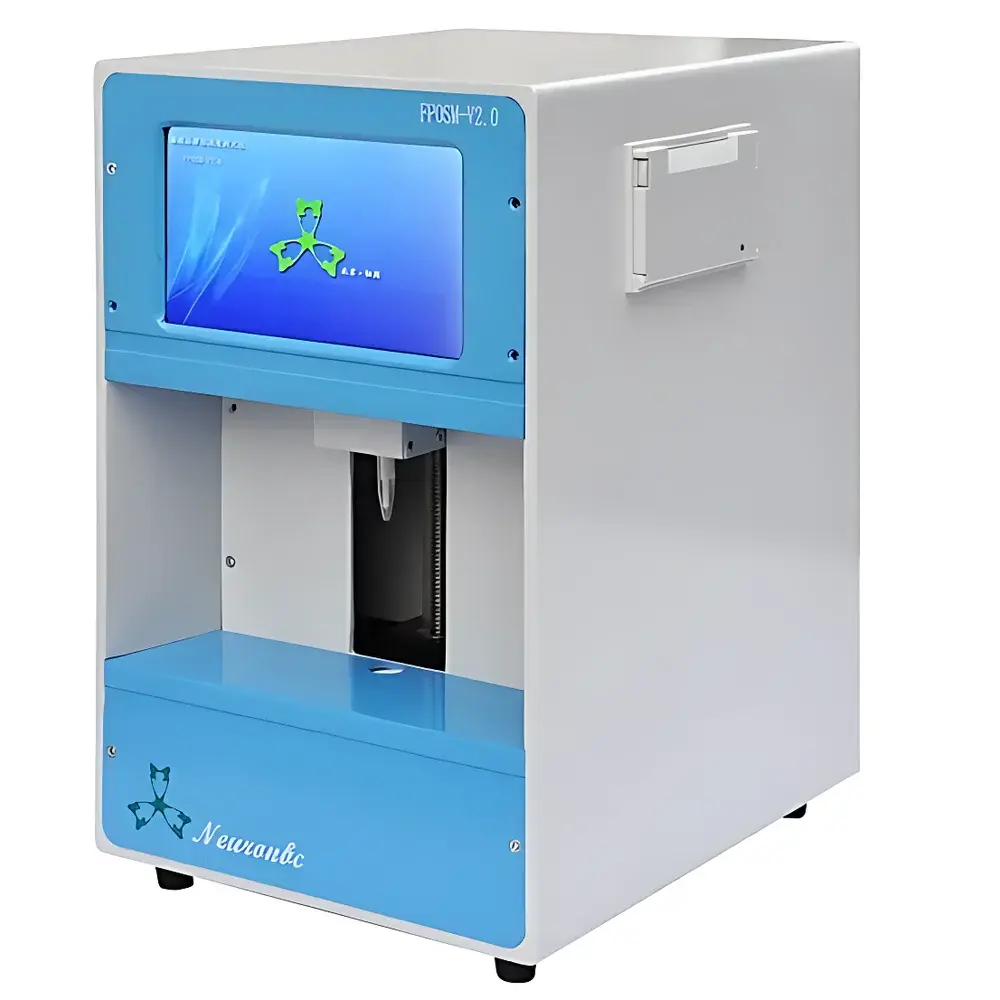
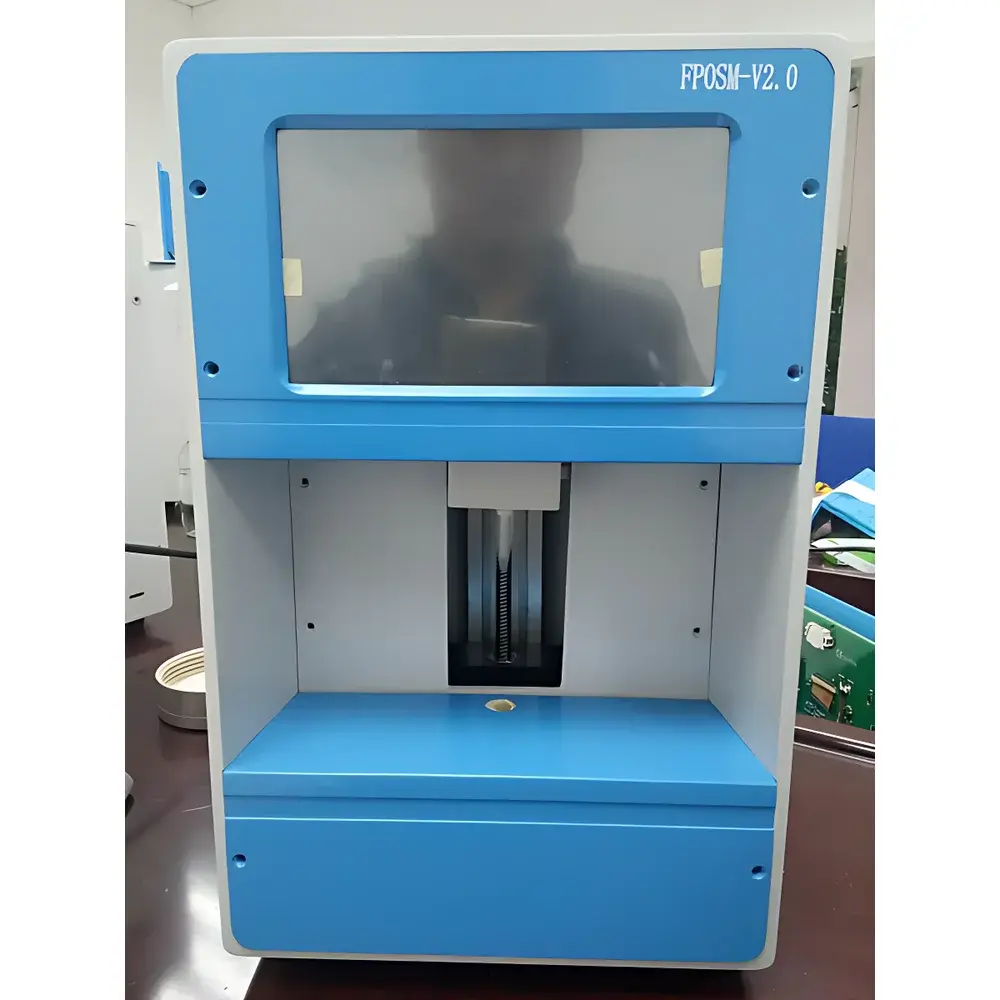
NeuronBC FPOSM2.0 Freezing Point Osmometer
| Brand | NeuronBC |
|---|---|
| Origin | Beijing, China |
| Model | FPOSM2.0 |
| Measurement Principle | Freezing Point Depression (based on Raoult’s Law) |
| Measurement Range | 0–2000 mOsmol/kg |
| Sample Volume | 100 µL |
| Test Time | ≤3 min |
| Pre-cooling Time | ≤3 min |
| Accuracy | ≤1% |
| Repeatability | ≤1% |
| Linearity | ≤1% |
| Operating Temperature | 0–30 °C (recommended 15–25 °C) |
| Relative Humidity | ≤60% |
| Power Supply | 220 V AC, 50 Hz, 150 VA |
| Dimensions | 225 × 275 × 345 mm |
| Weight | 15 kg |
| Compliance | Designed to support 21 CFR Part 11-compliant data integrity requirements (electronic signatures, user-level access control, audit-trail-capable data storage) |
Overview
The NeuronBC FPOSM2.0 Freezing Point Osmometer is a precision laboratory instrument engineered for the quantitative determination of osmolality in aqueous solutions via the colligative property of freezing point depression. Grounded in Raoult’s thermodynamic theory—where the magnitude of ice point depression (ΔTf) is directly proportional to the molal concentration of solute particles—the FPOSM2.0 delivers traceable, high-reproducibility osmolality measurements across pharmaceutical, biotechnological, clinical, and food science applications. Unlike vapor pressure or membrane-based osmometry, freezing point depression offers superior sensitivity at low-to-moderate osmolality ranges (0–2000 mOsmol/kg), making it the reference method endorsed by pharmacopoeial standards including the Chinese Pharmacopoeia (ChP), USP General Chapter <785>, and EP 2.2.35. The instrument employs a high-stability platinum resistance thermometer (PRT) with sub-millikelvin resolution, coupled with a dual-stage thermoelectric cooling system that eliminates reliance on cryogenic fluids or refrigerants—ensuring rapid thermal equilibration, minimal maintenance, and long-term calibration stability.
Key Features
- Integrated 7-inch capacitive touchscreen interface with intuitive Chinese/English bilingual navigation, real-time graphical display of freezing curve dynamics, and one-touch test initiation.
- 21 CFR Part 11-ready software architecture: Role-based user authentication (administrator/operator/auditor), electronic signatures, immutable audit trails, and time-stamped data logging compliant with GLP/GMP documentation requirements.
- Multi-point linear calibration capability (up to 31 points) using certified osmotic standards (e.g., NaCl, KCl, sucrose), enabling accurate interpolation across the full measurement span without manual slope adjustment.
- Dual-stage Peltier cooling system with active temperature stabilization—achieving pre-cooling in ≤3 minutes and total assay cycle time ≤3 minutes per sample—optimized for high-throughput QC environments.
- Minimal sample consumption (100 µL per test) accommodates precious biological specimens (e.g., CSF, vitreous humor, monoclonal antibody formulations) and small-volume drug product batches.
- Automated probe positioning mechanism driven by a precision lead-screw linear actuator, eliminating manual alignment errors and ensuring consistent thermal contact between sensor and sample capillary.
- Built-in ChP-compliant database containing over 300 registered injectable drug monographs—including tonicity references, excipient profiles, and regulatory acceptance criteria—for rapid method setup and result contextualization.
Sample Compatibility & Compliance
The FPOSM2.0 is validated for use with a broad spectrum of aqueous matrices, including parenteral drug solutions (IV infusions, ophthalmic preparations, lyophilized reconstitutes), biological fluids (serum, urine, cerebrospinal fluid), cell culture media, vaccine suspensions, and food-grade electrolyte beverages. It excludes non-aqueous solvents, highly viscous gels (>100 cP), or samples containing volatile organic compounds that may interfere with ice nucleation kinetics. Instrument design and firmware adhere to ISO/IEC 17025:2017 principles for testing laboratories, while data management features align with FDA expectations for electronic records under 21 CFR Part 11. Calibration verification follows ASTM D1120-22 (“Standard Test Method for Freezing Point of Engine Coolants”) adapted for pharmaceutical osmolality, with traceability to NIST-traceable osmotic reference materials.
Software & Data Management
Embedded firmware supports local storage of ≥10,000 test records with full metadata (operator ID, timestamp, calibration status, raw freezing curve data, calculated osmolality, ΔTf, and molality ratio). Data export is available via USB 2.0 to CSV or PDF formats, preserving digital signatures and audit trail integrity. Optional network connectivity enables integration into LIMS environments through standard TCP/IP protocols. All stored data comply with minimum retention mandates per ICH E6(R3) and ChP General Notices: three-year archival capacity is guaranteed under default settings, with configurable auto-purge policies governed by institutional SOPs.
Applications
- Final container release testing of sterile injectables per ChP Volume IV, USP <785>, and JP 17.
- Tonicity verification of ophthalmic solutions, nasal sprays, and topical anesthetics during formulation development.
- Stability-indicating monitoring of protein therapeutics (e.g., mAbs, fusion proteins) exposed to freeze-thaw cycles or long-term refrigerated storage.
- Quality control of dialysate concentrates and infusion admixtures in hospital pharmacy compounding units.
- Research-grade osmolality profiling in neurochemistry (CSF analysis), renal physiology (urine concentration studies), and plant cell biology (vacuolar sap characterization).
FAQ
Is the FPOSM2.0 suitable for measuring osmolality of ethanol-containing samples?
No. Ethanol and other volatile co-solvents depress freezing point non-colligatively and disrupt reproducible ice nucleation. Aqueous-only samples are required.
Does the instrument require routine recalibration with external standards?
Yes. Daily system suitability verification using two certified reference standards (e.g., 0 and 300 mOsmol/kg) is recommended prior to batch analysis, per pharmacopoeial guidance.
Can raw freezing curve data be exported for third-party kinetic modeling?
Yes. Full time-temperature datasets (≥1000 points per curve) are exportable in ASCII format for advanced analysis in MATLAB, Python, or Origin.
What is the expected service life of the temperature sensor?
The platinum resistance thermometer (PT1000-class) is rated for ≥50,000 freeze-thaw cycles under normal operating conditions, with annual verification recommended.
Is remote software update supported?
Firmware updates are delivered via encrypted USB key only; no internet-connected update mechanism is implemented to preserve data security and regulatory compliance.




