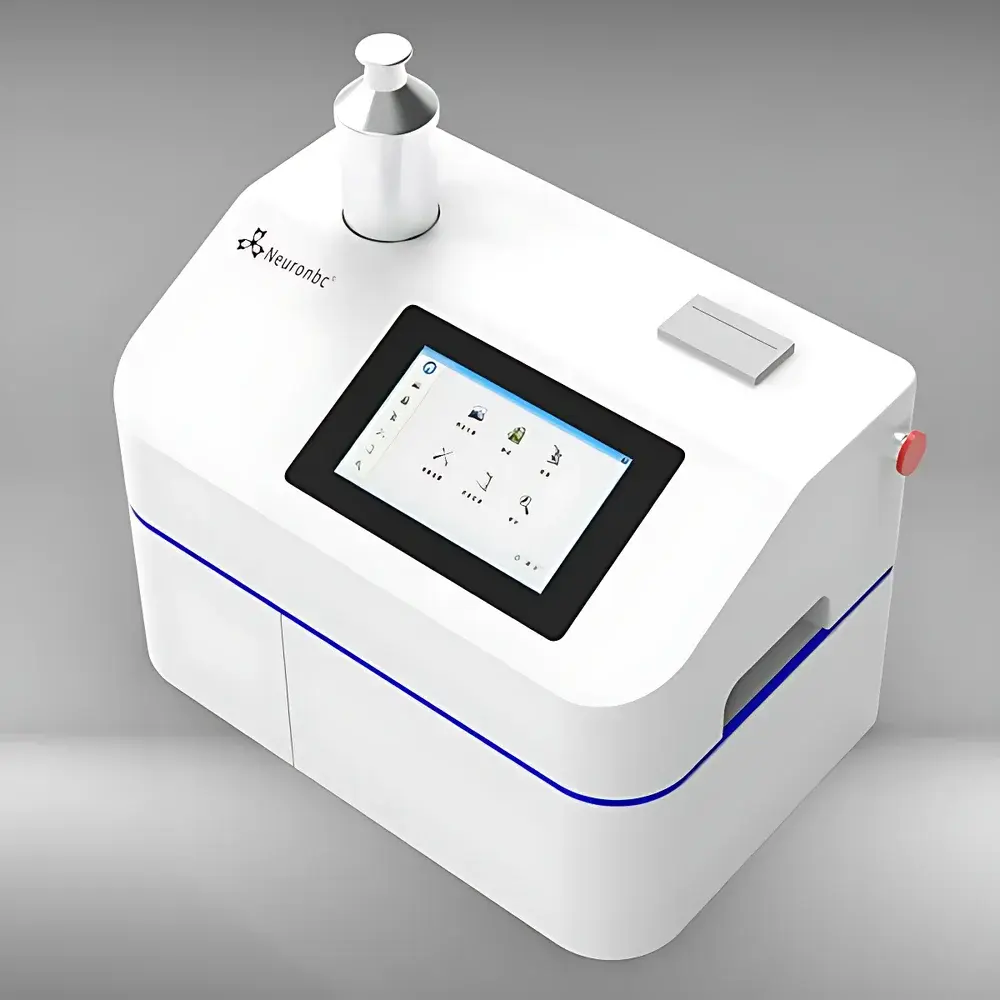
NeuronBC MFT-900 Non-Destructive Package Integrity Tester for Pharmaceutical Containers
| Brand | NeuronBC |
|---|---|
| Origin | Beijing, China |
| Model | MFT-900 |
| Detection Principle | Vacuum Decay / Differential Pressure |
| Compliance | USP <1207>, ASTM F2338-22, FDA Guidance on Container Closure Integrity Testing (CCIT) |
| Test Range | −0.1 to 1.0 MPa (selectable), Differential Pressure Sensor: ±2 kPa, Accuracy ≤0.5% F.S., Resolution: 0.1 Pa |
| Minimum Detectable Leak Equivalent Hole Diameter | 2 µm |
| Touchscreen | 10-inch Color TFT LCD |
| Power | AC 100–240 V, 50/60 Hz, ≤200 W |
| Audit Trail Retention | ≥5 years |
| User Access Control | 4-tier Role-Based Authentication |
| Data Export | USB drive, CSV format |
| Communication Interfaces | Ethernet, RS485, 4–20 mA analog output, 12 V alarm signal |
| Optional Accessories | Certified Standard Leak Reference Vials (NIST-traceable), Custom Test Chamber Kits, Method Validation Support Services |
Overview
The NeuronBC MFT-900 is a non-destructive, vacuum-decay-based package integrity tester engineered for pharmaceutical container closure integrity testing (CCIT) in compliance with current regulatory expectations. It operates on the differential pressure decay principle: a sealed test chamber containing the sample is evacuated to a defined vacuum level; any leakage causes a measurable pressure rise over time, which the system quantifies and correlates to an equivalent leak hole diameter (µm) using calibrated physical models derived from Poiseuille flow theory. This method is fully aligned with the scientific rationale outlined in USP “Package Integrity Evaluation – Sterile Products”, ASTM F2338-22 “Standard Test Method for Nondestructive Detection of Leaks in Packages by Vacuum Decay Method”, and the FDA’s 2022 Guidance for Industry on CCIT. Unlike probabilistic dye ingress or microbial challenge methods, the MFT-900 delivers quantitative, objective, and repeatable results—making it suitable for validation, routine QC release testing, stability studies, and root cause analysis of seal failures across sterile and non-sterile product lines.
Key Features
- Vacuum decay measurement with high-resolution differential pressure sensing (0.1 Pa resolution, ≤0.5% F.S. accuracy) and configurable test pressure ranges (−0.1 to 1.0 MPa)
- Automated conversion of measured leak rate to equivalent defect pore size (down to 2 µm), traceable to NIST-certified standard leak references
- Integrated four-tier user permission architecture supporting role-based access control, electronic signatures, and full 21 CFR Part 11 compliance—including audit trail generation with immutable timestamps, operator ID, and event type classification
- Modular, top-mounted test chamber design enabling rapid interchange of application-specific fixtures for vials (glass/plastic), syringes (PFS), cartridges, BFS/FFS blisters, aerosol cans (including piston, bag-in-can, elastomeric valve types), and pouches
- Touchscreen-driven workflow: intuitive setup of test parameters (vacuum level, hold time, decay time, pass/fail thresholds); manual sample loading/unloading only—no operator intervention during measurement cycle
- Onboard data management with ≥5-year local storage of raw pressure curves, pass/fail status, chamber ID, timestamp, operator ID, and environmental metadata (ambient temperature/pressure if equipped)
Sample Compatibility & Compliance
The MFT-900 accommodates diverse primary packaging formats used across biologics, small-molecule injectables, ophthalmics, and inhalation products. Validated configurations include 2R–50R glass and polymer vials (e.g., West, SCHOTT), pre-filled syringes (BD, Gerresheimer), cartridge systems (e.g., Ypsomed), blow-fill-seal (BFS) containers, form-fill-seal (FFS) pouches, and pressurized metered-dose inhalers (pMDIs) with various actuator designs. All test methods are developed and verified per ICH Q5A(R2), ISO 11607-1/-2, and Annex 1 (2022) requirements for sterility assurance. The instrument’s hardware and firmware architecture support GLP/GMP environments, with documented IQ/OQ protocols available upon request. Third-party certified standard leak vials (with uncertainty ≤±5% at 25°C) are supplied for daily system suitability verification and periodic recalibration.
Software & Data Management
Firmware version 3.2+ includes embedded database logging compliant with ALCOA+ principles (Attributable, Legible, Contemporaneous, Original, Accurate, Complete, Consistent, Enduring, Available). Every test record captures full pressure-time profiles, calculated leak rates (Pa·s⁻¹), converted pore diameters (µm), and decision logic flags. Audit trails log all critical events—including user login/logout, parameter changes, result overrides, and calibration actions—with cryptographic hashing to prevent tampering. Data export is supported via USB mass storage (CSV, PDF reports) or Ethernet (SCP/SFTP). Optional integration with LIMS or MES systems is enabled through Modbus TCP or custom REST API endpoints. Backup retention supports automated offsite archival to network-attached storage (NAS) or cloud platforms meeting HIPAA/GDPR encryption standards.
Applications
- QC release testing of lyophilized and liquid-filled vials prior to distribution
- Stability protocol execution per ICH Q1/Q5, including accelerated and real-time conditions
- Process validation of sealing equipment (e.g., crimping, stoppering, welding) across filling lines
- Root cause investigation of sterility failures linked to micro-leakage pathways
- Comparative assessment of different stopper formulations, seal geometries, or capping torque settings
- Support for regulatory submissions requiring analytical method validation (ICH Q2(R2)) including specificity, precision (repeatability & intermediate precision), accuracy, linearity, and robustness data
FAQ
Does the MFT-900 require helium or tracer gases? Why is compressed air used instead?
No. The MFT-900 uses ambient air as the test medium, eliminating dependency on helium supply chains, gas certification, or specialized gas handling infrastructure. Its vacuum decay methodology relies solely on absolute pressure change—not gas-specific thermal or acoustic properties—ensuring method transferability across labs without recalibration.
Can the system validate leak detection limits for specific container types?
Yes. NeuronBC provides method development services—including limit-of-detection (LOD) determination, ruggedness testing, and statistical power analysis—using customer-supplied samples and reference leaks. Full validation documentation follows ICH Q2(R2) and ASTM E2500-13 guidelines.
Is remote monitoring or preventive maintenance supported?
The MFT-900 features built-in diagnostics, email alerting for sensor drift or vacuum pump anomalies, and optional remote desktop support (via secure TLS-encrypted connection) for troubleshooting. Predictive maintenance schedules are generated based on cumulative pump runtime and pressure cycle counts.
How is software update integrity ensured?
Firmware updates are digitally signed using SHA-256 RSA-2048 certificates. Installation requires administrator-level authentication and automatic rollback if signature verification fails or flash memory write errors occur.
What documentation is provided for regulatory audits?
Standard delivery includes Factory Acceptance Test (FAT) report, Installation Qualification (IQ) checklist, Operational Qualification (OQ) protocol with acceptance criteria, electronic calibration certificate (traceable to national metrology institutes), and 21 CFR Part 11 readiness assessment summary.