
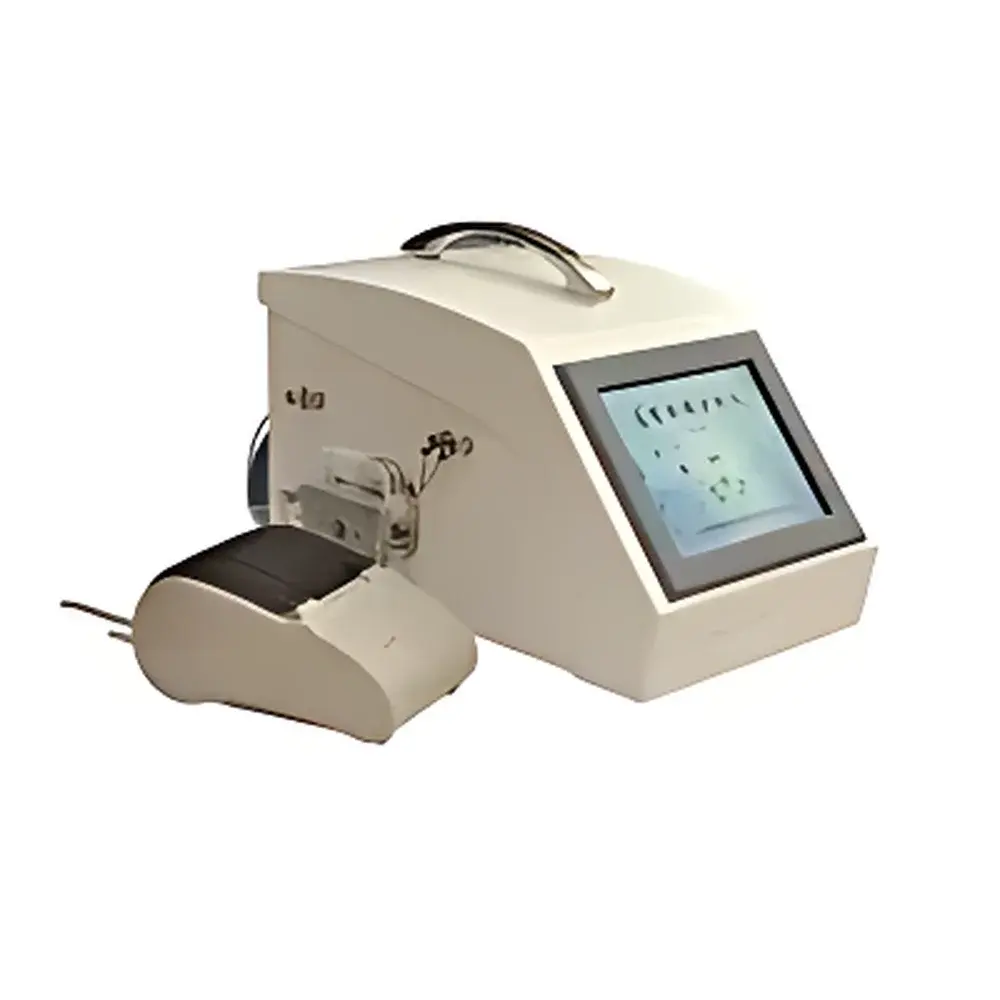
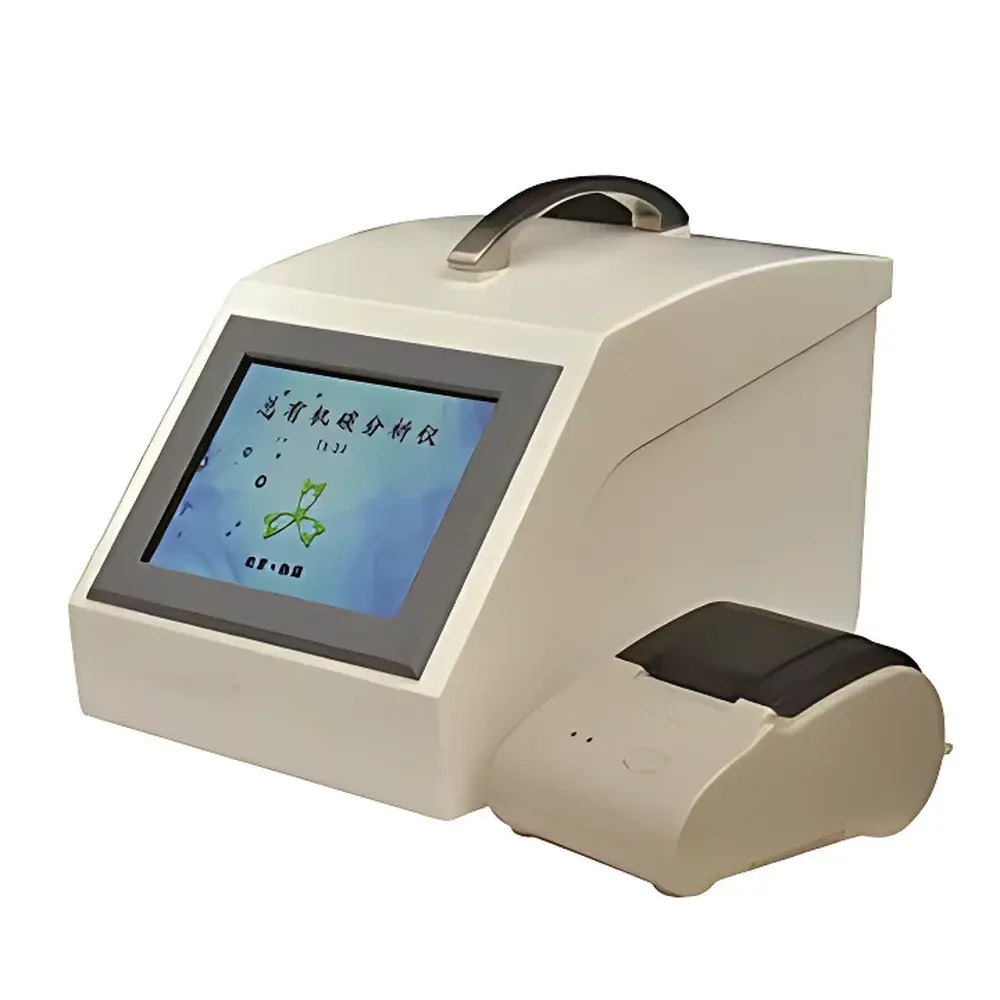
NeuronBC TA-1.0 Offline UV-Persulfate-Free Total Organic Carbon Analyzer
| Brand | NeuronBC |
|---|---|
| Origin | Beijing, China |
| Model | TA-1.0 Offline |
| Instrument Type | Laboratory TOC Analyzer |
| Detection Principle | Direct Conductivity Detection |
| Oxidation Method | UV Photocatalytic Oxidation (TiO₂-coated Quartz Tube) |
| Measurement Range | 1–1000 ppb (0.001–1.0 mg/L) |
| Accuracy | ±3% of reading |
| Resolution | 1 ppb (0.001 mg/L) |
| Detection Limit | 1 ppb (0.001 mg/L) |
| Repeatability | ≤3% RSD |
| Power Supply | 100–240 VAC, 50 Hz, 120 W |
| Sample Temp. Range | 1–99 °C |
| Data Storage | >5000 records |
| Audit Trail | 16-event log with timestamped traceability |
| User Access Control | 4-tier role-based authentication compliant with FDA 21 CFR Part 11 |
| Display | Color TFT touchscreen |
| Dimensions (L×W×H) | 400 × 240 × 270 mm |
| Weight | 8.5 kg |
Overview
The NeuronBC TA-1.0 Offline Total Organic Carbon (TOC) Analyzer is a laboratory-grade instrument engineered for precise, regulatory-compliant quantification of organic carbon in ultrapure water matrices. It operates on the principle of UV photocatalytic oxidation coupled with direct conductivity detection — a method recognized in USP , EP 2.2.44, and ChP 2020 for pharmaceutical water testing. Unlike combustion-based or chemical persulfate oxidation systems, the TA-1.0 employs a TiO₂-coated rotating quartz tube illuminated by low-pressure UV-C lamps (254 nm), generating hydroxyl radicals that mineralize non-volatile and semi-volatile organic compounds to CO₂. The resulting CO₂ dissolves in deionized carrier water, inducing a measurable change in solution conductivity proportional to the original TOC concentration. This approach eliminates dependency on compressed gases, strong acids, or hazardous oxidants — significantly reducing operational complexity, consumables cost, and safety risk while maintaining full alignment with pharmacopeial validation requirements.
Key Features
- UV photocatalytic oxidation system with TiO₂-coated quartz reactor — ensures stable, catalyst-free, and reagent-free oxidation of recalcitrant organics without carryover or memory effect
- Direct conductivity detection architecture — avoids interference from inorganic carbon species via real-time background subtraction and dual-electrode compensation
- Integrated peristaltic pumping and delay coil design — provides consistent residence time (>120 s) for complete CO₂ hydration and signal stabilization
- Color TFT touchscreen interface with intuitive workflow navigation — supports multilingual UI (English default), parameter lockout, and context-sensitive help
- Onboard audit trail with 16 configurable event categories — including user login/logout, method change, calibration, result override, and system error — all timestamped and non-erasable per FDA 21 CFR Part 11 Annex 11 expectations
- Four-level hierarchical user management — Admin, Supervisor, Analyst, and Viewer — with password enforcement, session timeout, and failed-login lockout
- Automated system suitability testing (SST) — performs blank, standard, and recovery checks per USP protocol with pass/fail flagging and report generation
Sample Compatibility & Compliance
The TA-1.0 is validated for offline analysis of purified water (PW), water for injection (WFI), and ultrapure water (UPW) used in biopharmaceutical manufacturing, sterile fill-finish operations, and clean-in-place (CIP) validation. It meets the performance criteria specified in Chinese Pharmacopoeia (ChP) 2020 Edition, USP , and EP 2.2.44 for TOC measurement in Grade A/B/C/D environments. The instrument’s 1 ppb detection limit and ≤3% RSD repeatability satisfy ICH Q5C recommendations for water quality monitoring during process validation. All firmware and software modules are designed to support GMP/GLP documentation workflows, including IQ/OQ/PQ protocol templates, electronic signature capture, and raw data archiving in vendor-neutral CSV/Excel formats. No external gas supply, acid reagents, or catalyst cartridges are required — eliminating cross-contamination pathways and simplifying qualification under ISO 13485 or EU Annex 1 frameworks.
Software & Data Management
Data acquisition and reporting are managed through embedded firmware with optional PC-based configuration software (Windows 10/11 compatible). Each analysis generates a timestamped record containing sample ID, operator ID, calibration status, raw conductivity values pre/post-oxidation, calculated TOC value, SST results, and environmental metadata (temperature, ambient humidity if logged externally). Up to 5,000 measurements are retained onboard; historical datasets can be exported via USB flash drive in audit-ready format — preserving file integrity, digital signatures, and full traceability. Exported files include embedded checksums and match the structure required for integration into LIMS platforms (e.g., LabWare, Thermo Fisher SampleManager) via standard ODBC or HL7 interfaces. All electronic records comply with ALCOA+ principles (Attributable, Legible, Contemporaneous, Original, Accurate, Complete, Consistent, Enduring, Available).
Applications
- Pharmaceutical water system monitoring: routine TOC verification of PW/WFI distribution loops and point-of-use locations
- Cleanliness verification: post-CIP and post-SIP TOC assessment of stainless-steel vessels, piping, and single-use systems
- Raw material water qualification: incoming utility water screening prior to pretreatment
- Process water characterization: TOC profiling during media preparation, buffer formulation, and chromatography eluent production
- Environmental monitoring support: ultra-trace organic load assessment in HVAC condensate and compressed air moisture traps
- Regulatory submission support: generation of validated data packages for FDA, EMA, PMDA, and NMPA inspections
FAQ
Does the TA-1.0 require carrier gas or chemical oxidants?
No. It uses only UV light and catalytically enhanced quartz surfaces — no nitrogen, oxygen, phosphoric acid, or sodium persulfate is needed.
Is the instrument suitable for USP compliance verification?
Yes. Its oxidation efficiency, detection limit, and system suitability test functionality fully satisfy USP Section 4 “System Suitability” and “Acceptance Criteria” clauses.
Can audit trail data be exported and reviewed externally?
Yes. All 16-event logs are exportable via USB in CSV format with ISO 8601 timestamps, user IDs, and action descriptors — compatible with third-party eDMS review tools.
What is the recommended calibration frequency?
Daily system suitability testing is advised; full calibration using certified KHP standards is recommended before each analytical batch or at least every 24 hours of continuous operation.
Does the TA-1.0 support automated sample introduction?
The base model is manual-load; an optional 40-position autosampler module (TA-AS40) is available for unattended sequential analysis with barcode sample ID recognition.
Related Products







