
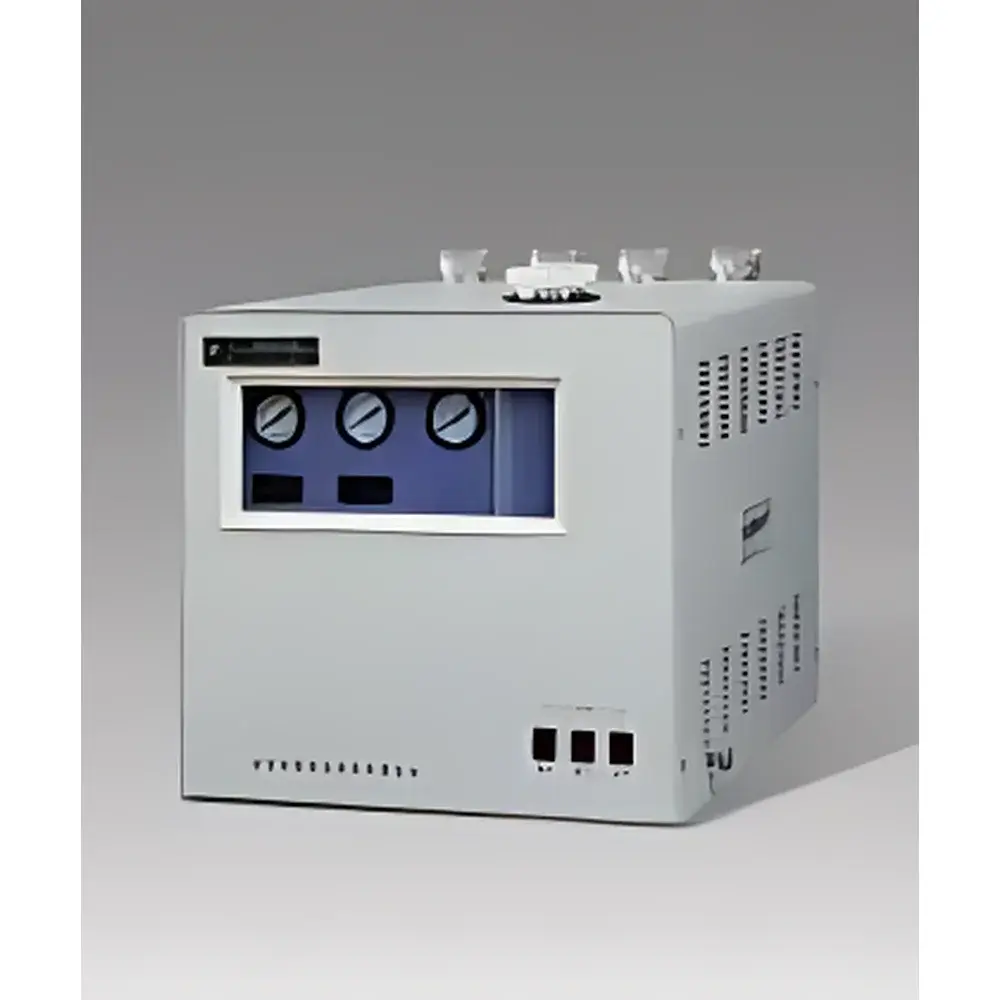
NHA-300 Integrated Nitrogen-Hydrogen-Air Gas Generator
| Key | Nitrogen Purity <3 ppm O₂, Dew Point −56 °C |
|---|
Overview
The NHA-300 Integrated Nitrogen-Hydrogen-Air Gas Generator is an engineered solution for laboratories requiring simultaneous, on-demand supply of high-purity carrier, fuel, and combustion gases for gas chromatography (GC) systems. Designed around membrane separation for nitrogen generation and proton exchange membrane (PEM) electrolysis for hydrogen production, the unit delivers stable, contamination-controlled gas streams without reliance on high-pressure cylinders. Its integrated architecture eliminates inter-unit pressure mismatches and cross-contamination risks common in multi-generator setups. The system operates continuously under ambient conditions (15–30 °C, <80% RH), supporting both split/splitless injectors and flame ionization (FID), thermal conductivity (TCD), and electron capture (ECD) detectors. All gas paths are constructed from electropolished stainless steel with low-sulfur silicone seals—ensuring compatibility with sulfur-sensitive detection methods and meeting baseline stability requirements per ASTM D3606 and ISO 6425.
Key Features
- Triple-gas integration: Independent yet synchronized control of nitrogen, hydrogen, and zero-air outputs within a single chassis
- High-purity nitrogen generation: Oxygen content <3 ppm (v/v) and dew point ≤−56 °C achieved via dual-stage hollow-fiber membrane separation and catalytic oxygen scavenging
- Ultra-high-purity hydrogen: 99.999% purity maintained through PEM electrolysis with integrated palladium diffusion purification and real-time H₂O vapor removal
- Zero-air generation: Oil-free diaphragm compressor coupled with activated carbon and desiccant filtration ensures hydrocarbon content <0.1 ppm and moisture <−40 °C dew point
- Intelligent flow tracking: Automatic dynamic adjustment of nitrogen and hydrogen output to match GC column flow demand—minimizing pressure fluctuations during method gradients
- Robust safety architecture: Overpressure relief valves on all three gas circuits, hydrogen leak detection with audible/visual alarm, automatic shutdown on electrolyte level drop or temperature anomaly
- Compact footprint: 350 × 350 × 500 mm (W × D × H) with vibration-damped base—designed for benchtop deployment adjacent to GC instruments
Sample Compatibility & Compliance
The NHA-300 is compatible with all major GC platforms—including Agilent, Thermo Fisher Scientific, Shimadzu, PerkinElmer, and Waters—regardless of injector type (cold-on-column, programmed temperature vaporizing, or packed column). Its low-sulfur seal design prevents detector poisoning in sulfur chemiluminescence (SCD) and pulsed flame photometric (PFPD) applications. The generator meets essential regulatory expectations for analytical gas supply: compliant with ISO 8573-1:2010 Class 2:2:2 for compressed air quality; supports GLP/GMP workflows through traceable calibration logs and configurable audit trail settings (when paired with optional RS-232/USB data logging module); and satisfies USP criteria for carrier gas purity in pharmaceutical residual solvent analysis.
Software & Data Management
The front-panel interface provides real-time monitoring of gas pressures, flow rates, operating temperatures, and system status codes. Optional PC connectivity enables remote diagnostics, firmware updates, and event-driven data export (CSV format) for QC documentation. When integrated into laboratory information management systems (LIMS), the generator supports time-stamped operational records—including start/stop cycles, filter replacement alerts, and maintenance history—aligned with FDA 21 CFR Part 11 requirements for electronic record integrity. Built-in password-protected configuration menus allow lab managers to define user access levels and enforce change control protocols.
Applications
- Routine QC testing in pharmaceutical manufacturing (ICH Q2-compliant method validation)
- Environmental analysis of volatile organic compounds (VOCs) in water and soil per EPA Method 8260D
- Petrochemical hydrocarbon profiling using ASTM D5186 and D6730
- Food safety screening for pesticide residues (AOAC 2007.01)
- Residual solvent quantification in polymer and coating formulations
- Research-grade method development where cylinder gas variability compromises retention time reproducibility
FAQ
What is the expected service life of the PEM electrolyzer stack?
Under normal operating conditions (≤8 h/day, ambient humidity <70%), the PEM stack maintains ≥95% nominal hydrogen output for ≥15,000 hours—verified by accelerated life testing per IEC 62282-6-100.
Can the NHA-300 be used with older GC models lacking digital communication ports?
Yes. Analog pressure and flow signals are provided via 0–10 V DC outputs, enabling seamless integration with legacy GC controllers via standard process input modules.
How often must the oxygen scavenger and desiccant filters be replaced?
Filter replacement intervals are usage-dependent: oxygen scavenger cartridges require replacement every 12 months or after 3000 L of nitrogen output; air desiccant packs every 6 months under continuous operation at 2000 mL/min.
Is external cooling required for sustained operation?
No. The unit employs passive convection cooling with thermally optimized heat sinks and does not require chilled water or forced-air ventilation.
Does the generator support multi-point calibration verification?
Yes. Internal reference sensors are traceable to NIST standards, and the system includes a built-in calibration mode that allows verification against certified gas standards at three flow points per gas channel.
Related Products



