
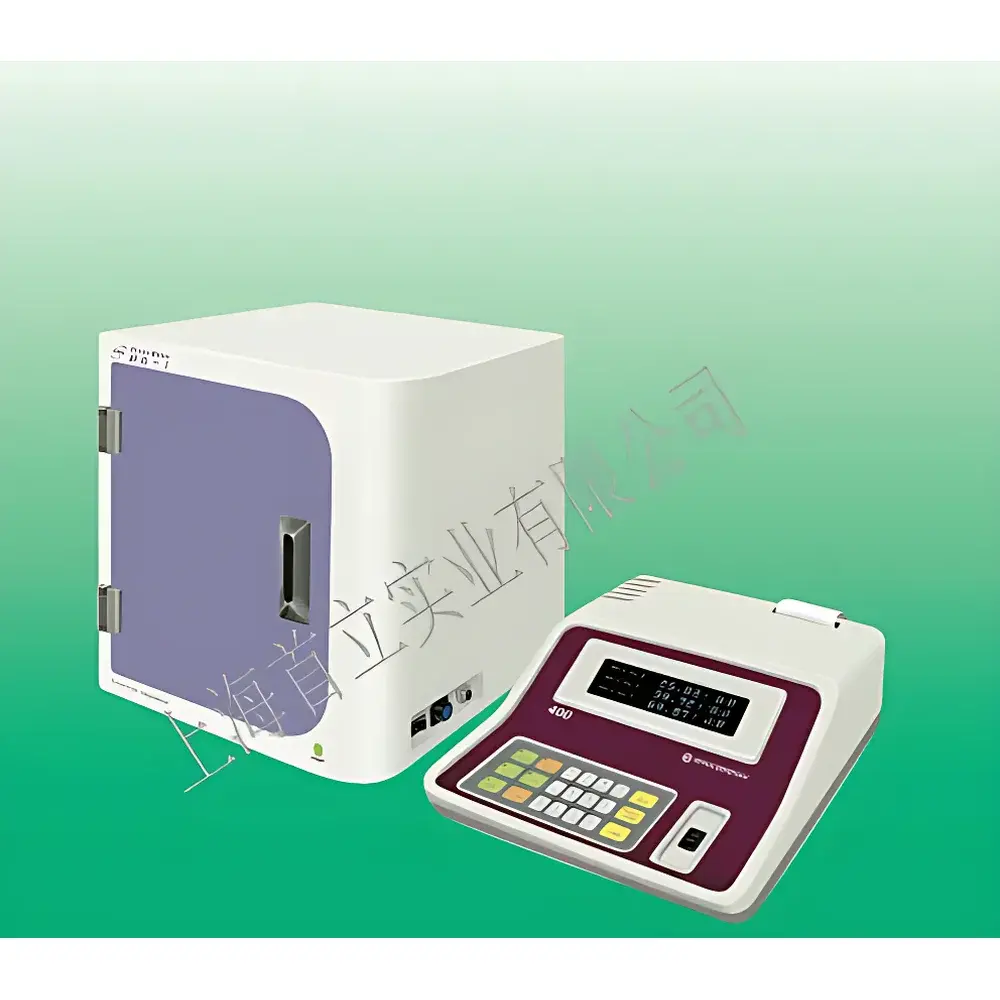
NIPPON DENSHOKU MG-I 400 Direct-Reading Specular Reflectometer
| Brand | NIPPON DENSHOKU |
|---|---|
| Origin | Japan |
| Model | MG-I 400 |
| Illuminant Options | Halogen Lamp (5 V, 9 W) or Optional White LED |
| Incident Angle | 25° |
| Receiving Angle | 25° |
| Reference Geometry | 0°–0° |
| Reflectance Range | 0.0–100.0% |
| Aperture Diameter | Φ40 mm |
| Measurement Time | Approx. 1 s |
| Repeatability | Standard Deviation ≤ 0.1% (10 consecutive readings in air within 10 s) |
| Compliance Standards | JIS D 5705, ISO 5740 |
| Power Supply | 100 V AC, 50/60 Hz |
| Power Consumption | 40 VA (Optical Unit), 26 VA (Measurement Unit) |
| Dimensions (Optical Unit) | 463 mm W × 325 mm D × 500 mm H, 19 kg |
| Dimensions (Measurement Unit) | 350 mm W × 360 mm D × 110 mm H, 5 kg |
Overview
The NIPPON DENSHOKU MG-I 400 is a precision-engineered direct-reading specular reflectometer designed specifically for compliance testing of automotive mirrors in accordance with ISO 5740 and JIS D 5705. Unlike integrating sphere-based or goniometric systems, the MG-I 400 employs a fixed-angle, collimated beam geometry—25° incident and 25° receiving angles—with a calibrated 0°–0° reference configuration to quantify absolute specular reflectance under standardized optical conditions. This architecture ensures high reproducibility for mirror-grade surfaces where directional reflectance dominates total optical response. The instrument is optimized for routine quality control in Tier-1 automotive suppliers, mirror manufacturers, and electroplating facilities, delivering traceable, operator-independent measurements without spectral deconvolution or software correction.
Key Features
- Direct-reading operation: Real-time reflectance (%) displayed immediately after single-button activation—no calibration sequence required between samples.
- Dedicated optical path: Fixed 25°/25° geometry aligned to ISO 5740’s definition of specular reflectance for rearview and side-view mirrors.
- Modular dual-unit design: Separated optical unit (light source, detector, sample chamber) and measurement unit (display, processor, interface) enable flexible lab integration and thermal isolation.
- Large sample chamber: Accommodates specimens up to 400 mm × 300 mm × 50 mm (W×D×H), supporting full-size interior/exterior mirrors and large-area polished substrates.
- Illuminant flexibility: Standard halogen lamp (5 V, 9 W) provides CIE illuminant A spectral output; optional white LED source offers enhanced stability, longer lifetime (>10,000 h), and reduced thermal drift.
- High repeatability: Achieves ≤0.1% standard deviation across 10 consecutive readings in ambient air—validated per ISO 5740 Annex B verification protocol.
Sample Compatibility & Compliance
The MG-I 400 is validated for planar and slightly curved mirror surfaces with specular reflectance >80% (e.g., Ag-coated glass, Al-sputtered polycarbonate, chrome-plated ABS). It supports QC testing of OEM mirror assemblies—including interior rearview mirrors (IRVM), exterior side mirrors (OSVM), and auto-dimming electrochromic units—prior to vehicle homologation. All measurements conform to the geometric and photometric requirements of ISO 5740:2019 (“Road vehicles — Rear-view mirrors — Performance requirements and test methods”) and its Japanese counterpart JIS D 5705. The system does not require spectral data export or colorimetric conversion; results are reported as absolute %R at the specified 25° geometry, fully auditable for IATF 16949 and ISO/IEC 17025 accredited laboratories.
Software & Data Management
The MG-I 400 operates as a standalone benchtop instrument with no PC dependency. Measurement data—including reflectance value, timestamp, and operator ID (via optional keypad input)—are stored internally (up to 1,000 records) and exportable via RS-232 serial interface to LIMS or MES platforms. While the base configuration lacks graphical analysis, optional firmware upgrade enables CSV-formatted data logging with GLP-compliant audit trail (user login, parameter changes, calibration history). For regulated environments, the instrument supports 21 CFR Part 11–compliant electronic records when integrated with validated third-party data acquisition software meeting ALCOA+ principles (Attributable, Legible, Contemporaneous, Original, Accurate).
Applications
- Automotive mirror certification: Pre-shipment verification of IRVM/OSVM reflectance per UN Regulation No. 46 and FMVSS 111 compliance protocols.
- Electroplating process control: Monitoring reflectivity stability of chromium, nickel, or silver deposits on plastic or metal substrates during production line validation.
- Optical coating QA: Final inspection of anti-reflective or high-reflectance dielectric stacks on flat optics used in HUD combiners or sensor housings.
- R&D of smart mirrors: Quantifying baseline reflectance shifts induced by electrochromic layer switching or polymer-dispersed liquid crystal (PDLC) activation.
- Regulatory testing labs: Supporting type-approval submissions to JAMA, NHTSA, or ECE Working Party on Brakes and Running Gear (GRRF).
FAQ
Does the MG-I 400 comply with ISO 5740:2019 for automotive mirror testing?
Yes—the optical geometry, illuminant spectral power distribution, and measurement uncertainty budget are fully aligned with Clause 6.2 and Annex B of ISO 5740:2019.
Can it measure curved mirrors with radius < 500 mm?
It is validated for convex/concave mirrors meeting ISO 5740’s curvature tolerance (R ≥ 500 mm); smaller radii introduce vignetting and require goniometric validation.
Is NIST-traceable calibration available?
NIPPON DENSHOKU provides factory calibration using certified reference mirrors (SRM 2037-type), with optional annual recalibration service including uncertainty reporting per ISO/IEC 17025.
What maintenance is required for the halogen lamp?
Lamp replacement is recommended every 1,000 hours of operation; LED option eliminates this requirement and reduces long-term cost of ownership.
Can measurement data be exported to Excel or LabVIEW?
Yes—RS-232 output supports ASCII protocol compatible with common SCADA, LabVIEW drivers, and custom Python scripts for automated batch reporting.






