
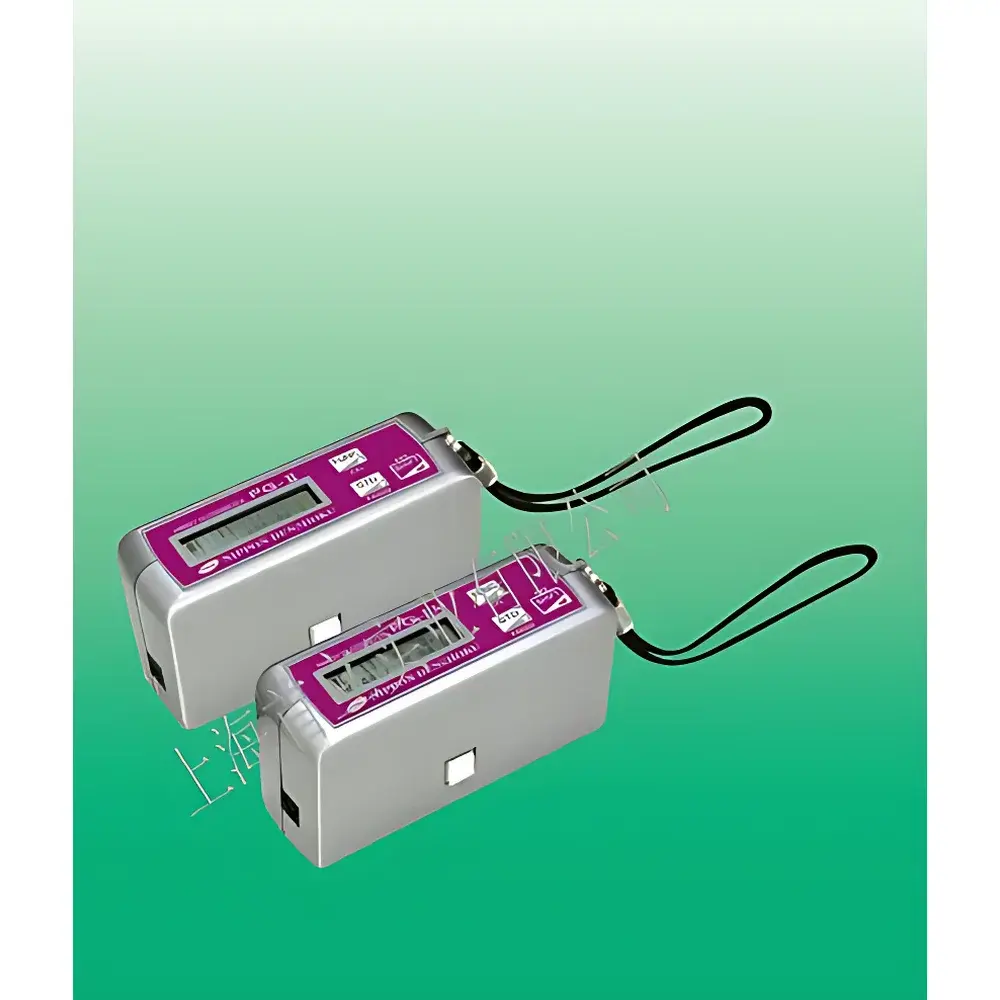
NIPPON DENSHOKU PG-II/II M Portable Gloss Meter
| Brand | NIPPON DENSHOKU |
|---|---|
| Origin | Japan |
| Model | PG-II/II M |
| Measurement Angles | PG-II — single angle (20°, 45°, 60°, 75° or 85°) |
| Gloss Range | 0.1–2038 GU (20°), 0.1–1675 GU (45°), 0.1–1000 GU (60°), 0.1–378 GU (75°), 0.1–162 GU (85°) |
| Light Source | Tungsten lamp (5 V / 125 mA, ~5,000 h lifetime) |
| Aperture | 10.5 mm × 60 mm |
| Measurement Time | ~1 s |
| Repeatability | ±0.5 GU (standard deviation, 20 measurements at 10 s intervals) |
| Power | 9 V alkaline battery (1 pc) |
| Power Consumption | 300 mW (single-angle), 600 mW (triple-angle) |
| Dimensions | 150 mm × 49 mm × 80 mm |
| Weight | 420 g (net, battery excluded) |
| Compliance | JIS Z 7841, ASTM D523, ISO 2813 |
| Interface | RS-232C for remote control and data export |
Overview
The NIPPON DENSHOKU PG-II/II M Portable Gloss Meter is a precision optical instrument engineered for rapid, repeatable, and standards-compliant gloss measurement across diverse industrial surfaces—including painted automotive panels, coated plastics, printed packaging, architectural finishes, and molded polymers. Operating on the principle of specular reflectance, the instrument quantifies the ratio of reflected luminous flux to incident flux at defined geometries, expressed in Gloss Units (GU). Its dual configuration—PG-II (single-angle selection) and PG-II M (simultaneous triple-angle acquisition)—enables flexible alignment with application-specific requirements and international test protocols. Designed for field and laboratory use, the meter delivers high reproducibility without warm-up time, leveraging a stabilized tungsten halogen light source and calibrated photodetector assembly optimized for long-term photometric stability.
Key Features
- Triple-angle capability (20°, 60°, 85°) in PG-II M model supports comprehensive surface characterization—low-angle for high-gloss materials (e.g., automotive clear coats), mid-angle for general-purpose evaluation, and high-angle for matte or textured substrates.
- Auto-ranging gloss detection (0.1–2038 GU) eliminates manual range switching and ensures full-scale accuracy across all supported angles.
- Integrated data handling: internal memory stores up to 999 measurement records with timestamp, angle identifier, and statistical parameters (mean, SD, min/max).
- One-touch operation with dedicated reference setting, averaging (up to 99 readings), and deviation display—designed for operator efficiency in QC environments.
- RS-232C serial interface enables bidirectional communication with PCs for real-time monitoring, automated reporting, and integration into SPC or LIMS platforms.
- Compact ergonomic housing (150 × 49 × 80 mm, 420 g) with low-power consumption (300–600 mW) ensures extended field deployment on a single 9 V alkaline battery.
Sample Compatibility & Compliance
The PG-II/II M is validated for flat, non-porous, and uniformly reflective surfaces per ISO 2813:2014, ASTM D523–14, and JIS Z 7841. It accommodates curved samples with radius ≥100 mm when used with optional contact fixtures. The 10.5 mm × 60 mm rectangular aperture provides stable sampling over macro-textured or brushed finishes where circular apertures may yield inconsistent results. Instrument calibration is traceable to NIST-certified reference standards, and routine verification adheres to GLP-aligned procedures. While not intrinsically compliant with FDA 21 CFR Part 11, audit trails and electronic records generated via companion software meet baseline requirements for regulated documentation under GMP/QSR frameworks when deployed with controlled access and versioned firmware.
Software & Data Management
NIPPON DENSHOKU provides Windows-compatible data acquisition software supporting real-time streaming, batch export (CSV/TXT), statistical summary generation (Cp/Cpk, X-bar R charts), and customizable report templates. The software logs operator ID, instrument serial number, calibration date, and environmental metadata (if external hygrothermometer input is enabled). All measurement sessions include automatic timestamping and sequence numbering; edited records retain original timestamps with revision flags—supporting ALCOA+ principles (Attributable, Legible, Contemporaneous, Original, Accurate). Optional thermal printer interface enables on-site hardcopy output with embedded calibration status indicators.
Applications
- Automotive OEMs and Tier-1 suppliers for incoming inspection of paint films and plastic trim components.
- Coatings manufacturers performing formulation development and batch release testing against ASTM D523.
- Packaging converters validating gloss uniformity across flexographic and gravure-printed laminates.
- Quality laboratories conducting comparative analysis between production lots and master standards per ISO 2813.
- R&D teams evaluating anti-glare additives, micro-roughness treatments, or UV-curable topcoats using multi-angle correlation models.
FAQ
What standards does the PG-II/II M comply with?
It conforms to ISO 2813:2014, ASTM D523–14, and JIS Z 7841 for specular gloss measurement at specified incidence angles.
Can the instrument measure curved or textured surfaces?
Yes—within limits: convex surfaces with radius ≥100 mm are acceptable; highly textured or diffusely scattering surfaces require validation against reference methods due to aperture geometry constraints.
Is calibration traceable to national standards?
Yes—factory calibration uses NIST-traceable ceramic and glass reference standards; users receive a certificate of calibration with uncertainty budget.
Does the device support GLP/GMP data integrity requirements?
While the standalone unit lacks electronic signature or user-role management, its RS-232C interface and companion software enable compliant data capture when configured with controlled access, audit logging, and secure file storage per Annex 11 and ALCOA+ guidelines.
How often should recalibration be performed?
Annual recalibration is recommended; however, daily verification using certified reference tiles (supplied with instrument) is required before critical measurements in regulated environments.




