
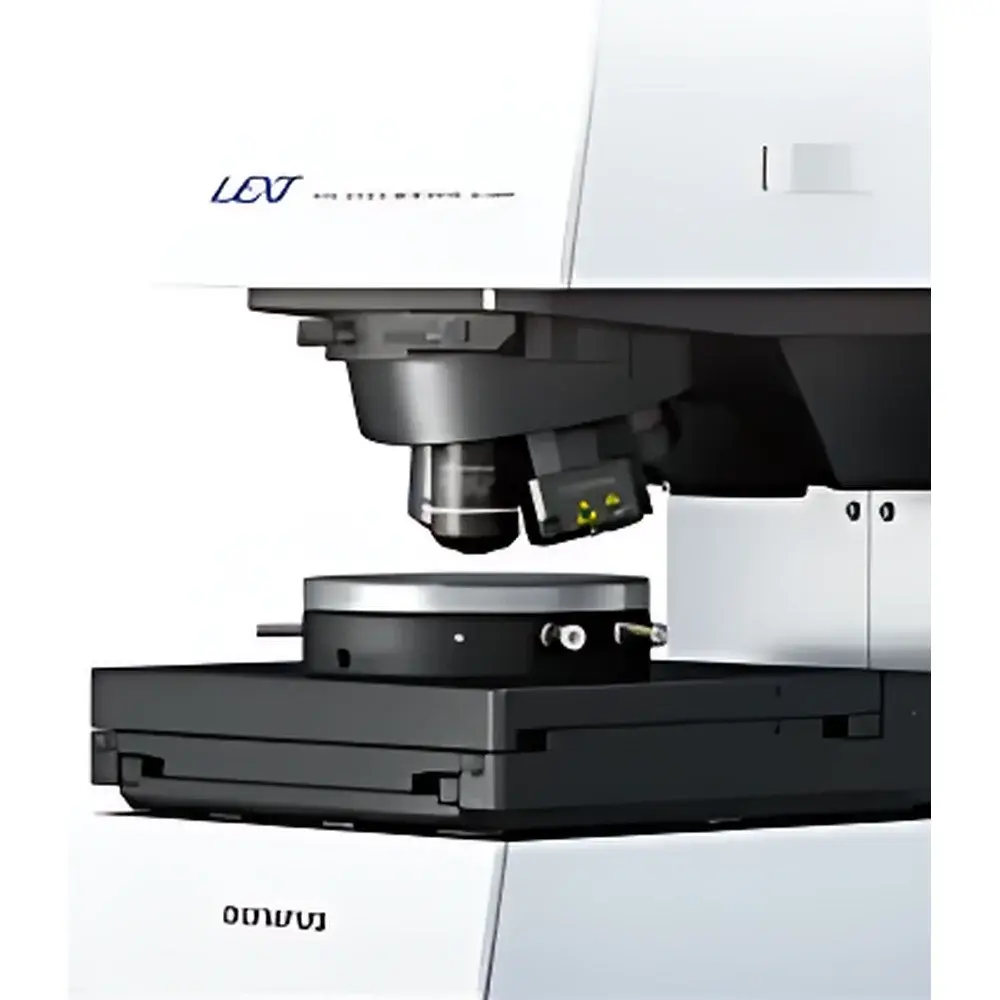
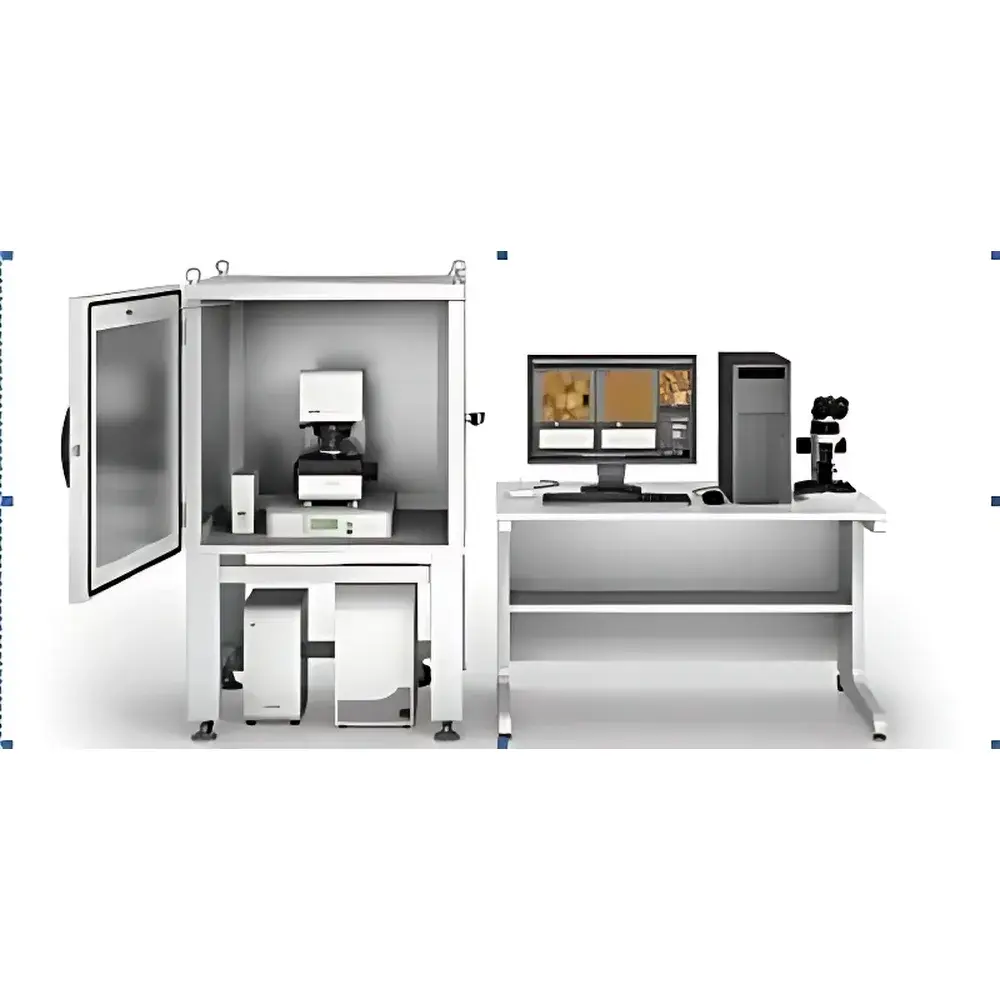
Olympus LEXT OLS4500 3D Laser Scanning and Probe Hybrid Microscope
| Brand | Olympus |
|---|---|
| Origin | Japan |
| Model | LEXT OLS4500 |
| Type | Hybrid Optical/Laser/Probe Microscope |
| Measurement Range | Millimeter to Nanometer Scale |
| Max Magnification | Up to 1,000,000× |
| Objective Lenses | Four Motorized Objectives (Low-to-Ultra-High Magnification) |
| SPM Integration | Integrated Lens-Type SPM Head on Motorized Nosepiece |
| SPM Modes | Contact, Dynamic, Phase, Current, Surface Potential, Magnetic Force (Optional) |
| Alignment | Coaxial and Confocal Objective–Cantilever Configuration |
| Automation | Guided Workflow for Rapid 3D Topography Acquisition and Analysis |
| Compliance | Designed for ISO/IEC 17025-aligned metrology workflows, supports GLP/GMP documentation traceability |
Overview
The Olympus LEXT OLS4500 is a high-precision hybrid 3D measurement microscope engineered for quantitative surface topography analysis across multi-scale regimes—from millimeter-level macrostructures to sub-10 nm surface features. Unlike conventional optical or single-mode scanning instruments, the OLS4500 integrates three complementary imaging and measurement modalities within a single, co-registered platform: wide-field optical microscopy (OM), confocal laser scanning microscopy (CLSM), and scanning probe microscopy (SPM). Its core architecture employs a coaxial, confocal optical path where the objective lens and SPM cantilever tip share a common focal axis—ensuring zero positional drift during modality switching. This eliminates the need for sample repositioning or coordinate recalibration when transitioning between optical survey, laser-based height mapping, and nanoscale probe-based force interaction analysis. The system is optimized for non-contact, non-destructive 3D profiling of optically reflective and semi-transparent surfaces, delivering traceable height data with sub-nanometer vertical resolution under controlled environmental conditions.
Key Features
- Tri-modal acquisition platform: Seamless toggling among optical microscopy, laser scanning confocal imaging, and probe-based surface characterization—without loss of field-of-view registration.
- Motorized quadruple-objective turret integrating four parfocal objectives (e.g., 10×, 20×, 50×, 100×), each calibrated for both optical and SPM operation.
- Lens-type SPM head mounted directly on the motorized nosepiece, enabling true co-axial alignment between optical focus and cantilever apex—critical for repeatable nanoscale targeting.
- Standard SPM modes include contact, dynamic (tapping), and phase imaging; optional modules support electrical (current, surface potential) and magnetic force microscopy (MFM) for functional property mapping.
- Automated cantilever exchange mechanism: Pre-aligned micro-cantilever holders insert directly into the SPM head, minimizing setup time and reducing alignment-induced measurement uncertainty.
- Onboard guided workflow software streamlines calibration, focus optimization, scan parameter selection, and 3D reconstruction—reducing operator dependency and improving inter-user reproducibility.
Sample Compatibility & Compliance
The LEXT OLS4500 accommodates rigid, flat, or gently curved solid samples up to 210 mm × 210 mm × 50 mm (W × D × H), including polished metals, semiconductor wafers, coated films, ceramics, and polymer substrates. It is routinely deployed in R&D and quality control environments where surface roughness (Sa, Sq), step height, volume loss, grain boundary morphology, and defect geometry must be quantified per ISO 25178-2, ISO 4287, and ASTM E2927 standards. The system supports audit-ready documentation: all measurement parameters, instrument configuration logs, and raw height maps are timestamped and stored with metadata compliant with GLP and GMP requirements. While not FDA 21 CFR Part 11-certified out-of-the-box, its data export architecture (CSV, TIFF, XYZ, OXF) enables integration with validated LIMS or ELN platforms for regulated environments.
Software & Data Management
Olympus LEXT software provides a unified interface for acquisition, visualization, and metrological analysis. It includes automated focus stacking for extended depth-of-field OM imaging, Z-stack reconstruction from CLSM data, and quantitative SPM topography processing (flattening, filtering, cross-section extraction, statistical roughness calculation). All datasets retain full spatial metadata, enabling correlation across modalities—for instance, overlaying an optical defect image with its corresponding SPM height profile and phase contrast map. Export formats conform to ASTM E57.02 standard file structures for 3D surface data. Raw scan files are saved in proprietary but fully documented binary format; conversion utilities support interoperability with third-party analysis tools such as MountainsMap®, Gwyddion, and MATLAB.
Applications
The OLS4500 serves critical roles in advanced materials characterization, microelectronics failure analysis, tribology research, and thin-film process development. Typical use cases include: 3D profiling of anodized aluminum oxide pore arrays; quantification of TiO₂ single-crystal step edges and terrace widths; dimensional verification of IC via holes and solder bump coplanarity; nanoscale wear scar analysis on DLC-coated automotive components; surface roughness validation of injection-molded polymer optics; and topographic correlation of hardness indentations (e.g., Vickers) with surrounding plastic deformation zones. In life sciences, it supports correlative morphological studies—such as bacterial colony surface texture mapping (via CLSM + SPM phase mode) or toner particle shape/size distribution analysis on printed media.
FAQ
Does the LEXT OLS4500 require vacuum operation for SPM measurements?
No. All SPM modes operate under ambient atmospheric conditions; no vacuum chamber or vibration isolation table is required.
Can the system measure transparent or semi-transparent thin films?
Yes—confocal laser mode enables precise interface detection in multilayer stacks (e.g., SiO₂/Si, polymer/glass), provided sufficient refractive index contrast exists.
Is SPM cantilever calibration traceable to NIST standards?
Cantilever spring constants are determined via thermal noise method or Sader calibration, both traceable to SI units; Olympus provides calibration certificates upon request.
What level of training is required to achieve ISO-compliant measurement repeatability?
Operator certification typically requires one week of hands-on training covering alignment validation, artifact mitigation (e.g., thermal drift, piezo creep), and uncertainty budgeting per ISO/IEC Guide 98-3.
Are firmware updates and software patches included post-purchase?
Yes—Olympus offers complimentary firmware and software maintenance for the first 12 months; extended support contracts are available.





