
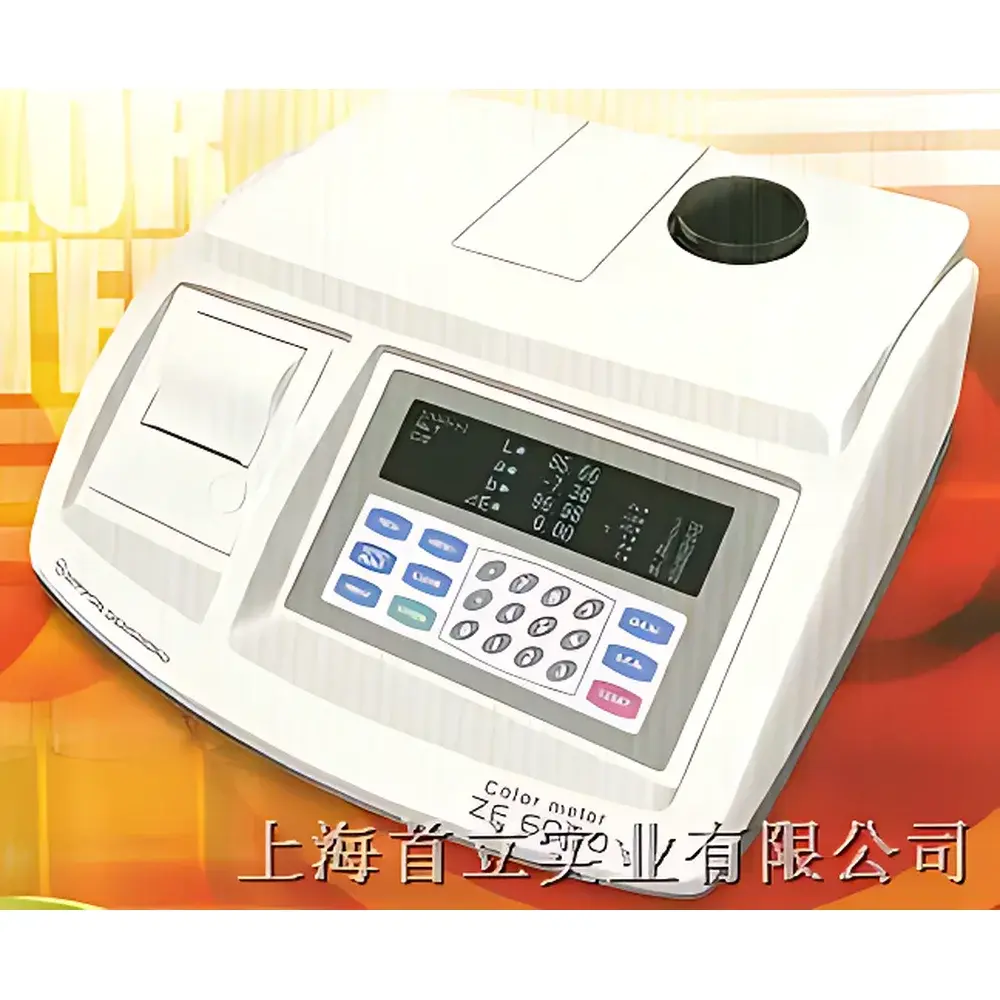
Nippon Denshoku ZE 6000 Color Difference Meter
| Origin | Japan |
|---|---|
| Manufacturer Type | Authorized Distributor |
| Origin Category | Imported |
| Model | ZE 6000 |
| Pricing | Available Upon Request |
Overview
The Nippon Denshoku ZE 6000 Color Difference Meter is a high-precision, dual-mode optical measurement instrument engineered for laboratory and industrial quality control environments requiring traceable, repeatable color evaluation across diverse material forms. Based on CIE tristimulus (XYZ) colorimetric principles and compliant with JIS Z 8722—Japan’s national standard for color measurement—it employs a calibrated halogen light source (12 V, 50 W) and fast-response silicon photodiode array to capture spectral reflectance and transmittance data across the visible spectrum (380–780 nm at 10 nm intervals). Its dual optical path design supports both reflective and transmissive measurements under standardized geometries: d/0° (diffuse illumination, normal viewing) for opaque solids and powders, and e/0° (diffuse transmission, normal viewing) for liquids, films, and translucent materials. The instrument delivers absolute color coordinates (CIE XYZ, L*a*b*, L*C*h*, Yxy, etc.) and delta-E metrics (ΔE*, ΔE94, ΔECMC) with documented repeatability: standard deviation ≤0.02 ΔE* over 30 consecutive readings at 10-second intervals after 30-minute warm-up—meeting ISO 13655 and ASTM E308 requirements for instrumental colorimetry stability.
Key Features
- Dual-mode optical architecture enabling simultaneous reflectance and transmittance measurement without hardware reconfiguration
- Multiple aperture options: 6 mm, 10 mm, and 30 mm reflectance ports; 30 mm transmittance port; optional 3 mm aperture for tablet and small-part analysis
- Flash-test mode ensures thermal and photometric stability during extended measurement sessions, minimizing drift in long-duration QC workflows
- Integrated UV-filtered optical path enables reliable fluorescence compensation for APHA (platinum-cobalt) and Gardner color index quantification per ASTM D1209 and ASTM D1500
- Large backlit LCD display (256 × 64 dots, 166.25 × 41.45 mm active area) with intuitive menu navigation and real-time multi-parameter visualization
- Footswitch-compatible operation for hands-free control in production-line or glove-box environments
- RS-232C serial interface supporting bidirectional communication with external PCs for automated data logging and batch reporting
Sample Compatibility & Compliance
The ZE 6000 accommodates heterogeneous sample geometries—including flat solids, curved surfaces, granular powders, viscous pastes, spherical objects, thin films, and liquid solutions—without requiring custom fixtures in most cases. Its mechanical design allows stable positioning of irregular or non-planar specimens via optional sample holders (e.g., powder cups, liquid cuvettes, tablet cradles). Regulatory alignment includes full compliance with JIS Z 8722, ASTM E308 (computation of color differences), ASTM E313 (yellowness index), ASTM D1925 (yellowness index for plastics), and ASTM D1209/D1500 (APHA/Gardner color scales). While not inherently 21 CFR Part 11–certified, its audit-ready data export capabilities (timestamped, user-ID-tagged, uneditable raw output) support GLP/GMP-aligned documentation practices when integrated into validated laboratory information management systems (LIMS).
Software & Data Management
The instrument interfaces seamlessly with Color Assistant 5—a Windows-based color management software package provided by Nippon Denshoku. This application enables comprehensive post-acquisition analysis: conversion between CIE color spaces (e.g., XYZ ↔ L*a*b* ↔ L*C*h*), generation of tolerance ellipses (CIEDE2000, CMC l:c), spectral curve overlay, batch statistical reporting (mean, SD, CPK), and customizable report templates exportable as PDF or CSV. All measurements retain full metadata: date/time stamp, operator ID (if configured), illuminant/observer condition (C/2°, D65/2°, D65/10°), aperture size, and measurement mode. Raw data files are structured for direct import into third-party statistical process control (SPC) platforms or enterprise QA databases.
Applications
- Pharmaceuticals: Tablet coating uniformity, excipient color consistency, and API purity screening via yellowness index (YI E313)
- Food & Beverage: Tomato paste hue tracking, orange juice clarity assessment, soy sauce browning index, and meat freshness monitoring
- Coatings & Inks: Automotive OEM paint match verification, ink formulation validation, and batch-to-batch gloss-independent color acceptance
- Paper & Pulp: Brightness (ISO 2470) correlation, lignin oxidation tracking, and recycled fiber whiteness grading
- Plastics & Polymers: Film haze-color coupling analysis, resin pellet lot release, and injection-molded part color shift detection
- Cosmetics: Lipstick pigment dispersion homogeneity, foundation shade consistency, and sunscreen UV absorber yellowing kinetics
- Medical Devices: Dental composite shade matching (VITA Classical/Lumin scale mapping), wound tissue chromaticity trending
FAQ
Does the ZE 6000 support spectral data export?
No—the instrument reports only calculated colorimetric values (XYZ, L*a*b*, etc.) and derived indices; it does not output full spectral reflectance/transmittance curves.
Can the ZE 6000 measure fluorescent samples accurately?
Yes—when equipped with the optional UV-blocking filter, it enables valid APHA and Gardner index determination for fluorescently enhanced liquids and coatings.
Is calibration traceable to NIST or other national standards?
Yes—Nippon Denshoku provides factory calibration certificates traceable to JCSS (Japanese Calibration Service System), which maintains mutual recognition agreements with NIST and PTB.
What is the warm-up time required before achieving specified accuracy?
30 minutes under ambient conditions (15–40 °C, 30–80 % RH, non-condensing) is required to stabilize thermal drift and meet ΔE* ≤ 0.02 repeatability specification.
Are there GMP-compliant audit trail features built into the instrument firmware?
The ZE 6000 itself does not include electronic signature or role-based access control; however, its RS-232C output supports integration with validated PC-based QA systems that implement 21 CFR Part 11 audit trails.






