
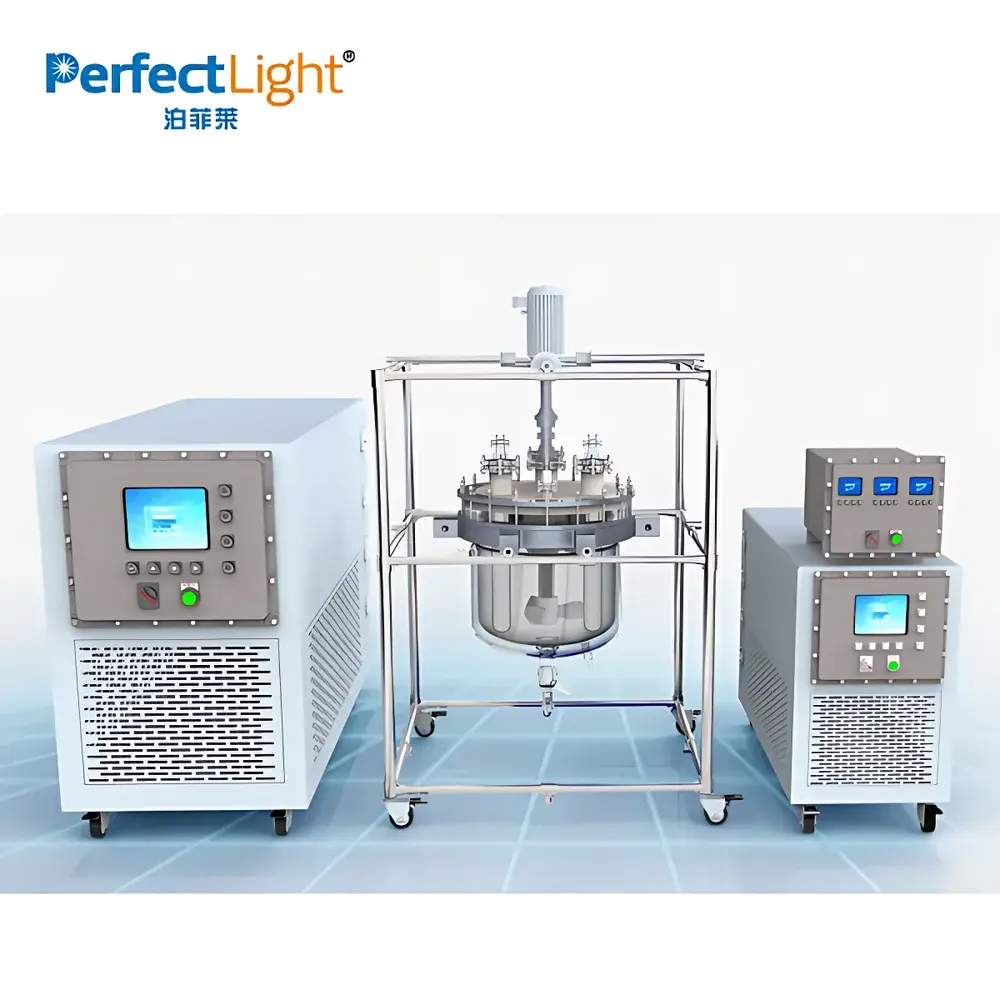
PerfetLight PL-PhotoReactor Series Bench-Scale to Pilot-Scale Photoreactor System
| Brand | PerfetLight |
|---|---|
| Origin | Beijing, China |
| Reactor Volumes | 10 L / 50 L / 100 L (customizable) |
| Vessel Material | High-Borosilicate Glass |
| Light Sources | Mercury Lamps (1–5 kW), LED Arrays (500 W–3 kW), Optional Gas Discharge & Fluorescent Lamps |
| Wavelength Range | Deep UV to Visible (254 nm–780 nm, customizable spectral enhancement) |
| Illumination Geometry | Internal Annular Irradiation |
| Cooling | Multi-Tube Cold Finger with Circulating Coolant Integration |
| Operating Temperature | −20 °C to 100 °C |
| Pressure Rating | Vacuum to Moderate Positive Pressure (material-dependent customization available) |
| Power Supply | 220 V AC, 90–400 V Output, ~2 kW Total System Load |
| Control Cabinet Dimensions | ~690 × 690 × 1700 mm (W×D×H), ~100 kg |
| Auxiliary Enclosure | ~400 × 600 × 1000 mm, ~30 kg |
| Optional Accessories | Explosion-Proof Temperature Controllers, Cryogenic Circulators, Integrated Gas Manifolds |
Overview
The PerfetLight PL-PhotoReactor Series is an engineered photoreactor platform designed for bench-scale process development and pilot-scale photochemical synthesis under controlled irradiation conditions. It operates on the principle of homogeneous or heterogeneous photocatalysis—where photons of defined wavelength and intensity initiate bond cleavage, radical generation, or excited-state electron transfer in molecular substrates. Unlike conventional thermal reactors, this system integrates high-power, spectrally tunable light sources directly within the reaction vessel geometry, enabling precise photon flux delivery across liquid-phase, gas–liquid, liquid–solid, and gas–liquid–solid reaction media. Its annular internal illumination architecture ensures radial photon penetration depth and minimizes shadowing effects common in external lamp configurations. The reactor is widely deployed in pharmaceutical process R&D for API and intermediate synthesis—including validated applications in the photochemical production of dydrogesterone and vitamin D3 analogs—supporting technology transfer from laboratory discovery to kilo-lab and pre-commercial scale.
Key Features
- Modular reactor volumes (10 L, 50 L, 100 L) with customizable vessel capacity and pressure rating—compatible with high-borosilicate glass for UV transparency and chemical inertness; alternative materials (e.g., quartz, Hastelloy C-276) available upon request.
- Annular internal irradiation design accommodates cylindrical light sources—including medium-pressure mercury lamps (1–5 kW), high-power LED arrays (500 W–3 kW), and custom-configured fluorescent or xenon-based modules—enabling uniform photon distribution across the entire reaction volume.
- Multi-layer tubular cold finger system integrated into the reactor head, compatible with external chiller loops for simultaneous spectral filtering and thermal management—critical for exothermic photoreactions and wavelength-selective excitation.
- Source-integrated active cooling and dimmable power control ensure long-term operational stability (>5,000 h lamp life for LEDs; >1,200 h for mercury arcs) and reproducible irradiance profiles (±3% spatial uniformity over active volume).
- Full electrical isolation and grounded stainless-steel framework meet IEC 61000-6-3 EMC standards; optional ATEX/IECEx-certified components available for explosion-hazardous environments (Zone 1/21).
Sample Compatibility & Compliance
The PL-PhotoReactor supports a broad range of photoactive chemistries—including [2+2] cycloadditions, C–H functionalizations, decarboxylative couplings, and asymmetric photocatalytic transformations—across diverse phase systems. It complies with ISO 17025 calibration traceability requirements for irradiance measurement when paired with NIST-traceable radiometric sensors. For regulated pharmaceutical development, the system’s programmable logic controller (PLC) supports audit-trail-enabled operation logs compliant with FDA 21 CFR Part 11 when integrated with validated SCADA software. Reaction protocols may be documented per ICH Q5C (photostability testing) and USP analytical instrument qualification guidelines.
Software & Data Management
Control is executed via a dedicated HMI panel with real-time monitoring of lamp voltage/current, jacket temperature, internal thermocouple readings, and pressure transducer output. Optional Ethernet-enabled PLC integration allows remote supervision through OPC UA or Modbus TCP protocols. All operational parameters—including irradiation time, power ramping profiles, temperature setpoints, and safety interlock status—are timestamped and exportable as CSV or PDF reports. Data integrity safeguards include write-protected storage, user-level access control (admin/operator/guest), and electronic signature capability for GLP/GMP workflows.
Applications
- Process optimization of photomediated C–N bond formation in heterocyclic API synthesis.
- Kinetic modeling of quantum yield and action spectra in visible-light-driven asymmetric catalysis.
- Scale-up studies for continuous-flow photochemistry using batch-to-continuous correlation methodology.
- Photostability assessment of drug substances per ICH Q1B under controlled UV–vis irradiance.
- Development of solar-simulated photocatalytic degradation pathways for environmental contaminant screening.
FAQ
Can the reactor operate under inert atmosphere or controlled gas composition?
Yes—the standard configuration includes dual-port gas inlet/outlet valves with Swagelok fittings, supporting nitrogen purging, hydrogenation, or CO₂-saturated reactions.
Is spectral irradiance mapping available as a validation service?
Yes—PerfetLight provides optional radiometric characterization using calibrated spectroradiometers (Hamamatsu CCD-based systems) with spatial mapping at multiple axial and radial positions.
What safety interlocks are built into the system?
Interlocks include lamp overtemperature cutoff, coolant flow failure detection, door-open emergency shutoff, and pressure deviation alarms—all hardwired to fail-safe relays.
Can the system be integrated with automated sampling or inline analytics?
Yes—standard 1/4″ OD ports and DIN 11851 flanges support integration with HPLC autosamplers, FTIR flow cells, or Raman probes via third-party OEM interfaces.
Are validation documents (IQ/OQ/PQ) provided?
Factory-verified IQ/OQ documentation is included; PQ protocols are customer-specific and developed collaboratively during site commissioning.



