
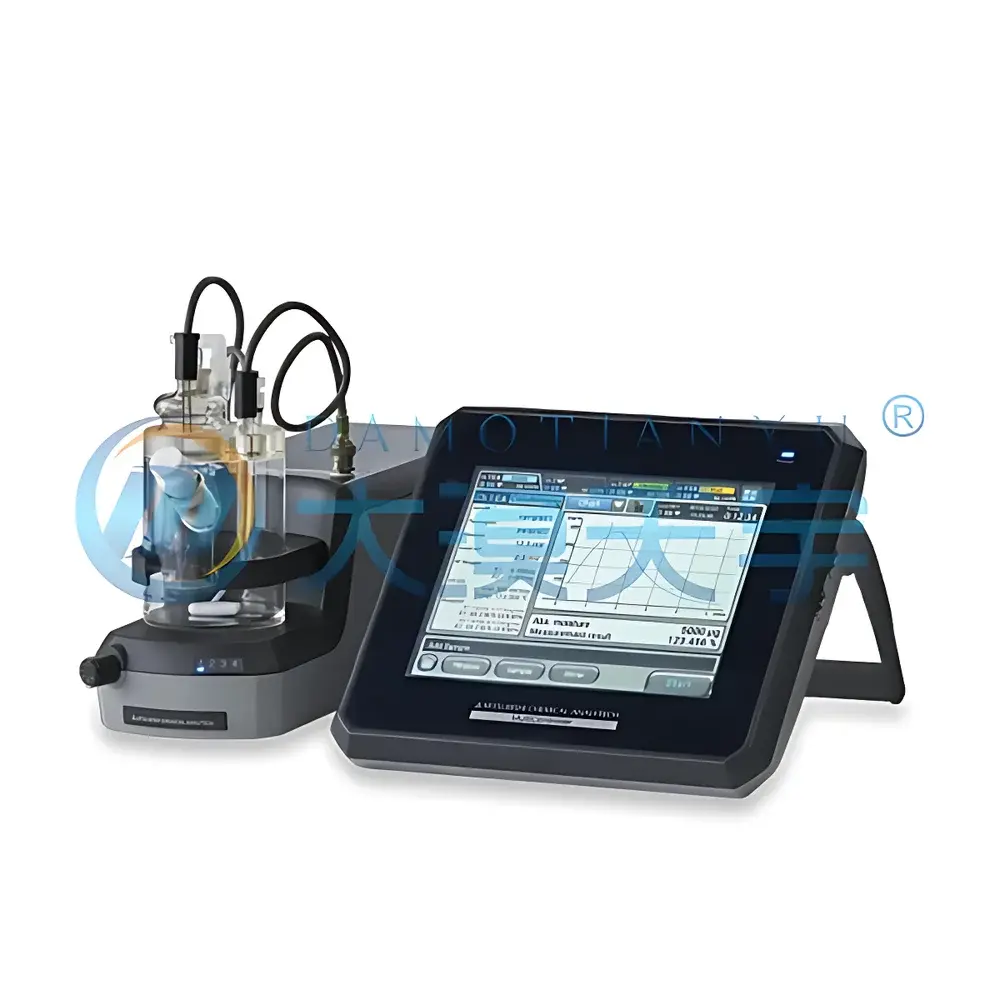
Nittoseiko Analytech CA-310BO Coulometric Karl Fischer Moisture Analyzer for Transformer Oil Analysis
| Brand | Nittoseiko Analytech |
|---|---|
| Origin | Japan |
| Model | CA-310BO |
| Titration Method | Fully Automatic Coulometric Titration |
| Instrument Type | Coulometric Karl Fischer Moisture Analyzer |
| Measurement Resolution | ±0.1 µA |
| Water Content Range | 5 µg to 999.9999 mg |
| Accuracy | < 0.3% RSD (for samples > 1 mg H₂O) |
| Sensitivity | 0.1 µg H₂O |
| Maximum Electrolysis Current | 516 mA |
| Average Titration Speed | 2.2 mg H₂O/min (2.64 mg H₂O/min in High-Speed Mode) |
| Background Correction | Auto-selected & continuously displayed |
| Sample Heating Control | Stepwise Temperature Control (Patent No. 3284783) |
| Display | 8.4-inch color LCD touchscreen |
| Data Storage Capacity | 9999 test records |
| GLP/GMP Compliance | Yes |
| Interface | 4× USB, 1× LAN |
| Operating Environment | 15–40 °C, ≤85% RH (non-condensing) |
Overview
The Nittoseiko Analytech CA-310BO is a high-precision coulometric Karl Fischer moisture analyzer engineered specifically for trace water quantification in electrically insulating liquids—most notably transformer oils—where moisture content directly impacts dielectric strength, oxidation stability, and long-term equipment reliability. Unlike volumetric KF systems, the CA-310BO employs coulometric titration: water in the sample reacts stoichiometrically with iodine generated electrochemically at the anode from iodide ions in the electrolyte solution. The total charge passed (Q = I × t) is measured with microampere-level resolution (±0.1 µA), enabling absolute quantification of water mass via Faraday’s law (1 mole H₂O ≡ 2 × 96,485 C). This principle delivers inherent accuracy and eliminates reagent standardization errors common in volumetric methods—critical for compliance with ASTM D1533, IEC 60814, and ISO 12937 standards governing moisture analysis in power transformer oils.
Key Features
- Coulometric detection with 0.1 µg H₂O sensitivity and 1 mg water—validated under controlled laboratory conditions per ISO/IEC 17025 practices.
- Stepwise temperature-controlled vaporization unit (Patent No. 3284783): dynamically adjusts heating profile based on real-time evaporation kinetics of water from oil matrices, minimizing thermal degradation and ensuring quantitative transfer.
- Modular multi-channel architecture: single master console supports up to four independent measurement channels—enabling parallel analysis for statistical validation, inter-channel calibration checks, or high-throughput QC workflows.
- Wireless channel control option (optional): decouples physical placement of vaporizers from the main console, improving lab ergonomics and safety when handling flammable solvents or hot surfaces.
- Intuitive 8.4-inch color touchscreen interface with embedded SOP guidance: operators select preloaded, version-controlled standard operating procedures; the system then prompts step-by-step execution—including electrode conditioning, solvent blanking, and sample injection timing—to enforce method consistency.
- Dual-electrode compatibility: supports both membrane-free and membrane-type generator electrodes. Membrane-free configuration enables use with single-component AQUAMICRON® reagents (e.g., AQ-100), simplifying maintenance. Membrane-type electrodes extend analyte scope to ketones, low-hydroxyl acids, and select aldehydes per USP & EP monographs.
Sample Compatibility & Compliance
The CA-310BO is validated for direct analysis of mineral-based, synthetic ester, and silicone-based transformer oils without dilution. Its vaporization module integrates seamlessly with Mitsubishi Chemical VA-series (VA-300, VA-200, VA-210, VA-230, VA-236S, VA-121, VA-122) and VG-200 units—all featuring identical stepwise temperature logic. The system meets data integrity requirements under FDA 21 CFR Part 11 (with audit trail, electronic signatures, and role-based access enabled), supports GLP and GMP environments through full traceability of instrument settings, operator IDs, calibration logs, and raw current-time profiles. All measurements comply with ASTM D1533 Method B (coulometric), IEC 60814 (moisture in insulating oils), and ISO 12937 (petroleum products—determination of water by coulometric Karl Fischer titration).
Software & Data Management
Data acquisition and reporting are governed by firmware-level security protocols. Each test record includes timestamped metadata: ambient temperature/humidity, electrode status, background current, titration curve (I vs. t), endpoint confirmation logic, and user-defined calculation parameters (e.g., sample weight, dilution factor). Up to 9999 results are stored internally with automatic time/date stamping. Four USB ports support encrypted export to external drives (CSV, PDF, XML), firmware updates, and backup/restore of method configurations. LAN connectivity enables integration into LIMS via TCP/IP—supporting automated result push to enterprise databases. Audit trails log all configuration changes, user logins, and critical events (e.g., electrode activation, blank correction override), satisfying ALCOA+ principles (Attributable, Legible, Contemporaneous, Original, Accurate, Complete, Consistent, Enduring, Available).
Applications
- Pre-commissioning and routine maintenance testing of power transformers per IEEE C57.106 guidelines.
- Quality control of new and reclaimed insulating oils during refinery blending and packaging.
- Stability studies evaluating hydrolytic degradation of ester-based biodegradable oils under accelerated aging conditions.
- Root-cause investigation of dielectric failure in high-voltage equipment where moisture-induced sludge formation or cellulose insulation hydrolysis is suspected.
- Method transfer and verification across centralized QC labs and field service units using identical SOPs and calibrated channels.
FAQ
What is the minimum detectable water mass, and under what conditions is it achievable?
The theoretical lower limit is 0.1 µg H₂O, but reproducible quantification at 5 µg requires strict environmental control: ≤30% RH ambient air, nitrogen-purged sample chamber, and freshly activated electrodes. ASTM D1533 specifies 10 µg as the practical lower reporting limit for routine testing.
Can the CA-310BO analyze samples containing reactive functional groups like aldehydes or ketones?
Yes—when equipped with a membrane-type generator electrode and appropriate electrolyte (e.g., Hydranal-Coulomat AG), the system mitigates side reactions and extends compatibility to challenging matrices per USP & Ph. Eur. general chapter 2.5.12.
How does the stepwise temperature control improve accuracy compared to fixed-temperature vaporizers?
It prevents localized overheating that causes oil cracking or incomplete water release. By tracking real-time current rise during vaporization, the system identifies optimal heating plateaus—ensuring complete water extraction while preserving sample integrity.
Is GLP/GMP compliance hardware-enforced or dependent on user configuration?
Core features—including electronic signatures, immutable audit trails, and password-protected method editing—are firmware-embedded and cannot be disabled. Full compliance requires documented SOPs, periodic performance verification (e.g., 10 µg water standard), and operator training records.
What maintenance intervals are recommended for long-term operational reliability?
Electrode activation every 2 weeks (or after 50 analyses), daily background current monitoring, quarterly verification with certified water standards (e.g., 1.00 ± 0.02 mg H₂O), and annual calibration of current measurement circuitry per manufacturer’s service protocol.
Related Products





