
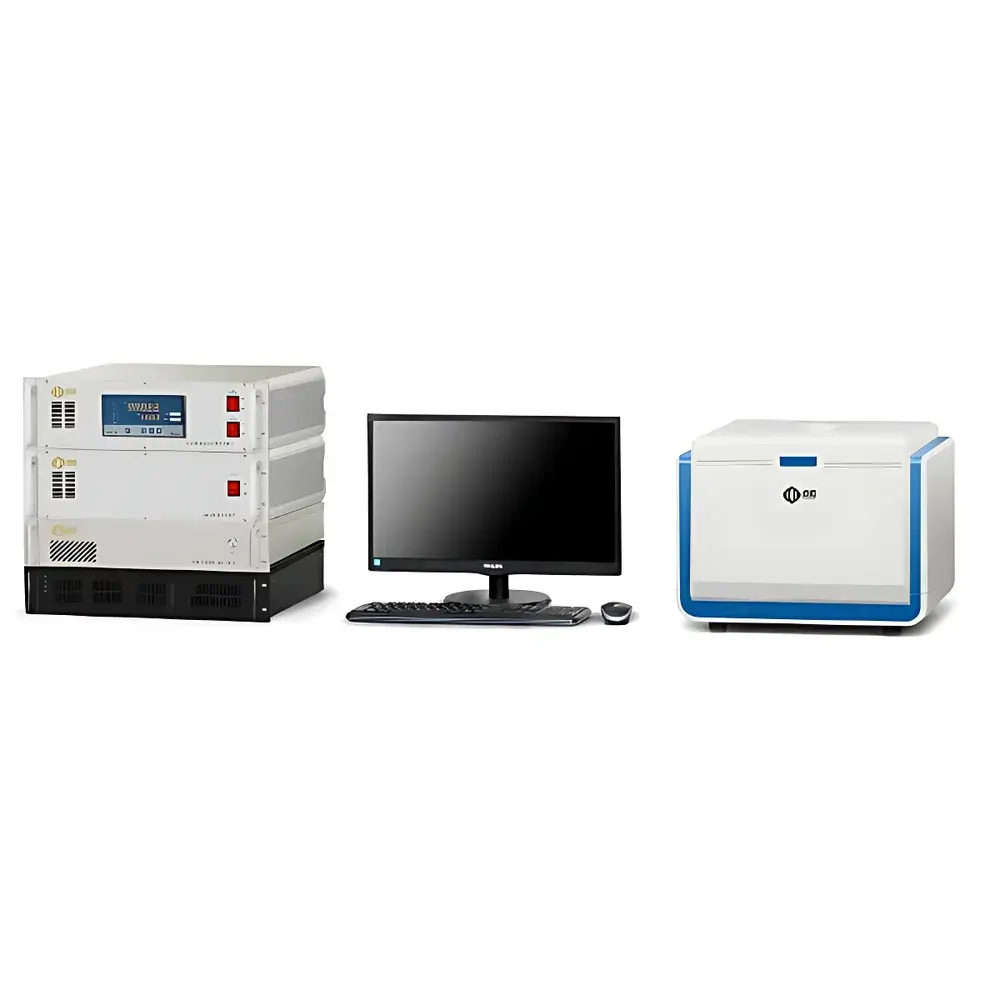
NIUMAG EDUMR20-015V-I Benchtop Low-Field MRI Teaching System
| Brand | NIUMAG |
|---|---|
| Origin | Jiangsu, China |
| Model | EDUMR20-015V-I |
| Instrument Type | Low-Field Nuclear Magnetic Resonance Imaging System |
| Sample Compatibility | Solid and Liquid Samples |
| Magnetic Field Strength | 0.5 T ± 0.03 T |
| Form Factor | Desktop Permanent Magnet System |
| Application Domain | MRI Physics Education, Biomedical Engineering Pedagogy, Medical Imaging Training |
Overview
The NIUMAG EDUMR20-015V-I is a purpose-built, benchtop low-field nuclear magnetic resonance (NMR) imaging teaching system engineered for undergraduate and graduate instruction in medical physics, biomedical engineering, radiological sciences, and clinical imaging technology. Unlike clinical MRI scanners, this instrument operates at a stable, homogeneous 0.5 T permanent magnetic field—sufficient to demonstrate core NMR phenomena including spin excitation, free induction decay (FID), spin echo formation, T₁/T₂ relaxation dynamics, and k-space-based image reconstruction—while eliminating the infrastructure, safety, and regulatory burdens associated with high-field clinical systems. Its design adheres to fundamental principles of pulsed NMR spectroscopy and Fourier-transform imaging, enabling students to observe real-time signal evolution in both time and frequency domains, manipulate pulse sequence timing (e.g., 90° and 180° RF pulse widths), and correlate raw k-space data with reconstructed anatomical cross-sections. The system serves as a pedagogical bridge between theoretical quantum mechanics and applied clinical MRI, supporting curriculum-aligned experiments compliant with ISO/IEC 17025–informed laboratory education standards.
Key Features
- Benchtop permanent magnet architecture delivering a stable 0.5 T field with ≤3% spatial inhomogeneity over a 60 mm DSV (Diameter Spherical Volume), optimized for educational reproducibility
- Fully open hardware and software architecture: all RF pulse parameters, gradient waveforms, receiver gain settings, and acquisition timing are user-configurable via intuitive GUI
- Integrated virtual data acquisition platform enabling synchronized hands-on hardware operation and simulated k-space sampling—ideal for pre-lab preparation and post-lab analysis
- Native support for standard MRI pulse sequences: Spin Echo (SE), Inversion Recovery (IR), Gradient Echo (GRE), and CPMG (Carr–Purcell–Meiboom–Gill) for T₂ quantification
- Real-time FID and echo signal visualization in both time domain (oscilloscope mode) and frequency domain (FFT spectrum), with exportable raw digitized waveforms
- Comprehensive image processing suite including window-level adjustment, ROI-based intensity profiling, pixel-value histogram generation, and DICOM-compatible export
- Remote experiment capability via secure Ethernet interface, supporting asynchronous lab access and blended learning models
- Hardware diagnostic mode permitting direct oscilloscope-level probing of RF transmit/receive paths, gradient driver outputs, and ADC front-end signals
Sample Compatibility & Compliance
The EDUMR20-015V-I accommodates solid and liquid phantoms—including agarose gels, oil–water emulsions, polymer rods, and custom tissue-mimicking materials—with sample diameters up to 50 mm and heights ≤40 mm. Its non-clinical classification exempts it from FDA 510(k) or CE IVD requirements; however, all electromagnetic emissions conform to CISPR 11 Group 1 Class B limits. Safety protocols align with IEC 62464-1 (MRI education devices) and include passive ferromagnetic screening checklists, RF exposure monitoring logs, and emergency quench simulation modules. While not intended for human scanning, its subsystem architecture mirrors that of clinical MRI systems—main magnet, shielded gradient coils, quadrature birdcage RF coil, and digital spectrometer—ensuring fidelity in component-level training.
Software & Data Management
The proprietary NMI-Teach software (v4.2+) provides a unified environment for experiment design, real-time acquisition, offline reconstruction, and pedagogical assessment. All acquisitions generate timestamped, metadata-embedded HDF5 files containing raw k-space data, processed images (NIfTI-1 format), and acquisition parameter sets—fully traceable for GLP-aligned lab reporting. Audit trails record user login, sequence modification history, calibration events, and export actions. Software supports 2D slice reconstruction (Fourier and iterative SENSE-based methods) and optional 3D volume rendering add-ons. Export interfaces comply with DICOM PS3.10 for integration into PACS-based teaching archives. License management enables concurrent multi-station deployment across teaching laboratories.
Applications
- Undergraduate physics labs: Demonstrating Larmor precession, resonance condition, and Bloch equation solutions
- Biomedical engineering capstone projects: Designing custom pulse sequences, optimizing SNR vs. scan time trade-offs, and validating reconstruction algorithms
- Radiologic technology programs: Practicing patient positioning simulation, contrast mechanism analysis (e.g., T₁-weighted vs. T₂-weighted contrast), and artifact identification (motion, truncation, chemical shift)
- Medical physics certification prep: Quantifying relaxation times using multi-echo CPMG and variable TR/TE parametric sweeps
- Interdisciplinary research training: Characterizing porous media, polymer crosslinking, or hydration dynamics in biomaterials using relaxometry and diffusion-weighted imaging (DWI) modules
FAQ
Is the EDUMR20-015V-I certified for clinical use?
No. It is strictly designated as an educational and research instrument under IEC 62464-1 and carries no regulatory clearance for human diagnostic imaging.
Can third-party pulse sequences be imported?
Yes. The system accepts custom sequence definitions in XML-based NMR-Seq format, provided they respect hardware timing constraints and gradient slew rate limits.
What phantom materials are recommended for student labs?
Agarose gel phantoms (0.5–2.0% w/v) doped with MnCl₂ or CuSO₄ for controlled T₁/T₂ tuning; silicone oil/water emulsions for diffusion contrast demonstration.
Does the system support quantitative T₁/T₂ mapping?
Yes. Built-in inversion recovery and multi-echo spin echo protocols generate voxel-wise relaxation maps with coefficient-of-variation <8% across repeated measurements.
Is MATLAB® or Python® integration available?
Yes. A documented API (Python 3.8+ compatible) enables direct control of acquisition, real-time data streaming, and batch processing of HDF5 datasets.





