
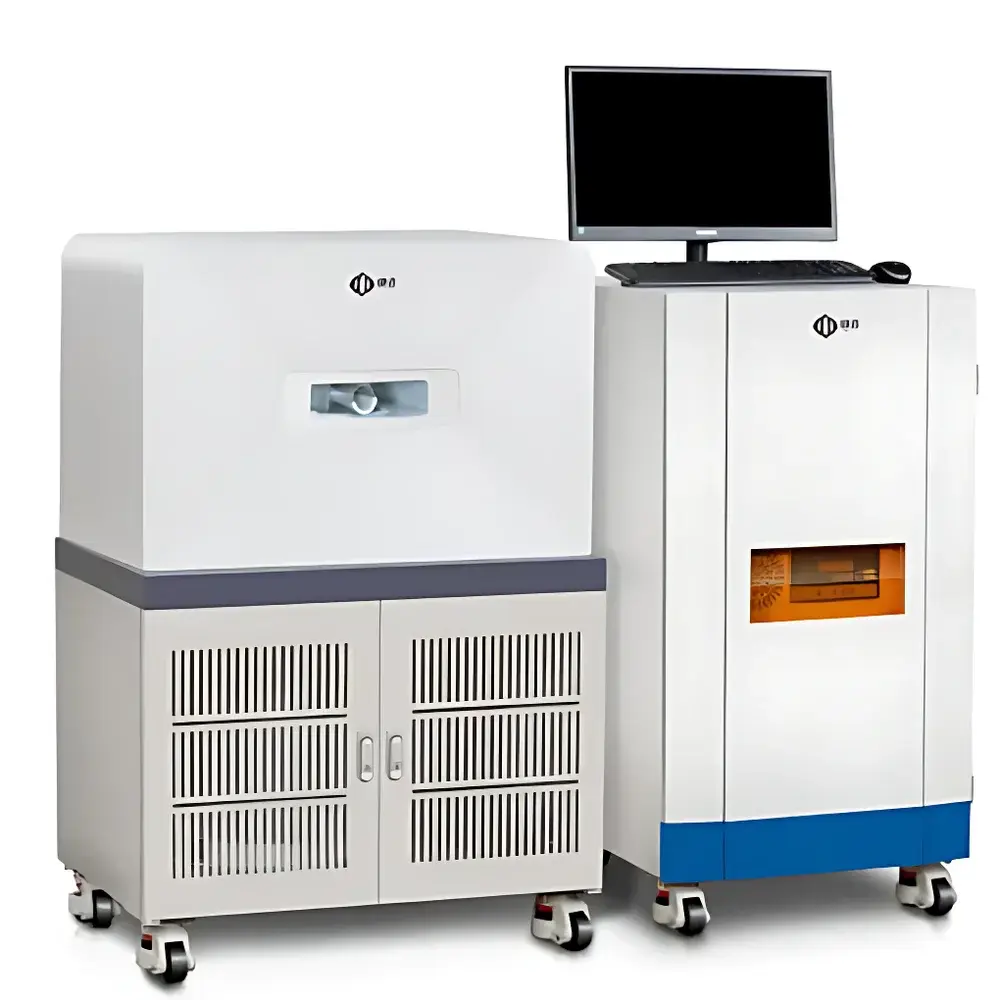
NIUMAG MesoMR21-060H-I High-Temperature & High-Pressure Low-Field Nuclear Magnetic Resonance Analyzer and Imaging System
| Brand | NIUMAG |
|---|---|
| Origin | Jiangsu, China |
| Manufacturer Type | Authorized Distributor |
| Product Origin | Domestic (China) |
| Model | MesoMR21-060H-I |
| Instrument Type | Low-Field NMR Analyzer & Imager |
| Sample Compatibility | Solid-Liquid Dual-Phase Samples |
| Operating Frequencies | 12 MHz / 23 MHz |
| Data Acquisition Mode | Pulsed Fourier Transform (PFT-NMR) |
Overview
The NIUMAG MesoMR21-060H-I is a benchtop low-field nuclear magnetic resonance (NMR) analyzer and imaging system engineered for quantitative characterization of porous media, soft matter, and multiphase systems under controlled thermal and mechanical stress. Based on the fundamental principles of pulsed Fourier-transform NMR spectroscopy, the system detects hydrogen-1 (1H) spin relaxation dynamics—primarily transverse relaxation time (T2), longitudinal relaxation time (T1), and diffusion-relaxation (D–T2) correlations—to non-invasively quantify pore structure, fluid distribution, saturation state, mobility, and interfacial interactions. Its permanent magnet architecture delivers stable field homogeneity (0.3 ± 0.03 T or 0.5 ± 0.03 T, corresponding to nominal Larmor frequencies of 12 MHz or 23 MHz) with minimal drift, enabling reproducible longitudinal studies over extended experimental cycles. The integrated 60 mm diameter RF probe supports both standard and custom coil configurations, ensuring compatibility with heterogeneous sample geometries across research and industrial QA/QC workflows.
Key Features
- Modular high-temperature & high-pressure (HTHP) accessory kit—designed for in-situ NMR measurements up to 200 °C and 40 MPa, with active temperature regulation (±0.5 °C stability) and pressure feedback control
- Dual-frequency operation: switchable 12 MHz / 23 MHz modes optimized for sensitivity vs. resolution trade-offs in different material classes
- Permanent magnet system with passive shimming—no cryogens, no external power supply required for magnet operation
- Customizable RF probe assembly with 60 mm inner diameter, supporting interchangeable solenoid and saddle coils for enhanced signal-to-noise ratio (SNR) in solid, semi-solid, and liquid-phase samples
- Full pulse sequence library including CPMG, IR, STIR, diffusion-weighted spin-echo, and multi-dimensional correlation experiments (e.g., T1–T2, D–T2)
- Rugged industrial-grade console with FPGA-based digital signal processing, real-time data streaming, and hardware-triggered synchronization for coupling with external stimuli (e.g., syringe pumps, thermal chambers)
Sample Compatibility & Compliance
The MesoMR21-060H-I accommodates solid-liquid dual-phase samples—including rock cores, polymer gels, food matrices, catalysts, and biological tissues—in standard cylindrical formats (up to Ø50 × H100 mm). With the HTHP module installed, samples are sealed in stainless-steel pressure vessels equipped with sapphire viewports and calibrated thermocouple feedthroughs, maintaining NMR signal integrity during dynamic processes such as hydrocarbon displacement, CO2 adsorption/desorption, freeze-thaw cycling, and reactive fluid infiltration. The system conforms to ISO/IEC 17025 requirements for testing laboratories and supports audit-ready documentation for GLP-compliant studies. All firmware and acquisition software comply with FDA 21 CFR Part 11 electronic record and signature standards when configured with user authentication, audit trail logging, and role-based access control.
Software & Data Management
NIUMAG’s proprietary MesoMR Studio v4.x provides an integrated environment for experiment design, real-time monitoring, spectral processing, and parametric mapping. Key capabilities include automated T2 inversion using non-negative least squares (NNLS), pore-size distribution modeling via Schlumberger-Doll Research (SDR) and Timur-Coates correlations, saturation quantification based on reference calibration curves, and 2D/3D image reconstruction using filtered back-projection and iterative SENSE algorithms. Raw FID data is stored in vendor-neutral HDF5 format; processed results export to CSV, MATLAB (.mat), and industry-standard NIfTI for cross-platform analysis. The software supports batch processing pipelines, script-driven automation (Python API), and integration with LIMS via RESTful web services.
Applications
- Energy & Geoscience: Porosity, permeability, and wettability assessment of reservoir rocks; movable/immovable fluid saturation under reservoir conditions; capillary pressure curve derivation; microfracture visualization via T2-weighted imaging
- Polymer & Materials Science: Crosslink density mapping in elastomers; solvent diffusion kinetics in membranes; phase separation dynamics in blends; aging effects in composites
- Food & Agriculture: Water mobility profiling in grains, meats, and dairy products; oil migration in baked goods; freezing behavior and ice crystal growth kinetics
- Life Sciences: Ex vivo tissue characterization; contrast agent uptake kinetics; hydrogel swelling behavior; biomaterial degradation monitoring
- Chemical Engineering: In-situ reaction monitoring in catalytic beds; gas hydrate formation/dissociation; supercritical fluid impregnation processes
FAQ
What is the maximum operating temperature and pressure supported by the HTHP module?
The MesoMR21-060H-I HTHP module enables continuous NMR acquisition at temperatures up to 200 °C and pressures up to 40 MPa, with full thermal and pressure feedback control.
Can the system perform T1–T2 correlation measurements under elevated temperature?
Yes—the pulse sequence engine supports 2D correlation experiments under HTHP conditions, provided appropriate RF pulse calibration and relaxation delay adjustments are applied.
Is the system compatible with ASTM D7264 or ISO 178 mechanical test frames?
While not directly interfaced, the modular probe design allows mechanical loading fixtures to be integrated within the 60 mm bore, enabling concurrent NMR and mechanical deformation studies.
Does the software support automated compliance reporting for regulatory submissions?
When deployed with validated configuration and electronic signature modules, MesoMR Studio generates complete audit trails, raw data archives, and metadata logs aligned with FDA 21 CFR Part 11 and EU Annex 11 expectations.
What sample preparation protocols are recommended for rock core analysis?
Standard protocols include vacuum saturation with brine or kerosene, centrifuge drainage for irreducible saturation determination, and aging under reservoir temperature/pressure prior to NMR measurement—all executable inside the HTHP vessel.





