
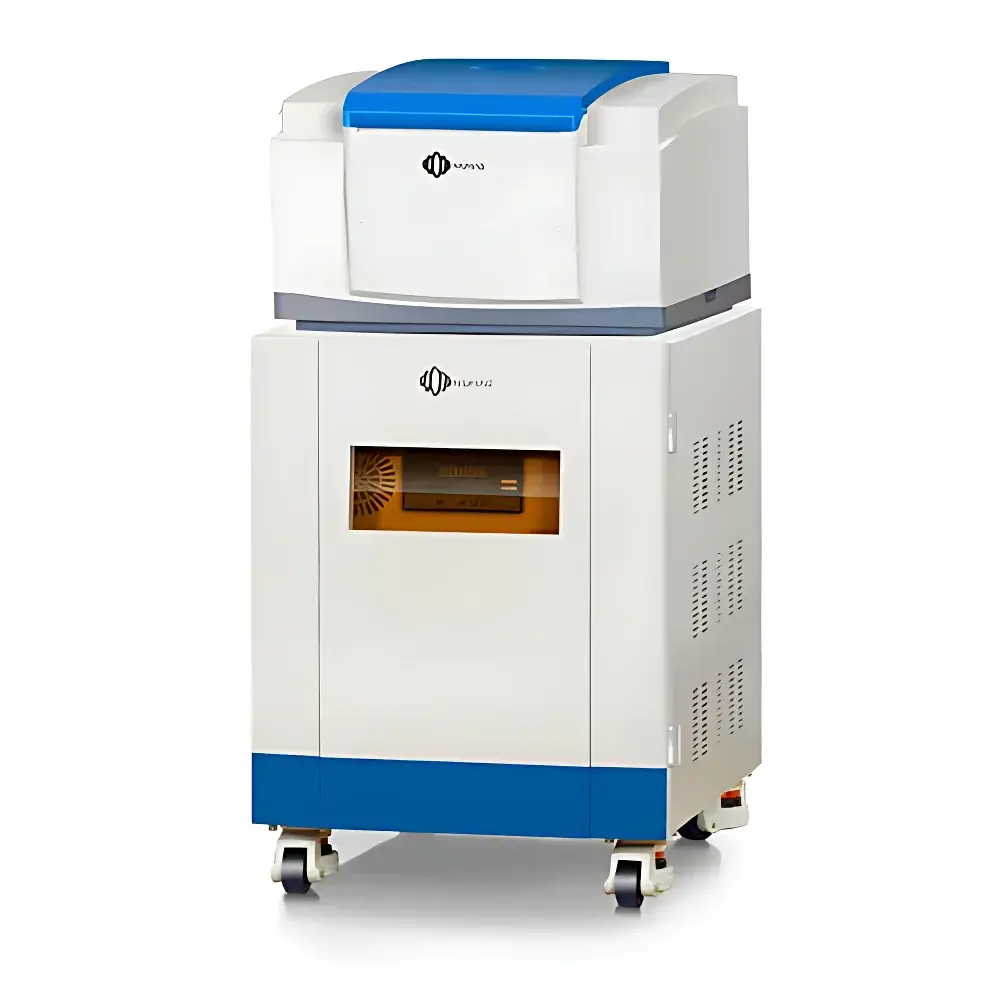
NIUMAG PQ001 Benchtop NMR Oil Content Analyzer for Seeds
| Brand | NIUMAG |
|---|---|
| Origin | Shanghai, China |
| Manufacturer Type | Authorized Distributor |
| Country of Origin | China |
| Model | PQ001 |
| Pricing | Available Upon Request |
| Magnet Type | Permanent Magnet |
| Magnetic Field Strength | 0.5 ± 0.08 T |
| Larmor Frequency | 21.3 MHz |
| Probe Coil Diameter | 25 mm |
Overview
The NIUMAG PQ001 Benchtop NMR Oil Content Analyzer for Seeds is a compact, self-shielded, permanent-magnet nuclear magnetic resonance (NMR) instrument engineered for rapid, non-destructive quantification of oil and moisture content in intact seeds and agricultural kernels. Based on the principle of pulsed NMR relaxation time measurement—specifically transverse relaxation (T₂) decay analysis—the PQ001 detects hydrogen proton signals from mobile triglyceride and water molecules within the sample matrix. Unlike destructive solvent extraction methods, this technique requires no chemical reagents, sample grinding, or drying, preserving sample integrity while delivering high reproducibility (RSD < 1.5% for repeated measurements under controlled conditions). Introduced in 2008 and continuously refined through field deployment across food, agri-science, and biofuel laboratories, the PQ001 operates at a fixed Larmor frequency of 21.3 MHz (corresponding to a 0.5 T static magnetic field), optimized for routine quality control in seed processing facilities and research environments where throughput, safety, and regulatory compliance are critical.
Key Features
- Compact one-box design with integrated magnet, probe, RF electronics, and control unit—no external cryogens, power amplifiers, or shielding rooms required.
- Permanent magnet architecture ensures long-term field stability, minimal drift (< 0.01% per hour), and zero operational helium or liquid nitrogen consumption.
- 25 mm diameter radiofrequency probe coil optimized for heterogeneous seed samples (e.g., whole peanuts, soybeans, sunflower kernels) with uniform excitation and signal reception.
- Automated frequency lock and tuning via proprietary self-locking algorithm—eliminates manual shimming and operator-dependent calibration steps.
- Robust electromagnetic interference (EMI) tolerance: validated operation in industrial lab environments with variable ambient RF noise (e.g., near HVAC systems, motor drives, or wireless networks).
- User-configurable measurement protocols: supports pre-set calibration curves for >12 major oilseed species, with optional custom model development using internal regression tools.
Sample Compatibility & Compliance
The PQ001 accepts intact, unprocessed seeds ranging from 0.5 g to 30 g per measurement, including but not limited to peanut, soybean, rapeseed, sesame, corn, cottonseed, sunflower, wheat, and tung nut. Sample containers are standard 15–25 mm OD glass or plastic tubes; no homogenization or solvent exposure is necessary. The method is recognized as an alternative reference procedure under ISO 10565:1995 (oil and water content in oilseeds by NMR) and aligns with AOAC Official Method 994.01 (NMR determination of oil in oilseeds). While not FDA-cleared as a medical device, its data output supports GLP-compliant documentation workflows when paired with audit-trail-enabled software configurations. Instrument firmware and data files comply with basic 21 CFR Part 11 readiness (electronic signature support, user access logs, and immutable raw data storage).
Software & Data Management
The embedded Windows-based acquisition software provides guided workflow navigation—from sample loading and parameter selection to result export. All raw FID (free induction decay) data, T₂ distribution spectra, and quantitative reports are stored in vendor-neutral CSV and XML formats. Calibration models are managed via encrypted project files with version timestamps. Data can be exported directly to USB flash drives or network shares; batch reporting supports customizable templates (PDF, Excel) with embedded metadata (operator ID, timestamp, instrument serial number, environmental temperature/humidity). Optional software modules include multi-sample queue scheduling, statistical process control (SPC) charting, and integration with LIMS via TCP/IP API.
Applications
- Routine oil content screening in seed breeding programs and varietal certification labs.
- In-process monitoring of oil extraction efficiency in crushing facilities—tracking residual oil in meal post-pressing.
- Moisture content and bound/free water phase differentiation using multi-exponential T₂ fitting—critical for storage stability assessment and germination potential modeling.
- Method validation studies comparing NMR against gravimetric, Soxhlet, or near-infrared (NIR) techniques per ISO 5725 or ASTM E177 guidelines.
- Research into lipid oxidation kinetics via longitudinal T₁ relaxation monitoring under accelerated aging protocols.
FAQ
What sample preparation is required prior to measurement?
None—intact, unshelled, or shelled seeds may be loaded directly into the sample tube. No drying, grinding, or solvent treatment is needed.
Can the PQ001 differentiate between oil and moisture signals?
Yes—through multi-component T₂ relaxation analysis, the instrument resolves distinct decay populations corresponding to bulk water, bound water, and triglyceride protons based on their characteristic relaxation times.
Is method validation support available for regulatory submissions?
NIUMAG provides technical documentation packages—including system suitability test procedures, repeatability/intermediate precision reports, and traceable calibration certificates—for integration into internal SOPs and external audit preparations.
How often does the instrument require recalibration?
Factory calibration remains stable for ≥12 months under normal operating conditions; annual verification using certified reference standards (e.g., doped water/glycerol phantoms) is recommended per ISO/IEC 17025 laboratory practice.
Does the PQ001 support remote diagnostics or firmware updates?
Yes—via secure HTTPS interface, authorized service engineers can initiate remote health checks, log file retrieval, and over-the-air firmware upgrades without onsite intervention.






