
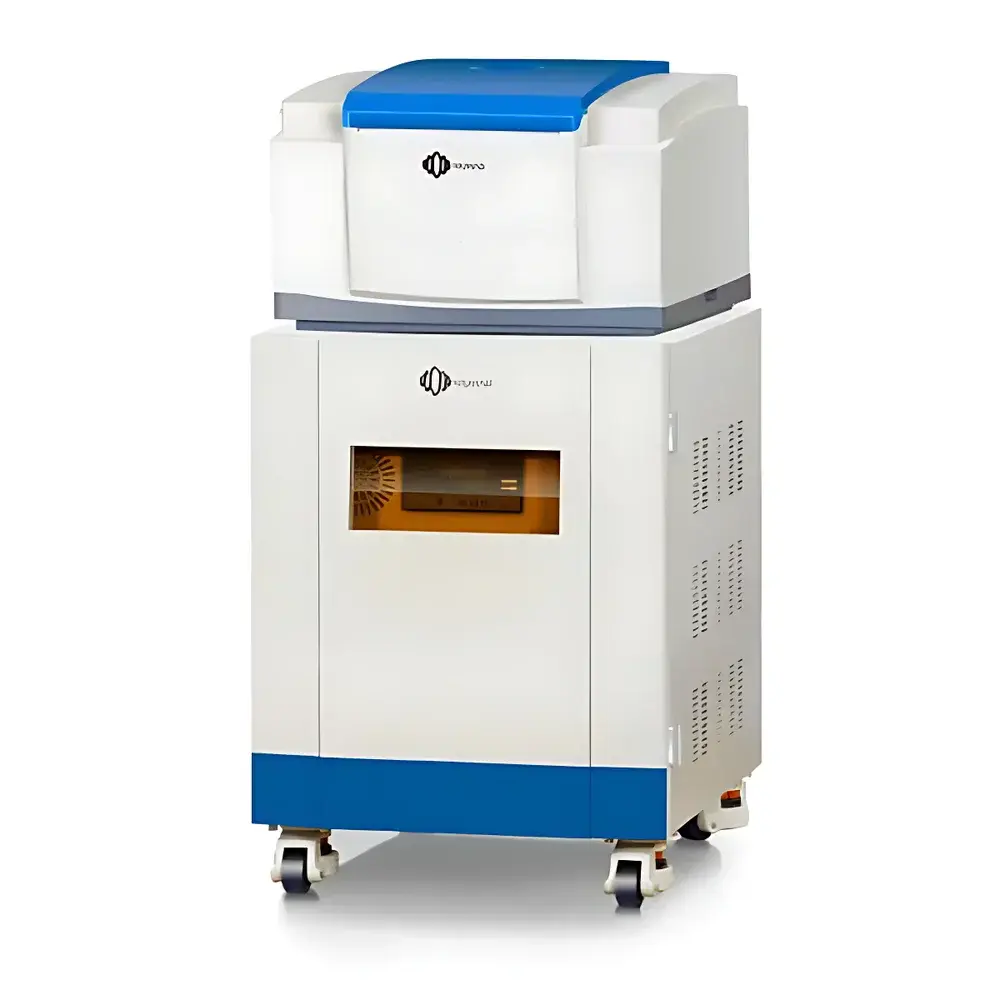
NIUMAG PQ001 Low-Field Nuclear Magnetic Resonance (LF-NMR) Particle Surface Affinity Analyzer
| Brand | NIUMAG |
|---|---|
| Origin | Jiangsu, China |
| Manufacturer Type | Authorized Distributor |
| Product Category | Domestic |
| Model | PQ001 |
| Pricing | Upon Request |
Overview
The NIUMAG PQ001 Low-Field Nuclear Magnetic Resonance (LF-NMR) Particle Surface Affinity Analyzer is a dedicated benchtop instrument engineered for quantitative assessment of interfacial compatibility and colloidal stability in opaque, high-solid-content suspensions—particularly relevant to electronic pastes, battery slurries, ceramic inks, and functional coatings. Unlike optical techniques such as dynamic light scattering (DLS) or electron microscopy (SEM/TEM), the PQ001 leverages proton transverse relaxation time (T2) distribution analysis to probe hydrogen mobility at particle–liquid interfaces without sample dilution, drying, or vacuum treatment. In heterogeneous dispersions, surface-bound solvent molecules exhibit restricted motion compared to bulk-phase protons; this differential relaxation behavior yields a quantifiable parameter—the relative spin–spin relaxation rate (RSP)—which correlates directly with the degree of particle–medium affinity. The system operates at a fixed static magnetic field (typically 0.5 T), enabling robust, temperature-stable measurements under ambient conditions while maintaining sufficient signal-to-noise ratio for statistically representative ensemble averaging over the entire 1 mL sample volume.
Key Features
- Non-invasive, non-optical measurement principle—fully compatible with turbid, conductive, or pigment-rich suspensions that preclude DLS or UV-Vis analysis
- Minimal sample preparation: no centrifugation, filtration, dilution, or chemical labeling required
- Single-shot T2 decay acquisition with CPMG pulse sequence, optimized for rapid (<90 s per scan) and reproducible data collection
- Integrated temperature control module (±0.5 °C stability) for evaluating thermal dependence of interfacial hydration or binder adsorption
- Modular hardware architecture supporting optional add-ons including rheo-NMR coupling and automated sample changers
- Compliance with IEC 61000-4 electromagnetic immunity standards and CE marking for laboratory use
Sample Compatibility & Compliance
The PQ001 accommodates standard 10 mm outer-diameter NMR tubes containing ≥1 mL of undiluted suspension, emulsion, or paste—regardless of opacity, conductivity, or viscosity (up to 10,000 mPa·s). It has been validated for use with aqueous and organic-based systems including ethylene glycol, terpineol, butyl carbitol, and epoxy resins. All measurement protocols adhere to principles outlined in ISO 13321 (particle size analysis by NMR relaxometry) and support GLP-compliant documentation workflows. Data integrity meets ALCOA+ criteria (Attributable, Legible, Contemporaneous, Original, Accurate, Complete, Consistent, Enduring, Available), with full audit trail capability for FDA 21 CFR Part 11–aligned environments when deployed with optional software modules.
Software & Data Management
The proprietary PQ-Studio software suite provides intuitive workflow navigation—from pulse sequence selection and parameter optimization to multi-exponential T2 inversion and RSP derivation. Key functions include automatic baseline correction, outlier rejection based on chi-square minimization, and batch processing of up to 96 samples with customizable reporting templates (PDF/CSV/XLSX export). Raw FID data are stored in vendor-neutral JCAMP-DX format, ensuring long-term archival compatibility. Software validation packages—including IQ/OQ documentation, traceable calibration logs, and electronic signature support—are available upon request for regulated QC laboratories.
Applications
- Quantitative evaluation of silane coupling agent efficacy on silica, alumina, or metal oxide fillers in polymer composites
- Optimization of dispersant dosage and type in Li-ion cathode slurries (e.g., NMC, LFP) to minimize agglomeration during coating
- In-process monitoring of surface modification reactions (e.g., grafting, phosphorylation) via real-time RSP trend analysis
- Differentiation of physically adsorbed vs. chemically bonded surfactants through comparative T2 shortening kinetics
- Identification of paramagnetic impurities (e.g., Fe3+, Mn2+) in pharmaceutical excipients via accelerated transverse relaxation
- Correlation of RSP values with rheological yield stress and storage modulus in viscoelastic pastes
FAQ
Can the PQ001 measure particles smaller than 10 nm?
Yes—unlike DLS, LF-NMR sensitivity is not governed by particle size but by the fraction of immobilized protons at the interface; sub-10 nm nanoparticles with high surface area-to-volume ratios often yield strong RSP signals.
Is calibration required before each measurement?
No routine recalibration is needed; the system uses internal reference standards (deuterated solvents) and factory-characterized RF coil profiles to ensure inter-day repeatability within ±1.5% RSD for T2 values.
Does the instrument require liquid nitrogen or helium cooling?
No—it employs permanent magnet technology and room-temperature RF probes, eliminating cryogen dependency and associated operational costs.
Can raw data be exported for third-party modeling (e.g., MATLAB, Python)?
Yes—FID time-domain data and inverted T2 distributions are exportable in ASCII and HDF5 formats, enabling custom fitting routines and machine learning–based classification models.
How does the PQ001 handle highly viscous or thixotropic samples?
The system’s low-field design minimizes susceptibility artifacts; for shear-thinning materials, optional in situ stirring accessories maintain homogeneity during acquisition without compromising relaxation fidelity.



