
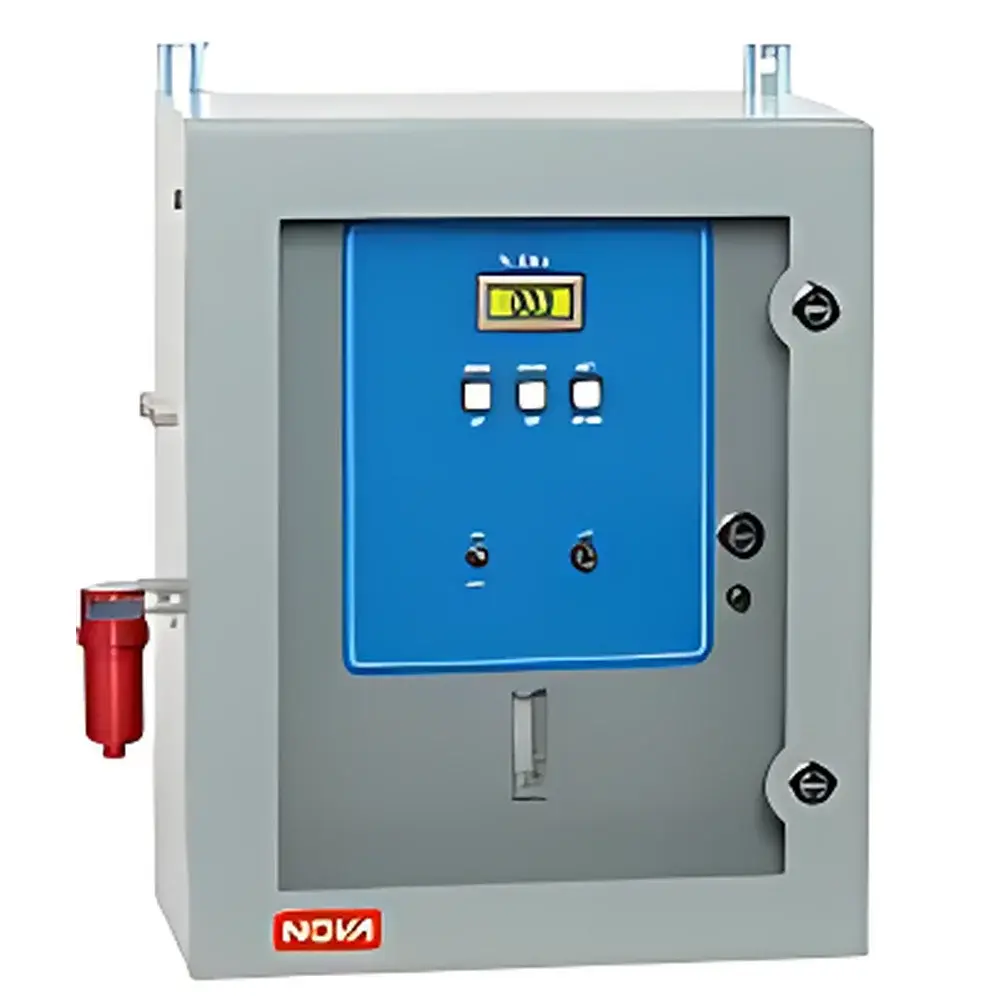
Nova 460 Series Continuous SO₂ Infrared Analyzer
| Brand | Nova |
|---|---|
| Origin | Canada |
| Model | 460 Series (460 / 460L / 461) |
| Detection Principle | Microprocessor-Controlled Single-Cell NDIR (460, 460L) / Electrochemical Sensor (461) |
| Measurement Range | 460: 0–1% to 0–100% SO₂ |
| 460L | 0–2000 ppm to 0–5000 ppm SO₂ |
| 461 | 0–200 ppm to 0–1000 ppm SO₂ |
| Resolution | 0.1% (percent range), 10 ppm (ppm range) |
| Accuracy & Repeatability | ±1% of full scale |
| Drift | ≤2% of full scale per month |
| Response Time (T₉₀) | <15 s |
| Operating Temperature | 5–50°C (standard), –20°C with optional cold-environment package |
| Linearity | ±1% of full scale |
| Output Options | 4–20 mA (500 Ω, non-isolated |
| Alarm Outputs | Dual SPDT relay contacts (5 A, 220 VAC), optional low-flow alarm |
| Power Supply | 115 VAC, 60 Hz (220 VAC, 50 Hz available) |
| Enclosure | NEMA 4X-rated housing (configurable) |
Overview
The Nova 460 Series Continuous SO₂ Infrared Analyzer is an industrial-grade, microprocessor-controlled gas monitoring system engineered for high-reliability, real-time sulfur dioxide (SO₂) quantification in continuous emission monitoring systems (CEMS), flue gas desulfurization (FGD) bypass streams, stack ducts, and ambient air quality networks. Utilizing non-dispersive infrared (NDIR) spectroscopy in the 460 and 460L variants—and electrochemical sensing in the low-range 461 model—the analyzer delivers stable, interference-resistant measurements across a broad dynamic range. The NDIR detection principle relies on selective absorption of infrared radiation at characteristic wavelengths (~7.3 µm) by SO₂ molecules, enabling non-invasive, maintenance-light operation without consumables or chemical reagents. All models integrate an internal sample pump, dual-stage particulate filtration (including heated pre-filter option for wet-stack applications), mass flow control, and temperature-stabilized optical cells to ensure measurement integrity under variable process conditions.
Key Features
- Microprocessor-based digital signal processing with auto-linearization algorithms, eliminating analog drift and enabling direct % or ppm readout on high-contrast LED display
- Modular architecture with field-replaceable sensor modules, optical cells, and filter assemblies—designed for minimal downtime during routine maintenance
- Thermally regulated detector and reference chambers maintain long-term baseline stability, critical for compliance-grade data continuity
- Integrated sample handling system: built-in diaphragm pump (flow rate adjustable 0.5–2.0 L/min), primary particulate filter (5 µm), secondary hydrophobic membrane filter, and precision laminar flow meter
- Rapid response kinetics: T₉₀ < 15 seconds from ambient to full-scale concentration, meeting EPA Method 6C and EN 14181 QAL1 requirements for CEMS validation
- Configurable output suite supporting both legacy and modern industrial protocols—including isolated/non-isolated 4–20 mA analog output (500 Ω load), RS232/RS485 serial interfaces, MODBUS RTU/TCP, and TCP/IP Ethernet connectivity
- Dual programmable alarm relays (SPDT, 5 A @ 220 VAC) for high/low concentration thresholds and optional low-flow fault detection
Sample Compatibility & Compliance
The 460 Series is validated for use with dry or moderately humid flue gases (dew point ≤ 5°C recommended; optional heated sampling line available). It exhibits minimal cross-sensitivity to CO₂, CO, NOₓ, H₂O vapor, and hydrocarbons within typical combustion exhaust matrices—verified per ISO 12039 and ASTM D6216. Units comply with electromagnetic compatibility standards IEC 61326-1 (industrial environment) and safety standard UL 61010-1. When deployed in regulated environments—including power generation, cement kilns, and municipal waste incinerators—the system supports audit-ready data logging and meets key regulatory frameworks: U.S. EPA 40 CFR Part 60 Appendix B (Performance Specification 2), EN 15267-3 (QAL1 certification path), and EU Industrial Emissions Directive (IED) reporting requirements. Optional firmware enables 21 CFR Part 11-compliant electronic records with user authentication, audit trail, and secure data export.
Software & Data Management
The embedded firmware provides local configuration via intuitive front-panel keypad navigation and password-protected calibration routines (zero/span using certified gas standards). Remote supervision is enabled through Nova’s optional PC-based Configuration & Diagnostics Software (v4.x), which supports real-time waveform viewing, historical trend analysis (up to 30 days onboard storage), calibration log export (CSV), and firmware updates via USB or Ethernet. For integration into SCADA or DCS platforms, the MODBUS TCP and Ethernet/IP drivers are pre-certified for Siemens Desigo CC, Honeywell Experion PKS, and Yokogawa CENTUM VP. All digital outputs include timestamped data packets with CRC error checking; analog outputs feature galvanic isolation (optional) to suppress ground-loop interference in electrically noisy plant environments.
Applications
- Continuous emission monitoring (CEMS) of SO₂ in coal-, oil-, and biomass-fired boiler stacks
- Process control feedback for wet limestone FGD scrubber systems
- Environmental compliance verification at municipal solid waste (MSW) incineration facilities
- Industrial hygiene monitoring in sulfuric acid production, pulp & paper bleaching, and metal smelting operations
- Ambient air quality stations requiring EPA-equivalent performance in urban or industrial boundary zones
- Calibration verification and span-check support for multi-gas analyzers in laboratory and field service settings
FAQ
What is the difference between the 460, 460L, and 461 models?
The 460 is optimized for percent-level SO₂ measurement (0–1% to 0–100%), typically used in high-concentration flue gas streams. The 460L extends NDIR sensitivity down to ppm-level ranges (0–2000 ppm to 0–5000 ppm) while retaining the same optical architecture. The 461 employs an electrochemical sensor for ultra-low-range applications (0–200 ppm to 0–1000 ppm), offering enhanced resolution where NDIR signal-to-noise limitations apply.
Does the analyzer require periodic calibration with certified gases?
Yes—zero and span calibration using NIST-traceable SO₂ standards is required per regulatory guidelines (e.g., EPA PS-2, EN 14181). The instrument supports automated zero calibration with synthetic air and manual or scheduled span adjustments via front-panel interface or remote software.
Can the 460 Series operate in sub-zero ambient conditions?
Standard units operate from +5°C to +50°C. With the optional cold-environment package—including heated enclosure, thermal insulation, and low-temperature-rated electronics—the analyzer maintains specified accuracy down to –20°C ambient.
Is the 4–20 mA output intrinsically safe?
The base 4–20 mA output is non-isolated and not intrinsically safe. However, an isolated 4–20 mA module (certified to ATEX II 3G Ex nA IIC T4 Ga and IECEx nA IIC T4 Ga) is available as a factory-installed option for Zone 2 hazardous locations.
How is data integrity ensured during power interruptions?
Onboard non-volatile memory retains configuration, calibration history, and up to 30 days of 1-minute averaged data. Upon power restoration, the unit resumes operation without manual reset and timestamps all recovered data points to preserve temporal continuity for regulatory reporting.







