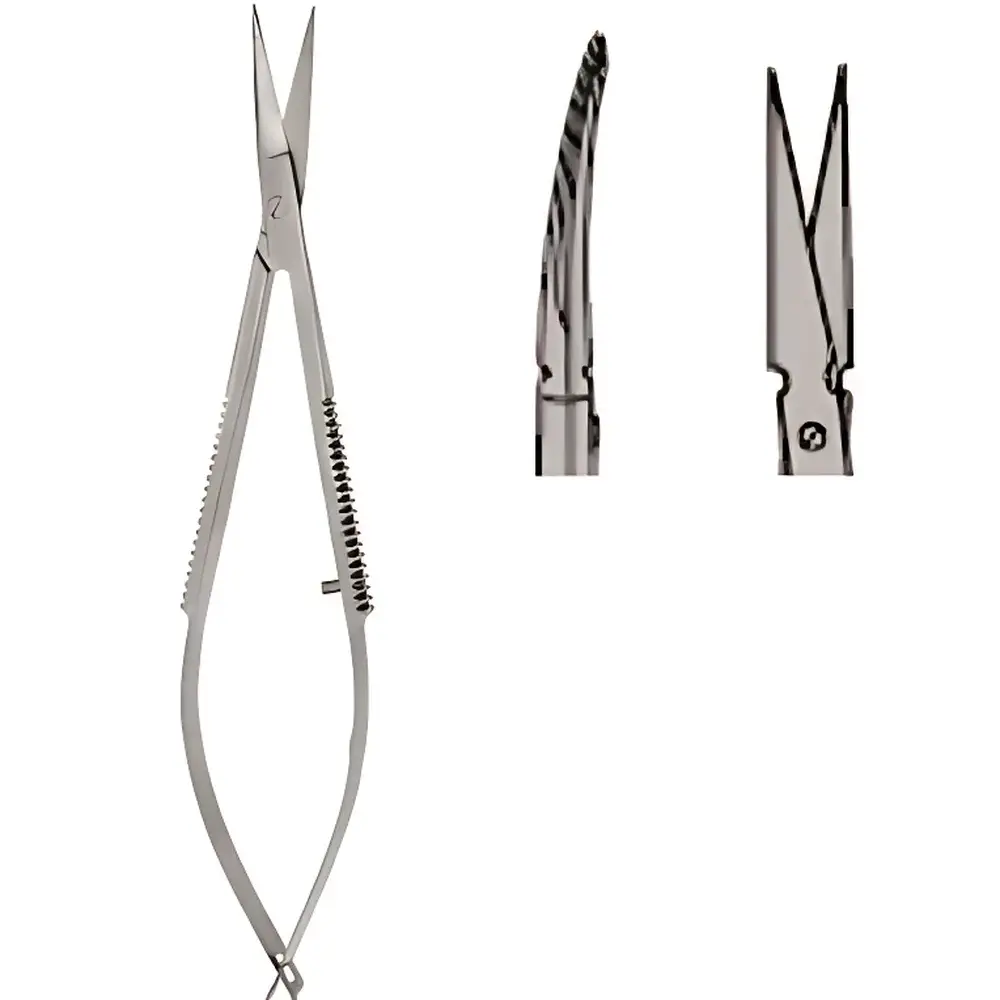
NOYES S11006-12 Straight/Tapered-Tip Spring-Handle Microscissors
| Brand | RWD |
|---|---|
| Origin | Shenzhen, China |
| Manufacturer Type | Direct Manufacturer |
| Origin Classification | Domestic (China) |
| Model | S11006-12 |
| Price | USD 60 (approx.) |
Overview
The NOYES S11006-12 Spring-Handle Microscissors are precision-engineered surgical and laboratory instruments designed for fine dissection, tissue manipulation, and microscale cutting tasks under stereomicroscopic or high-magnification visual guidance. Built on a classic spring-lever mechanism, these microscissors eliminate hand fatigue during prolonged use by returning the blades to an open position automatically after each cut—enabling rapid, controlled, and repeatable actuation with minimal finger movement. The instrument operates on mechanical leverage principles rather than electronic or powered actuation, ensuring reliability, sterility compatibility, and zero electromagnetic interference in sensitive environments such as electrophysiology rigs, cleanroom-based cell culture workflows, or laser-assisted microsurgery setups.
Key Features
- Spring-loaded handle design reduces operator fatigue and enhances procedural consistency during extended microdissection sessions.
- Two interchangeable tip configurations: straight/tapered (sharp) for precise incision of delicate membranes or nerve sheaths, and blunt-tipped variant (S11006-12B, sold separately) for non-traumatic tissue separation and vessel isolation.
- 12 cm total length optimized for ergonomic control under binocular microscopes and within laminar flow hoods—balancing reach, maneuverability, and tactile feedback.
- High-carbon stainless steel construction (AISI 420 equivalent) with mirror-finish blade surfaces ensures corrosion resistance, edge retention, and compatibility with standard autoclaving cycles (134°C, 2 bar, 18 min).
- Blade geometry engineered for minimal lateral force transmission—critical for preserving structural integrity of neural tissues, embryonic explants, or organotypic brain slices.
Sample Compatibility & Compliance
These microscissors are routinely employed in rodent and avian neuroanatomy, developmental biology, ophthalmic research, and in vitro electrophysiology preparations. They are compatible with all common biological sample types including fixed and live tissue sections, primary neuronal cultures, retinal explants, and vascular grafts. Instruments comply with ISO 7740-1:2015 (Surgical Instruments — Microsurgical Instruments — Part 1: General Requirements) and meet material biocompatibility requirements per ISO 10993-1 for short-term tissue contact. Sterilization validation documentation is provided per EN 556-1 for steam sterilization processes.
Software & Data Management
As a purely mechanical hand instrument, the S11006-12 requires no firmware, drivers, or software integration. Its operation is independent of digital systems—ensuring uninterrupted functionality in electromagnetically shielded environments (e.g., MRI-adjacent labs), Faraday cages, or ISO Class 5 cleanrooms where wireless or powered tools are prohibited. All calibration and performance verification are conducted manually per manufacturer’s torque and blade alignment specifications; no electronic audit trail is generated, though usage logs may be maintained manually in GLP-compliant lab notebooks or LIMS platforms for traceability.
Applications
- Microdissection of hippocampal subregions and cortical layers in acute brain slice preparations.
- Transection of dorsal root ganglion axons for regeneration assays.
- Cutting of vitelline membranes in avian embryo manipulation protocols (HH stage 10–18).
- Trimming of collagen gels and Matrigel™-embedded 3D organoids prior to imaging or transplantation.
- Delicate trimming of electrode leads and microwire arrays during chronic implant fabrication.
- Preparation of explant cultures from zebrafish lateral line neuromasts and Xenopus laevis tadpole skin.
FAQ
Are these microscissors suitable for sterile surgical procedures in vivo?
Yes—they are autoclavable and manufactured to ISO 7740-1 standards; however, terminal sterilization must follow validated cycle parameters and post-sterilization inspection for blade integrity is recommended.
What is the recommended maintenance protocol between uses?
Rinse immediately with deionized water after tissue contact, followed by ultrasonic cleaning in enzymatic detergent (e.g., Enzol®), air-drying, and light application of medical-grade mineral oil to hinge points.
Can the spring tension be adjusted or replaced?
No—the integrated torsion spring is permanently calibrated during assembly and not user-serviceable; replacement is only available through RWD’s authorized service channel.
Is there a CE mark or FDA listing for this model?
The S11006-12 carries CE marking under EU MDR 2017/745 as a Class I non-sterile, non-measuring surgical instrument; it is not FDA-cleared, as it falls outside the scope of US regulatory classification for general laboratory tools.
Do you offer custom tip geometries or OEM branding?
RWD provides limited customization—including specialized tip angles, laser-etched identifiers, and private-label packaging—for institutional procurement contracts meeting minimum order thresholds.