
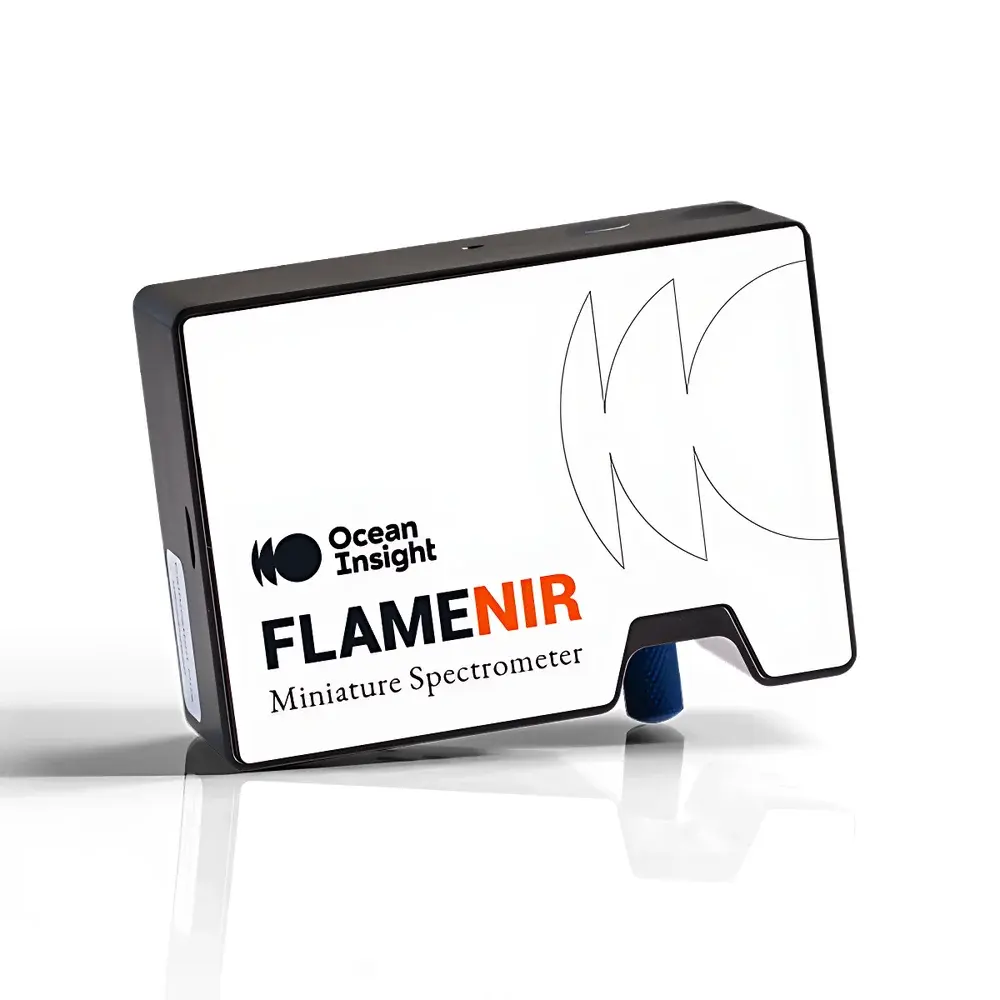
Ocean Optics FLAME-NIR Portable Near-Infrared Spectrometer
| Brand | Ocean Optics |
|---|---|
| Model | FLAME-NIR |
| Type | Portable NIR Spectrometer |
| Principle | Fiber-coupled, non-cooled InGaAs-based dispersive spectroscopy |
| Wavelength Range | 950–1650 nm |
| Optical Resolution | ~10 nm FWHM (configuration-dependent) |
| Scan Rate | 400 spectra/sec |
| Integration Time | 1 ms – 65 s |
| Sampling Interval | 1 ms – 65 s |
| Measurement Mode | Transmission |
| Detector | Uncooled 128-pixel InGaAs linear array (900–1700 nm response) |
| SNR | 6000:1 (full signal) |
| Dynamic Range | 6000:1 |
| Dimensions | 89.1 × 63.3 × 34.4 mm (incl. feet) |
| Weight | 265 g |
| Interface | Micro-USB (plug-and-play) |
| Software Compatibility | OceanView, OceanInsight NIR Chemometrics Suite |
| Compliance | CE, RoHS, FCC Class B |
| Modularity | Interchangeable slits, fiber-optic coupling, OEM-ready architecture |
Overview
The Ocean Optics FLAME-NIR is a compact, fiber-coupled portable near-infrared spectrometer engineered for high-stability field and process applications requiring robust spectral acquisition in the 950–1650 nm range. Unlike thermoelectrically cooled NIR systems, the FLAME-NIR employs an uncooled 128-pixel InGaAs linear detector array—enabling ultra-low power consumption (<1.5 W typical), rapid thermal stabilization, and immunity to condensation-related drift in variable ambient environments. Its optical design follows Czerny-Turner configuration with optimized grating dispersion and fixed focal-length optics, delivering consistent ~10 nm FWHM resolution across the full spectral window. The instrument operates on standard USB 2.0 bus power, eliminating external power supplies and supporting true plug-and-play integration into handheld analyzers, inline monitoring stations, or mobile laboratory platforms.
Key Features
- Ultra-compact form factor: Dimensions of 89.1 × 63.3 × 34.4 mm and mass of only 265 g enable seamless integration into space-constrained or battery-powered systems.
- Uncooled InGaAs detection: Eliminates TEC-related power draw, thermal cycling stress, and failure modes—ideal for continuous-duty industrial deployment and GLP-compliant field use.
- High-speed acquisition: Capable of acquiring up to 400 full-spectrum scans per second at 1 ms integration time, supporting real-time process monitoring and dynamic sample analysis.
- Modular optical configuration: User-replaceable entrance slits (10–200 µm options) allow empirical optimization of resolution vs. throughput trade-offs without recalibration.
- OEM-ready interface: Micro-USB connection provides both power and bidirectional communication; supported by OceanInsight’s SDKs (C++, Python, LabVIEW) for embedded control and custom GUI development.
- Stable photometric performance: <60 ppm/°C wavelength shift and <0.05% RMS intensity drift over 8-hour operation under ambient temperature fluctuations (20–30 °C).
Sample Compatibility & Compliance
The FLAME-NIR is designed for transmission-mode measurements using standard SMA 905 fiber optic cables (e.g., 200 µm or 400 µm core diameters). It interfaces natively with Ocean Insight’s portfolio of broadband NIR light sources—including tungsten-halogen and quartz-tungsten-halogen lamps—and accessories such as integrating spheres, flow cells, and cuvette holders. All optical path components comply with ISO 17025 traceable calibration protocols. The device meets CE marking requirements for electromagnetic compatibility (EN 61326-1) and safety (EN 61010-1), and conforms to RoHS Directive 2011/65/EU and FCC Part 15 Class B emission limits. For regulated environments, raw spectral data export supports 21 CFR Part 11-compliant audit trails when used with validated versions of OceanView software.
Software & Data Management
Data acquisition and preprocessing are supported through OceanInsight’s cross-platform OceanView application, which includes real-time spectral visualization, dark/bias correction, smoothing, baseline subtraction, and peak identification tools. For quantitative analysis, the integrated NIR Chemometrics Suite enables partial least squares (PLS) regression, principal component analysis (PCA), and support vector machine (SVM) modeling—fully compatible with ASTM E1655 and ISO 12099 reference methodologies. Spectral libraries may be exported in ASTM E131-compliant JCAMP-DX format. All firmware updates and spectral metadata (integration time, slit width, calibration coefficients) are embedded within .spc and .csv file headers, ensuring full experimental traceability per GLP/GMP documentation standards.
Applications
- Moisture content quantification in granular agricultural products (grains, seeds, feed pellets) via O–H overtone absorption bands near 1450 nm and 1940 nm.
- In-line quality assurance of edible oils and fats using C–H combination bands (1680–1760 nm) to assess iodine value, free fatty acid concentration, and oxidation state.
- Pharmaceutical blend uniformity testing—non-destructive verification of API distribution in tablet formulations using multivariate calibration models trained on reference NIR spectra.
- Real-time monitoring of polymer melt composition during extrusion processes via CH2/CH3 band ratios in the 1150–1250 nm region.
- Field-deployable soil organic carbon estimation leveraging spectral features between 1000–1300 nm correlated with humic substance absorbance.
FAQ
Is the FLAME-NIR suitable for quantitative analysis in regulated laboratories?
Yes—when operated with validated OceanView software configurations and calibrated against NIST-traceable standards, it meets analytical requirements for method validation per USP <1119> and ICH Q2(R2) guidelines.
Can I change the spectral resolution after purchase?
Yes—by swapping the entrance slit with factory-calibrated alternatives (10 µm, 25 µm, 50 µm, or 200 µm), users can adjust resolution and sensitivity without altering optical alignment or requiring recalibration.
Does the detector require periodic recalibration?
No—Ocean Insight provides factory-applied wavelength and intensity calibrations stored in onboard memory; however, annual verification using certified tungsten-halogen and deuterium reference sources is recommended for ISO/IEC 17025 compliance.
What is the maximum allowable fiber core diameter?
The input port accepts SMA 905 connectors with fiber cores up to 600 µm; optimal coupling efficiency is achieved with ≤400 µm fibers to maintain spatial resolution and minimize modal noise.
Is there a built-in shutter or mechanical dark reference?
No—the FLAME-NIR relies on electronic dark measurement (zero-integration-time readout) and user-acquired dark spectra; external motorized shutters or filter wheels may be integrated via TTL trigger signals.






