
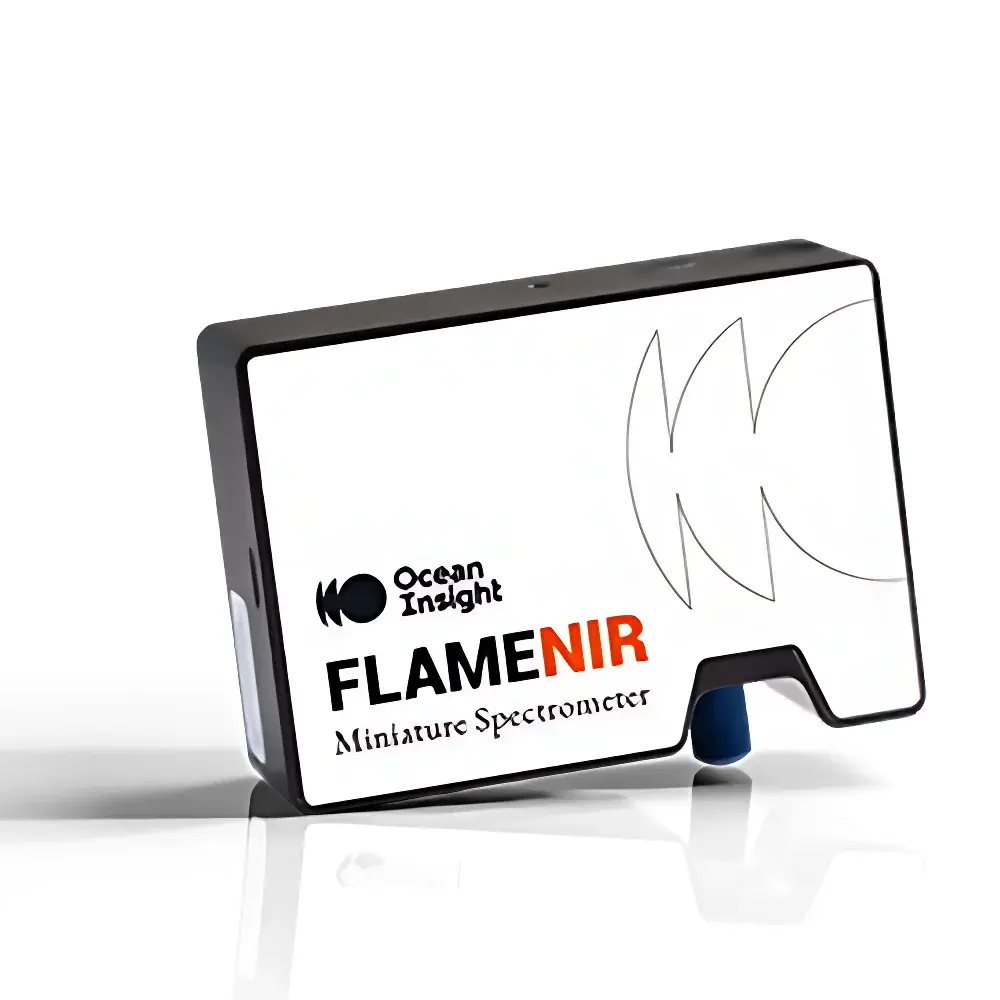
Ocean Optics Flame-NIR+ Portable Near-Infrared Spectrometer
| Brand | Ocean Optics |
|---|---|
| Model | Flame-NIR+ |
| Type | Portable NIR Spectrometer |
| Principle | Grating-based Scanning Spectrometer |
| Wavelength Range | 970–1700 nm |
| Optical Resolution | ~10 nm FWHM (25 µm slit) |
| Signal-to-Noise Ratio | 6000:1 (full signal) |
| Dynamic Range | 6000:1 (single acquisition) |
| Thermal Drift | 0.08 nm/°C |
| Scan Rate | ~400 Hz |
| Integration Time | 1 ms to 45 s |
| Detector | Uncooled InGaAs linear array (128 pixels) |
| Dimensions | 89.1 × 63.3 × 31.9 mm (34.4 mm including feet) |
| Weight | 265 g |
| Interface | Micro-USB |
| Origin | Shanghai, China |
| Manufacturer | Ocean Optics (Shanghai) |
Overview
The Ocean Optics Flame-NIR+ is a compact, field-deployable near-infrared (NIR) spectrometer engineered for high-fidelity spectral acquisition in resource-constrained or mobile laboratory environments. Based on a fixed-grating scanning optical architecture, it employs an uncooled InGaAs linear photodiode array (128 pixels) to deliver stable, repeatable measurements across the 970–1700 nm spectral window—a range critical for quantifying overtone and combination bands of C–H, O–H, and N–H functional groups. Its thermally stabilized optical bench minimizes wavelength drift (<0.08 nm/°C), ensuring long-term measurement integrity without active cooling—reducing power demand and mechanical complexity. Designed for integration into automated QA/QC workflows or handheld analytical platforms, the Flame-NIR+ meets the practical requirements of process monitoring, raw material verification, and at-line compositional analysis in regulated industrial settings.
Key Features
- Compact & rugged form factor: Dimensions of 89.1 × 63.3 × 31.9 mm and mass of only 265 g enable seamless integration into portable probes, robotic arms, or benchtop analyzers with space constraints.
- High thermal stability: Passive thermal management yields <0.08 nm/°C wavelength shift, supporting multi-hour uninterrupted operation without recalibration—critical for GLP-compliant routine testing.
- Optimized sensitivity and dynamic range: 6000:1 signal-to-noise ratio (full signal) and equivalent dynamic range (single acquisition) allow detection of low-absorbance features in dilute or highly scattering samples, such as pharmaceutical tablets or grain kernels.
- Flexible integration interface: Micro-USB connectivity supports plug-and-play operation with Windows, Linux, and macOS hosts; compatible with Ocean Insight’s OceanView SDK and third-party LabVIEW, Python, and MATLAB drivers.
- Modular optical configuration: Interchangeable slits (25 µm standard) permit resolution–throughput trade-off tuning; accepts fiber-coupled illumination sources (e.g., tungsten-halogen or pulsed LEDs) and sampling accessories (reflectance probes, integrating spheres, transmission cells).
- Low-power operation: Typical power draw 4 hours using external USB power banks—ideal for field-based agricultural screening or warehouse inventory verification.
Sample Compatibility & Compliance
The Flame-NIR+ supports reflectance, transmittance, and diffuse reflectance configurations via standardized SMA 905 fiber-optic interfaces. It is routinely deployed in compliance with ASTM E1655 (standard practices for NIR quantitative analysis), ISO 12099 (animal feeding stuffs), and USP <1119> (NIR spectroscopy for pharmaceuticals). While the instrument itself does not embed regulatory-grade audit trails, its raw data output (ASCII .csv or binary .jdx formats) is fully compatible with validated chemometric software platforms (e.g., Unscrambler X, Pirouette, or custom PLS regression models) operating under 21 CFR Part 11–compliant environments when hosted on validated systems. The device bears CE marking and conforms to IEC 61326-1 (electromagnetic compatibility for laboratory equipment).
Software & Data Management
Ocean Insight provides the cross-platform OceanView spectroscopy software suite, which supports real-time spectral visualization, dark/baseline correction, peak identification, and export of calibrated intensity values. For advanced modeling, users export time-stamped spectral datasets (with metadata including integration time, scan count, and temperature sensor readings) to external chemometric tools. The SDK includes full API documentation for C/C++, C#, Python (via PyOcean), and LabVIEW, enabling custom GUI development and integration into SCADA or MES systems. All firmware updates are delivered via signed binaries with SHA-256 checksum validation—supporting traceable version control required in GMP environments.
Applications
- Pharmaceutical manufacturing: Rapid identity testing of excipients and APIs; blend uniformity assessment of powder mixtures; non-destructive tablet coating thickness evaluation.
- Food & agriculture: Moisture, protein, and fat content prediction in cereals, dairy powders, and meat products; authenticity screening of olive oil or honey; harvest maturity grading of fruits via soluble solids index (SSI).
- Chemical & polymer QC: Monitoring of polyethylene glycol (PEG) molecular weight distribution; detection of residual solvents in polymer films; catalyst activity tracking in batch reactors.
- Environmental field analysis: Soil organic carbon estimation; hydrocarbon contamination screening in sediments; microplastic identification in water filtration studies.
FAQ
Is the Flame-NIR+ suitable for Good Manufacturing Practice (GMP) environments?
Yes—when deployed with validated chemometric methods, documented calibration procedures, and integrated into a Part 11–compliant data system, it fulfills instrumentation requirements for routine release testing per ICH Q2(R2).
Can the spectral resolution be adjusted?
Resolution is primarily determined by the installed slit width (25 µm standard); optional 10 µm or 50 µm slits may be installed to prioritize resolution or throughput, respectively—requiring optical recalibration.
Does the device include built-in chemometric modeling capabilities?
No—the Flame-NIR+ is a spectral acquisition engine only. Chemometric modeling must be performed externally using validated software packages compliant with your organization’s data governance policy.
What is the recommended calibration frequency for routine use?
We recommend wavelength calibration using a NIST-traceable holmium oxide or rare-earth emission source every 30 days under continuous operation, or prior to each analytical campaign requiring quantitative accuracy.
Is temperature compensation applied in real time during acquisition?
The onboard thermistor records detector housing temperature for post-acquisition correction; however, no real-time hardware-based wavelength adjustment is implemented—drift mitigation relies on stable thermal design and periodic reference checks.
Related Products



