
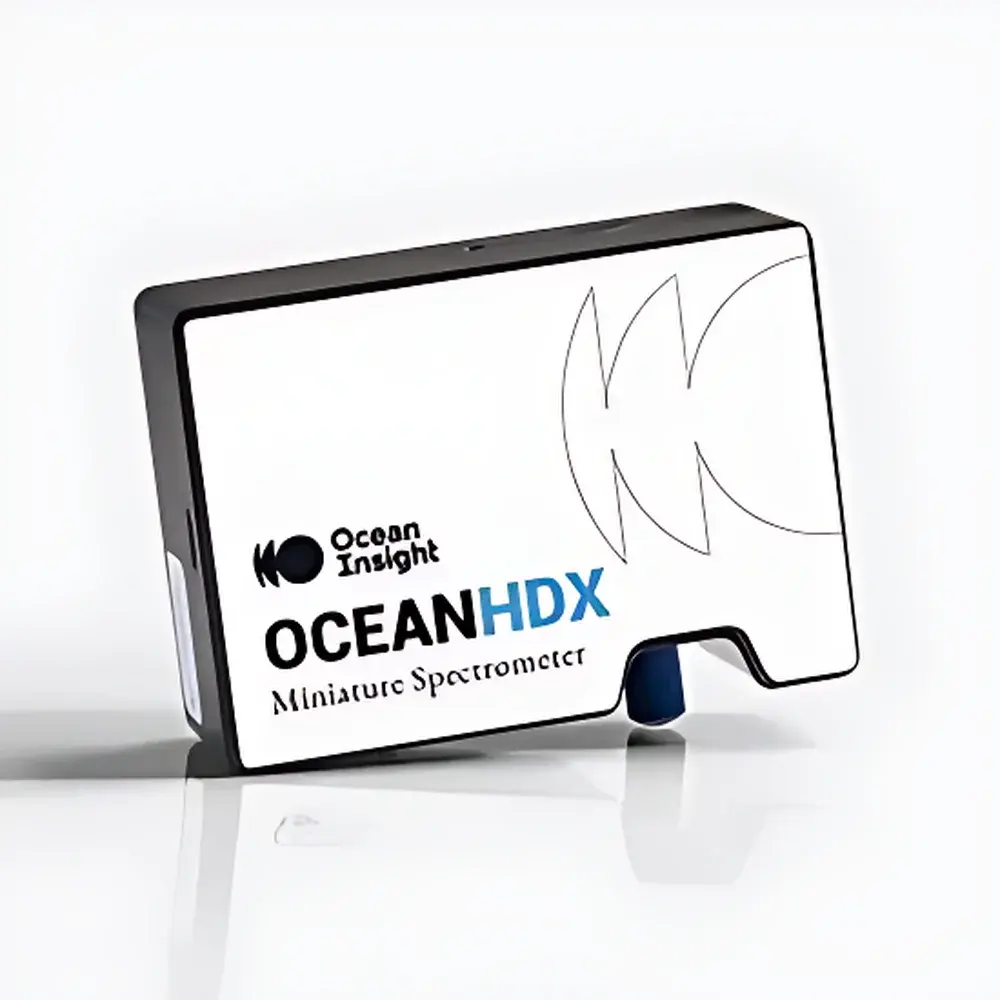
Ocean Optics HDX Fiber Optic Spectrometer
| Brand | Ocean Optics |
|---|---|
| Origin | Imported |
| Manufacturer Type | Manufacturer |
| Model | HDX |
| Spectral Range | 200–925 nm |
| Detector | Back-Illuminated CCD |
| Resolution | 0.61–0.72 nm FWHM (with 10 µm slit) |
| Signal-to-Noise Ratio | 400:1 |
| Dynamic Range | 12,000:1 |
| Stray Light | < 0.1% (typical, 3 AU at 600 nm) |
| A/D Conversion | 16-bit |
| Integration Time | 6 ms – 10 s |
| Thermal Stability | ±1 pixel over 0–40 °C |
| F-number | f/4 |
| Onboard Memory | Up to 50,000 spectra |
| I/O | 8 user-programmable digital I/O lines |
| Communication Interfaces | USB 2.0, Gigabit Ethernet, Wi-Fi (802.11 b/g/n), SPI, RS-232 |
| Operating Temperature | 0–40 °C |
| Dimensions | 88.9 × 63.5 × 52.4 mm |
| Weight | 400 g |
Overview
The Ocean Optics HDX Fiber Optic Spectrometer is a high-performance, compact benchtop spectrometer engineered for precision spectral measurement across demanding industrial, OEM integration, and research environments. Based on a Czerny-Turner optical architecture with a back-illuminated, deep-depletion CCD detector, the HDX delivers exceptional sensitivity from the deep ultraviolet (200 nm) through the visible into the near-infrared (925 nm). Its low-stray-light design—achieving 3 AU attenuation at 600 nm)—ensures high-fidelity quantification in applications where spectral purity is critical, such as fluorescence background suppression, Raman edge rejection, or colorimetric analysis of highly absorbing samples. The instrument’s thermal stability of ±1 pixel over 0–40 °C eliminates the need for frequent wavelength recalibration in uncontrolled ambient conditions, while its f/4 optical speed enables efficient light collection from fiber-coupled sources, LEDs, or plasma emissions.
Key Features
- Back-illuminated, deep-depletion CCD detector optimized for quantum efficiency >90% in UV–Vis and >60% at 900 nm
- Low-stray-light optical bench with optimized grating coating and baffling to minimize out-of-band signal contamination
- Onboard X-electronics platform featuring real-time processing, embedded firmware, and multi-interface connectivity (USB 2.0, Gigabit Ethernet, Wi-Fi 802.11 b/g/n, SPI, RS-232)
- Integrated 16-bit analog-to-digital conversion with 12,000:1 dynamic range and 400:1 signal-to-noise ratio (at full well)
- Programmable 8-channel digital I/O for hardware triggering, synchronization with external devices (e.g., lasers, shutters, stages), and TTL-level control
- On-device storage supporting up to 50,000 full-resolution spectra—enabling autonomous operation in embedded or remote deployments
- Compact form factor (88.9 × 63.5 × 52.4 mm, 400 g) with robust aluminum housing rated for continuous operation in industrial settings
Sample Compatibility & Compliance
The HDX is designed for fiber-optic coupling via standard SMA 905 connectors, supporting multimode fibers (e.g., 200 µm, 400 µm, or 600 µm core diameters) and optional slit-based input configurations. It complies with CE, FCC Part 15 Class B, and RoHS directives. While not certified for intrinsic safety or explosion-proof use, its low-power electronics (typ. 3.5 W) and passive thermal management make it suitable for cleanroom-adjacent installations and GLP-compliant laboratories. Data acquisition workflows can be configured to meet audit-trail requirements under FDA 21 CFR Part 11 when used with Ocean Insight’s OceanView software in validated environments. The spectrometer supports calibration traceability to NIST-traceable standards via factory-provided radiometric and wavelength calibration certificates.
Software & Data Management
Ocean Insight provides comprehensive software support including OceanView (Windows/macOS), OceanDirect SDK (C/C++, Python, MATLAB, LabVIEW, .NET), and cloud-ready APIs for integration into Industry 4.0 architectures. OceanView enables real-time spectral visualization, multichannel averaging, dark/baseline correction, peak identification, and export in CSV, ASCII, or HDF5 formats. The HDX’s onboard processing allows for user-defined spectral math (e.g., absorbance calculation, ratioing, smoothing) prior to data transfer—reducing host computational load and latency in high-throughput systems. Firmware updates are delivered over-the-air via Ethernet or Wi-Fi, ensuring long-term maintainability without physical access.
Applications
- Real-time process monitoring in pharmaceutical manufacturing (e.g., dissolution testing, blend uniformity, API concentration)
- OEM integration into handheld analyzers, environmental sensors (e.g., water quality UV-Vis nitrate/nitrite detection), and laser-induced breakdown spectroscopy (LIBS) systems
- Academic and industrial research in photoluminescence quantum yield (PLQY), LED spectral power distribution (SPD), and thin-film interference characterization
- Quality assurance in display manufacturing (OLED, microLED) requiring precise CIE chromaticity and CCT validation
- In-line color measurement for paint, textile, and plastic production using reflectance or transmittance geometries
FAQ
What spectral calibration options are available for the HDX?
Factory-installed wavelength and radiometric calibrations are provided with NIST-traceable documentation. Optional recalibration services—including irradiance, absorbance, and fluorescence intensity calibration—are available through Ocean Insight’s ISO/IEC 17025-accredited metrology lab.
Can the HDX operate autonomously without a connected PC?
Yes—the onboard memory and programmable I/O enable standalone logging triggered by external TTL signals or internal timers, with spectra retrievable later via Ethernet or Wi-Fi.
Is the HDX compatible with third-party optical accessories such as integrating spheres or cuvette holders?
Yes—standard SMA 905 fiber inputs ensure compatibility with Ocean Insight’s full suite of sampling optics, as well as third-party accessories meeting SMA 905 mechanical and numerical aperture specifications.
How is thermal drift managed during extended measurements?
The HDX employs thermally compensated optical alignment and a temperature-stabilized detector housing; combined with ±1 pixel wavelength stability over 0–40 °C, it minimizes recalibration frequency in typical lab or factory-floor conditions.





