
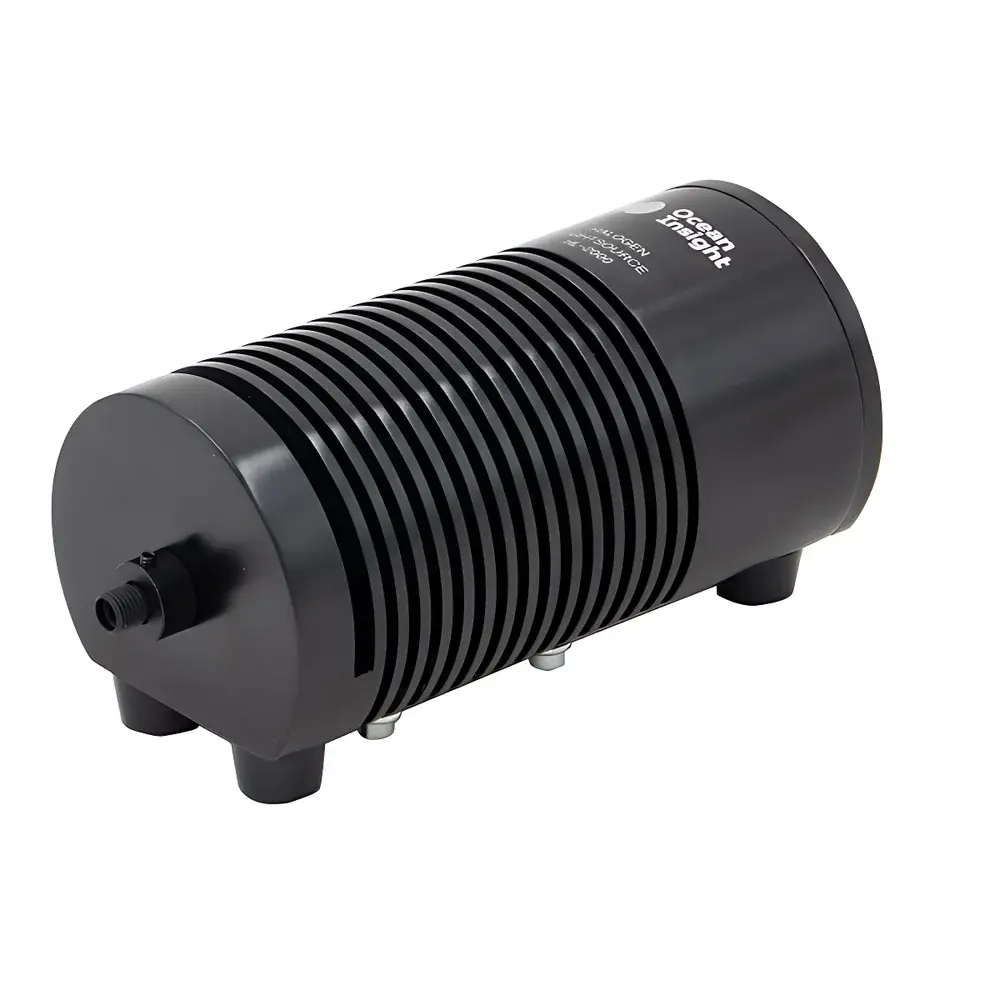
Ocean Optics HL-2000-CAL NIST-Traceable Radiometric Calibration Source
| Brand | Ocean Optics |
|---|---|
| Origin | Imported |
| Manufacturer | Ocean Optics |
| Model | HL-2000-CAL |
| Light Source Type | Tungsten-Halogen (Calibrated) |
| Illumination Mode | External Illumination |
| Spectral Range (Calibrated) | 300–1050 nm |
| Output Intensity Unit | µW/cm²/nm |
| Power Supply | 12 VDC, 600 mA |
| Lamp Power | 6.5 W |
| Lamp Lifetime | 900 h |
| Recommended Recalibration Interval | Every 50 h of operation |
| Color Temperature | 3100 K |
| Voltage Stability | ±0.2% |
| Warm-up Time to Stability | ~30 min |
| Fiber Connector | SMA905 |
| Cosine Adapter Interface | 6.35-mm barrel |
| Integrating Sphere Interface | PTFE plug |
| Certifications | NIST-traceable calibration certificate provided (paper + digital) |
Overview
The Ocean Optics HL-2000-CAL is a precision-engineered, NIST-traceable radiometric calibration source designed for absolute spectral irradiance and radiance validation in laboratory and field-deployable optical measurement systems. Based on a stabilized tungsten-halogen lamp architecture, it operates under tightly controlled thermal and electrical conditions to deliver high reproducibility across its calibrated spectral range of 300–1050 nm. Unlike generic broadband sources, the HL-2000-CAL undergoes rigorous factory calibration against primary standards maintained by the National Institute of Standards and Technology (NIST), with traceability documented per ISO/IEC 17025 requirements. Its output is characterized as absolute spectral irradiance — expressed in µW/cm²/nm — enabling quantitative validation of spectroradiometers, fiber-coupled UV-Vis-NIR spectrometers, and optical sensor systems used in environmental monitoring, remote sensing validation, display metrology, and photobiological safety testing.
Key Features
- NIST-traceable absolute spectral irradiance calibration across 300–1050 nm, with uncertainty budgets fully documented in the included certificate.
- Stabilized tungsten-halogen lamp with 3100 K correlated color temperature, optimized for broad continuum emission and minimal spectral discontinuities.
- Dual-output interface architecture: SMA905 port for direct fiber coupling, 6.35-mm barrel mount for CC-3-UV cosine correctors, and PTFE-tipped connector for ISP-50-8-I integrating spheres.
- Integrated 12 VDC regulated power supply ensures voltage stability within ±0.2%, minimizing drift during warm-up and extended operation.
- Thermally managed housing with active stabilization enables spectral output repeatability better than 0.5% over 30-minute equilibration period.
- Supplied with both printed and digital calibration data (CSV and XML formats), compatible with Ocean Insight’s OOIIrrad-C and SpectraSuite software platforms.
- Designed specifically for end-to-end system-level calibration — including bare fiber inputs, cosine-corrected detector configurations, and integrating sphere-based collection geometries.
Sample Compatibility & Compliance
The HL-2000-CAL supports calibration of diverse optical detection configurations without modification. It is routinely deployed in accordance with ASTM E275, ISO 17025, and CIE S 025/E:2015 standards for spectral irradiance measurement. When paired with the CC-3-UV cosine corrector, it satisfies angular response requirements for hemispherical irradiance measurements per IEC 62471. For integrating sphere applications using the ISP-50-8-I, the HL-2000-CAL-ISP variant provides spatially uniform illumination with known exitance, enabling absolute responsivity calibration of sphere-coupled spectrometers. All calibration certificates include full uncertainty analysis, reference standard identification, environmental conditions at time of calibration, and compliance statements suitable for GLP/GMP audits and FDA 21 CFR Part 11–aligned documentation workflows.
Software & Data Management
Calibration data from the HL-2000-CAL is delivered in machine-readable formats (CSV, XML) and natively supported by Ocean Insight’s OOIIrrad-C radiometric analysis suite and SpectraSuite spectral acquisition platform. OOIIrrad-C implements ISO 17025–compliant data handling protocols, including audit-trail logging, user authentication, and electronic signature capability for 21 CFR Part 11 compliance. SpectraSuite allows direct import of HL-2000-CAL spectral intensity files for real-time instrument response correction, dark-current subtraction, and spectral flux normalization. Both applications support batch processing of multi-point calibration datasets and export of corrected spectra in standardized formats (e.g., JIS Z 8401, ASTM E1331). No proprietary drivers or dongles are required; all interfaces operate over standard USB 2.0 HID protocols.
Applications
- Validation and recalibration of UV-Vis-NIR spectroradiometers used in solar simulator characterization and photovoltaic QE testing.
- Absolute irradiance calibration of handheld and benchtop field spectrometers employed in atmospheric science and water quality monitoring (e.g., Secchi disk replacement protocols).
- System-level verification of optical sensors in medical device development, including LED-based phototherapy emitters and dermatological light dosimeters.
- Reference source for inter-laboratory comparison studies coordinated under ILAC MRA frameworks.
- Traceable intensity transfer between primary standards laboratories and end-user instrumentation in national metrology institutes and accredited test labs.
- Supporting ISO/IEC 17025 accreditation for optical testing laboratories performing spectral radiance, irradiance, and luminous flux measurements.
FAQ
Is the HL-2000-CAL suitable for calibrating CCD or CMOS array spectrometers?
Yes — its absolute spectral irradiance output enables pixel-level responsivity mapping when coupled via fiber or cosine corrector. Requires proper slit-width matching and dark-signal characterization for optimal results.
What is the recommended recalibration schedule?
Ocean Insight recommends recalibration after every 50 hours of cumulative lamp operation, or annually — whichever occurs first — to maintain NIST-traceable uncertainty performance.
Can the HL-2000-CAL be used with third-party spectrometers?
Yes. Its calibration data is provided in vendor-neutral CSV/XML formats and can be imported into most commercial spectroscopy platforms supporting user-defined reference spectra.
Does the HL-2000-CAL-ISP variant require separate calibration when used with an integrating sphere?
No — the HL-2000-CAL-ISP is pre-calibrated as a complete system (lamp + ISP-50-8-I), delivering absolute spectral radiance values at the sphere exit port.
Is the power supply included with the HL-2000-CAL?
Yes — a 12 VDC regulated power supply is supplied with each unit, ensuring stable lamp operation without external regulation hardware.




