
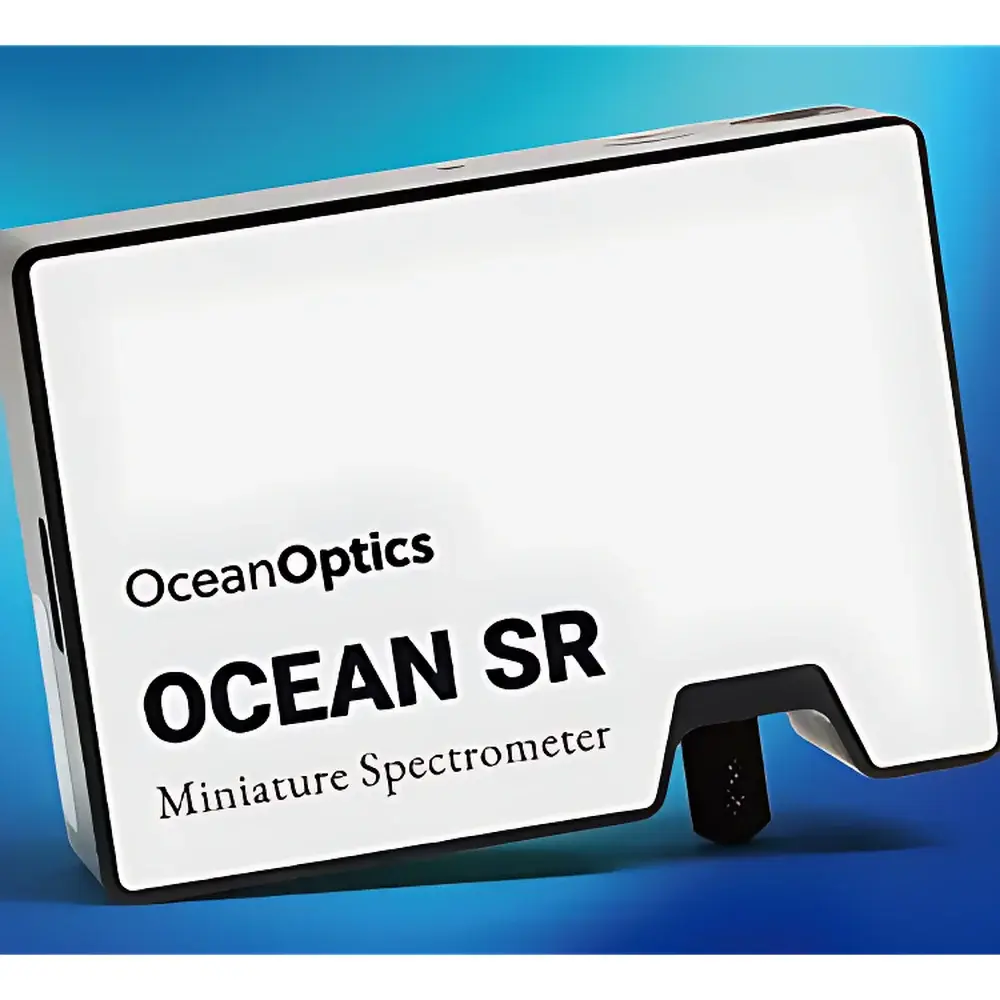
Ocean Optics Ocean SR4 Fiber Optic Spectrometer
| Brand | Ocean Optics |
|---|---|
| Origin | USA |
| Manufacturer Type | Original Equipment Manufacturer (OEM) |
| Import Status | Imported |
| Model | Ocean SR4 |
| Detector Type | 3648-pixel CCD linear array |
| Spectral Range | 190–1100 nm (configurable) |
| Optical Resolution (25 µm slit) | 1.36–1.65 nm (FWHM) |
| Signal-to-Noise Ratio | 3000:1 (per second, High-Speed Averaging Mode) |
| Dynamic Range | 1370:1 (single scan) |
| Integration Time | 3.8 ms – 10 s |
| Stray Light | < 2.3 AU |
| Thermal Wavelength Stability | 0.05 pixels/°C |
| Scan Rate | 74 spectra/s |
| ADC | 16-bit |
| Trigger Modes | External TTL, Software, Hardware Synchronization |
| Interface | USB 3.2 Gen 1 (Type-B connector, TFM-108-02-L-DH compliant) |
| Dimensions | 88.1 × 63.5 × 31.4 mm |
| Weight | 254 g |
Overview
The Ocean Optics Ocean SR4 Fiber Optic Spectrometer is a high-resolution, thermally stable spectrometer engineered for precision spectral acquisition across the ultraviolet, visible, and near-infrared (UV-VIS-NIR) spectrum (190–1100 nm). Based on Czerny-Turner optical architecture with a fixed grating and optimized collimating/focusing optics, the SR4 delivers consistent wavelength calibration and minimal thermal drift—critical for long-duration measurements in uncontrolled environments. Its core detector is a 3648-pixel linear CCD array with back-thinned silicon technology, enabling high quantum efficiency across the full spectral range and low read noise performance. Designed for both laboratory-grade characterization and industrial process monitoring, the SR4 integrates robust mechanical construction, low-stray-light optical design (<2.3 AU), and real-time thermal compensation to maintain wavelength fidelity within ±0.05 pixels/°C. This stability ensures reproducible peak identification and quantitative absorbance/transmission measurements without frequent recalibration.
Key Features
- High optical resolution of 1.36–1.65 nm FWHM (with 25 µm input slit), configurable via interchangeable slits (5–200 µm) and grating options
- 3000:1 signal-to-noise ratio per second in High-Speed Averaging Mode (HSAM), a hardware-accelerated averaging technique that improves SNR without increasing integration time
- 1370:1 dynamic range in single-scan mode, supporting simultaneous detection of weak and strong spectral features
- USB 3.2 Gen 1 interface (Type-B) with TFM-108-02-L-DH compliance for deterministic latency and robust electromagnetic compatibility in industrial settings
- Real-time thermal stabilization system minimizing wavelength shift under ambient temperature fluctuations
- Support for multiple hardware-triggered acquisition modes—including external TTL pulse synchronization, gated integration, and programmable delay—enabling precise temporal alignment with pulsed light sources or process events
- Compact form factor (88.1 × 63.5 × 31.4 mm; 254 g) suitable for embedded OEM integration, portable field instruments, and space-constrained benchtop setups
Sample Compatibility & Compliance
The Ocean SR4 interfaces seamlessly with Ocean Insight’s portfolio of fiber-coupled light sources (e.g., deuterium-halogen, LED, and pulsed xenon), cuvette holders, integrating spheres, and reflection probes—enabling flexible measurement geometries including transmission, absorbance, reflectance, fluorescence, and emission spectroscopy. It complies with IEC 61326-1:2013 for electromagnetic immunity and safety in laboratory and industrial environments. While not certified as a medical device, its data integrity framework supports GLP/GMP-aligned workflows when paired with validated software configurations. The instrument meets key spectral metrology requirements outlined in ASTM E308 (computing color from spectral data), ISO 17025 (for accredited testing laboratories), and USP (spectrophotometric analysis), provided calibration traceability is maintained using NIST-traceable standards.
Software & Data Management
The SR4 is fully supported by OceanView spectroscopy software (v3.x+), offering intuitive spectral visualization, real-time baseline correction, peak identification, and multivariate analysis tools. For automated and integrated systems, OceanDirect SDK—a cross-platform, C/C++, Python, MATLAB, and LabVIEW-compatible API—is included. OceanDirect provides low-level access to all instrument registers, enabling custom timing control, asynchronous acquisition, metadata tagging, and direct memory-mapped data streaming. All firmware and driver updates are digitally signed and distributed through Ocean Insight’s secure repository. Audit trails, user-access controls, and electronic signatures can be implemented at the application layer to satisfy FDA 21 CFR Part 11 requirements for regulated environments, contingent upon site-specific validation protocols.
Applications
- Plasma diagnostics and arc lamp spectral characterization in semiconductor manufacturing and thin-film deposition
- Quantitative UV-Vis absorbance assays for nucleic acid and protein concentration (e.g., A260/A280 ratios) in life science labs
- In-line monitoring of chemical reaction kinetics and endpoint detection in pharmaceutical synthesis
- Colorimetric analysis of pigments, coatings, and printed materials per CIE L*a*b* and ΔE metrics
- Environmental water quality assessment via nitrate, phosphate, and organic matter absorbance profiling
- LED and laser diode spectral purity verification, including side-mode suppression ratio (SMSR) estimation
- OEM integration into handheld Raman spectrometers, gas analyzers, and agricultural nutrient sensors
FAQ
What spectral calibration standards are recommended for routine verification?
NIST-traceable holmium oxide and mercury-argon emission lamps are recommended for wavelength calibration; neutral density filters or calibrated reflectance standards (e.g., Spectralon®) support radiometric validation.
Can the SR4 operate in continuous streaming mode at maximum scan rate?
Yes—74 spectra/second is sustainable over extended periods when using USB 3.2 bandwidth-optimized acquisition buffers and disabling non-essential metadata logging.
Is firmware update reversible or version-locked?
Firmware images include rollback capability; prior versions remain accessible via Ocean Insight’s secure firmware archive portal for regression testing.
How does HSAM differ from software-based spectral averaging?
HSAM performs on-device frame averaging before ADC digitization, preserving full 16-bit dynamic range and eliminating quantization noise accumulation inherent in post-acquisition summation.
Are custom grating or slit options available for OEM volume orders?
Yes—Ocean Insight offers tailored optical configurations, including UV-enhanced coatings, NIR-optimized gratings, and proprietary slit assemblies, subject to minimum order quantities and NDA-compliant design review.







