
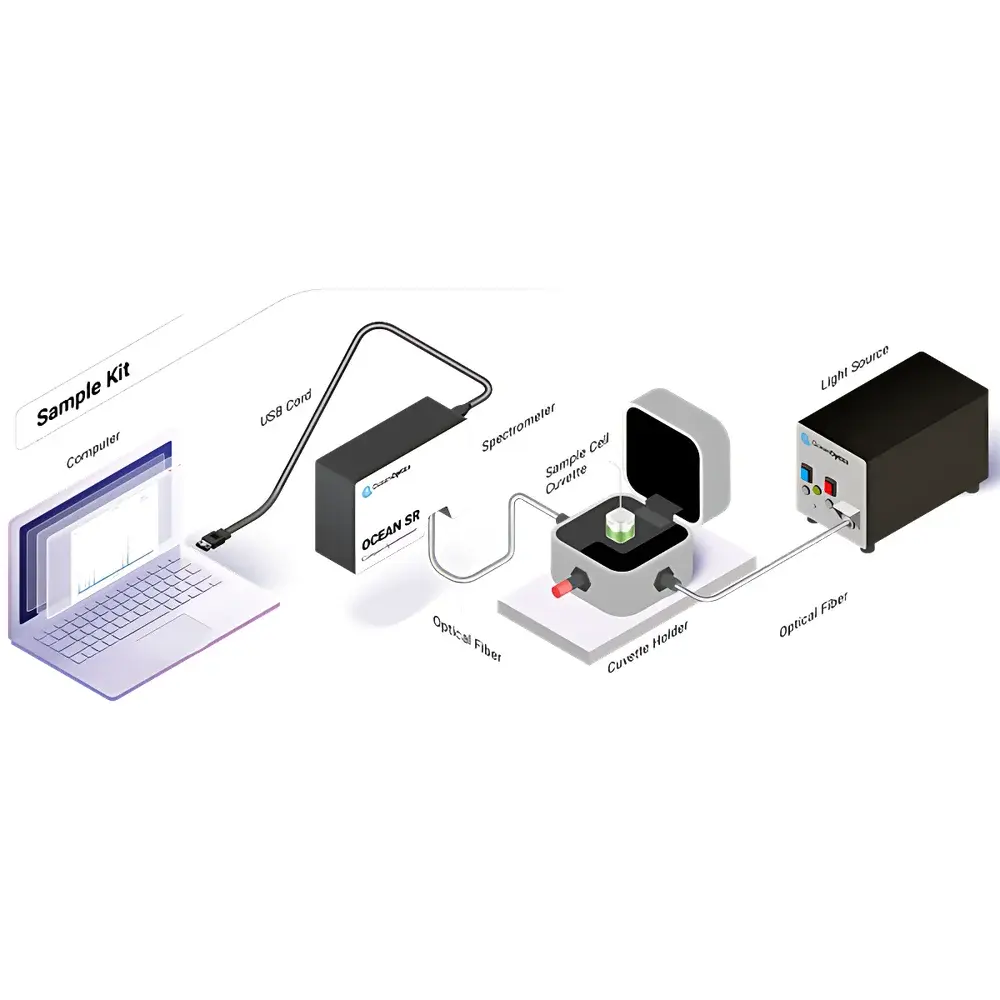
Ocean Optics Spectral Measurement Kit
| Brand | Ocean Optics |
|---|---|
| Origin | USA |
| Manufacturer Type | Original Equipment Manufacturer (OEM) |
| Product Origin | Imported |
| Model | Spectral Measurement Kit |
| Spectral Range | 200–1100 nm (configurable) |
| Detector Type | CCD or CMOS (application-dependent) |
| Optical Resolution | Configurable (typically 0.1–10 nm FWHM, dependent on grating and slit) |
| Sensitivity | Configurable (quantum efficiency up to ~90% in visible range) |
| Signal-to-Noise Ratio | ≥300:1 (full signal, 1 s integration) |
| Dynamic Range | >4.5 OD (optical density) |
| Stray Light | <0.05% at 600 nm, <0.1% at UV edge |
Overview
The Ocean Optics Spectral Measurement Kit is a fully integrated, application-ready spectroscopy platform engineered for rapid deployment in teaching laboratories, research facilities, and field-deployable analytical workflows. Built upon Ocean Optics’ legacy of modular fiber-optic spectrometry, the kit implements dispersive spectroscopy via holographic or ruled diffraction gratings coupled with linear array detectors (CCD or back-thinned CMOS), enabling high-fidelity spectral acquisition across the ultraviolet, visible, and near-infrared (UV-VIS-NIR) spectrum (200–1100 nm). Its core architecture supports absorbance, reflectance, transmittance, fluorescence, and radiometric measurements—each traceable to NIST-traceable calibration standards. The system operates on the principle of wavelength-encoded intensity detection: light collected via optical fiber is collimated, dispersed by a grating, and focused onto a photodetector array; spectral data are reconstructed using pixel-wavelength mapping algorithms validated per ISO/IEC 17025-compliant procedures.
Key Features
- Modular, pre-validated component integration: includes spectrometer, stabilized broadband or LED-based illumination source, SMA-905 terminated optical fiber (typically 2 m, 200–600 µm core), and application-specific sampling accessories (e.g., cuvette holders, integrating spheres, reflection probes, or collimating lenses)
- Configurable spectral performance: users select grating groove density, entrance slit width (10–200 µm), and detector type to optimize resolution (0.1–10 nm FWHM), sensitivity, and speed for target applications
- Factory-calibrated radiometric and photometric response: each spectrometer undergoes wavelength and intensity calibration using mercury-argon and tungsten-halogen standards; calibration files are embedded and auto-loaded in software
- Ruggedized OEM-grade enclosure: aluminum housing with thermal stabilization (±0.1 °C) minimizes wavelength drift during extended acquisitions
- USB 2.0/3.0 interface with 16-bit ADC and programmable integration time (1 ms–65 s), supporting trigger synchronization and external shutter control
Sample Compatibility & Compliance
The kit accommodates liquid, solid, powder, and gaseous samples through interchangeable sampling interfaces—including 1-cm pathlength quartz cuvettes (for absorbance), 99% reflective integrating spheres (for diffuse reflectance), and bifurcated reflection probes (for non-contact surface analysis). All optical components comply with RoHS 2 and REACH directives. Spectral data acquisition and processing workflows support GLP/GMP-aligned documentation: audit trails, user authentication, electronic signatures, and raw-data immutability are enforced in optional OceanView Pro software licensed under FDA 21 CFR Part 11 compliance modules. Calibration certificates conform to ISO/IEC 17025 requirements when requested with accredited calibration services.
Software & Data Management
OceanView™ software (included free of charge) provides real-time spectral visualization, multi-curve overlay, baseline correction, peak identification (with centroid and FWHM calculation), and quantitative analysis via Beer-Lambert modeling or multivariate regression (PLS, PCA). Data export supports CSV, TXT, XML, and HDF5 formats; API access (Python, MATLAB, LabVIEW, C#) enables integration into custom LIMS or automated test benches. Firmware updates and spectral library management (e.g., NIST SRD databases, pigment libraries, water quality reference spectra) are handled via the OceanInsight Device Manager utility. All raw spectra retain embedded metadata: timestamp, integration time, lamp status, fiber ID, and calibration version.
Applications
- Academic instruction: hands-on validation of Beer-Lambert law, bandgap determination of semiconductors, chlorophyll-a quantification in phytoplankton assays
- Environmental monitoring: turbidity, nitrate/nitrite, and dissolved organic carbon (DOC) analysis in freshwater and wastewater matrices
- Materials science: thin-film thickness measurement via interference fringe analysis, coating colorimetry (CIE L*a*b*), and photovoltaic quantum efficiency mapping
- Life sciences: enzyme kinetics (NADH/NADPH assays), protein secondary structure estimation (circular dichroism proxy), and cell culture density monitoring
- Industrial QA/QC: LED binning, ink formulation verification, pharmaceutical tablet coating uniformity assessment
FAQ
What spectral resolution can I achieve with this kit?
Resolution is configuration-dependent: standard kits with 300 lines/mm grating and 25-µm slit yield ~1.5 nm FWHM at 500 nm; high-resolution variants (2400 lines/mm + 10-µm slit) reach ≤0.15 nm.
Is the system suitable for regulatory submissions?
Yes—when paired with OceanView Pro and 21 CFR Part 11 add-ons, it meets FDA, EMA, and PMDA requirements for electronic records and signatures in GxP environments.
Can I upgrade components post-purchase?
All modules—including spectrometers, light sources, and fiber probes—are field-replaceable and backward-compatible with Ocean Optics’ ecosystem of >200 accessories.
How is stray light performance verified?
Each unit undergoes double-monochromator validation per ASTM E275-22 Annex A1; reported values reflect worst-case measurements at spectral extremes using certified low-stray-light filters.
Do you provide application-specific validation protocols?
Yes—Ocean Insight offers method development services aligned with USP , ISO 13406-2, and ASTM D1003 for reflectance/transmittance, including uncertainty budgets and reproducibility studies.





