
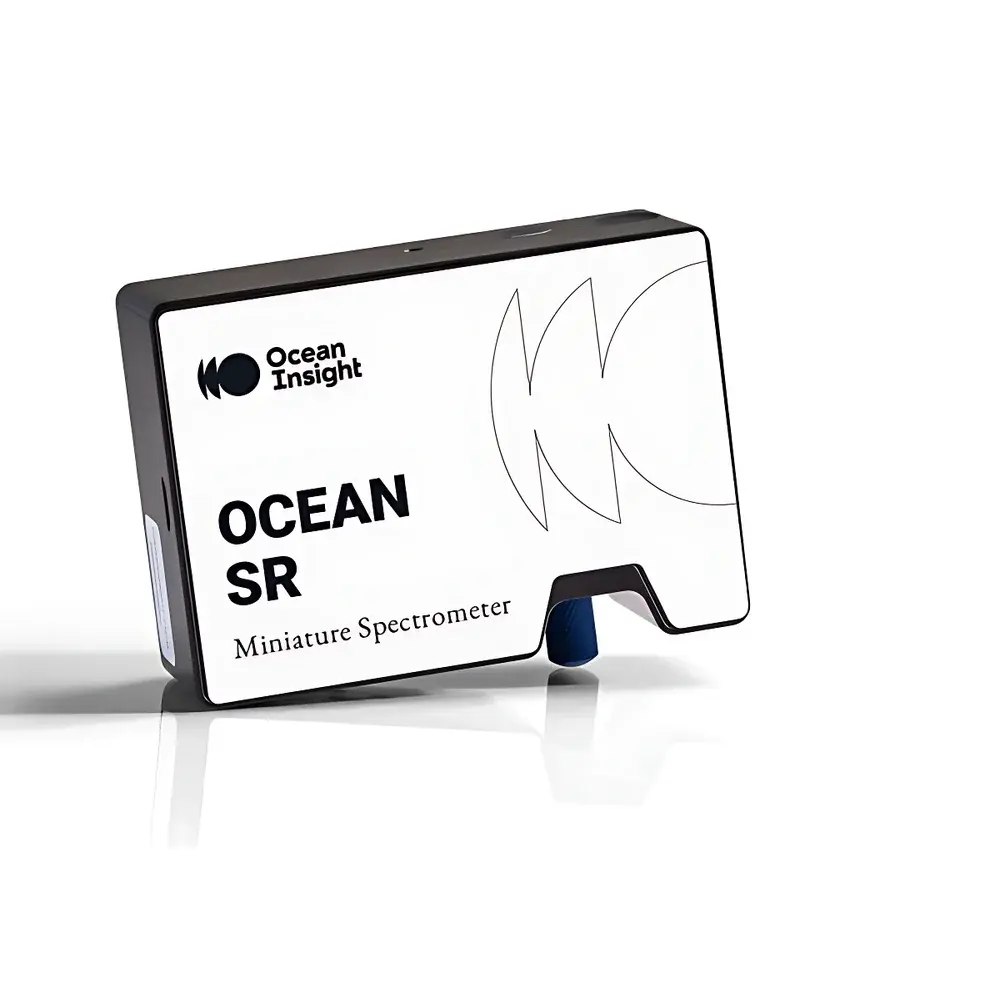
Ocean Optics SR2 Fiber Optic Spectrometer
| Brand | Ocean Optics |
|---|---|
| Origin | USA |
| Manufacturer Type | Original Equipment Manufacturer (OEM) |
| Product Category | Imported Instrument |
| Model | SR2 |
| Spectral Range | 185–1100 nm (configuration-dependent) |
| Detector Type | CCD |
| Optical Resolution (FWHM) | 0.56–1.71 nm |
| Signal-to-Noise Ratio (SNR) | 380:1 (single acquisition) |
| Dynamic Range | 3400:1 (single acquisition) |
| Integration Time | as low as 10 µs |
| Stray Light | Not Specified |
| Sensitivity | Not Specified |
Overview
The Ocean Optics SR2 Fiber Optic Spectrometer is a high-performance, compact dispersive spectrometer engineered for demanding spectroscopic applications requiring both rapid spectral acquisition and high fidelity signal integrity. Based on a Czerny-Turner optical architecture with optimized collimation and focusing optics, the SR2 leverages a back-thinned, scientific-grade CCD detector to deliver exceptional quantum efficiency across the deep ultraviolet (UV) to near-infrared (NIR) spectrum (185–1100 nm). Its core design philosophy centers on resolving the traditional trade-off between speed and sensitivity—achieving sub-millisecond spectral capture (down to 10 µs integration time) while maintaining a robust SNR of 380:1 in single-shot mode and a dynamic range of 3400:1. This balance makes the SR2 particularly suited for transient phenomena analysis, such as pulsed laser characterization, time-resolved plasma emission monitoring, real-time absorbance kinetics, and process analytical technology (PAT) deployments where temporal resolution and photometric accuracy are simultaneously critical.
Key Features
- Ultrafast acquisition capability: configurable integration times from 10 µs to 65 s, enabling precise temporal gating for short-lived optical events.
- High optical throughput and stability: precision-machined aluminum housing with thermally optimized optical path, delivering low inter-unit variability (< ±0.3 nm wavelength shift over 0–40 °C) and minimal thermal drift during extended operation.
- Configurable spectral resolution: selectable entrance slits (5–200 µm) allow users to tune the FWHM resolution between 0.56 nm and 1.71 nm—optimizing the trade-off between resolution and light throughput per application requirement.
- Modular fiber-coupled interface: standard SMA 905 connector compatible with Ocean Insight’s full ecosystem of UV-VIS-NIR illumination sources, cuvette holders, flow cells, and remote sampling probes.
- Robust mechanical architecture: sealed optical bench with anti-reflection coated fused silica windows and UV-enhanced coatings ensure long-term reliability in laboratory and industrial environments.
Sample Compatibility & Compliance
The SR2 supports a broad range of sample presentation methods—including transmission, reflectance, fluorescence, and emission configurations—via interchangeable optical accessories. It is routinely deployed in GLP-compliant laboratories and regulated manufacturing settings where traceability and instrument performance verification are essential. While the SR2 itself does not carry intrinsic regulatory certification, its hardware and firmware architecture support compliance workflows: wavelength calibration traceable to NIST-traceable standards, intensity linearity verification protocols, and stable dark current behavior enable adherence to ASTM E308 (for colorimetry), ISO 17025 (for testing laboratories), and USP (for pharmaceutical spectroscopy). When integrated with validated software environments (e.g., OceanView with audit trail enabled), the system can meet FDA 21 CFR Part 11 requirements for electronic records and signatures in GMP contexts.
Software & Data Management
Every SR2 spectrometer ships with OceanDirect—a cross-platform, royalty-free SDK supporting Windows, macOS, and Linux. OceanDirect provides a comprehensive API (C/C++, Python, .NET, LabVIEW, MATLAB) for low-level control of integration time, scan averaging, triggering modes (hardware TTL, software, or external sync), and real-time data streaming at up to 1000 spectra/second. The SDK includes built-in functions for dark correction, nonlinearity compensation, and pixel binning—all accessible programmatically to ensure reproducible data reduction. For end-user analysis, OceanView desktop software offers intuitive visualization, spectral library matching, kinetic plot generation, and export to CSV, HDF5, or vendor-neutral JCAMP-DX formats. All raw and processed data retain embedded metadata (wavelength calibration coefficients, slit width, grating ID, detector temperature), facilitating FAIR (Findable, Accessible, Interoperable, Reusable) data practices.
Applications
- Laser pulse characterization: measuring spectral width, central wavelength shift, and mode structure of Q-switched and mode-locked lasers.
- Plasma diagnostics: real-time monitoring of atomic and ionic emission lines (e.g., O I, N II, Hα) in combustion, sputtering, and plasma etching processes.
- UV-Vis absorbance kinetics: tracking rapid chemical reactions (e.g., enzyme kinetics, photochemical degradation) with millisecond time resolution.
- LED and OLED spectral profiling: evaluating peak wavelength, FWHM, CIE chromaticity coordinates, and radiant flux consistency across production batches.
- Environmental sensing: dissolved organic matter (DOM) fluorescence excitation-emission matrix (EEM) mapping using synchronized excitation source control.
FAQ
What spectral calibration options are available for the SR2?
Factory calibration uses NIST-traceable tungsten-halogen and mercury-argon lamps; users may perform field recalibration using optional Ocean Insight calibration kits (UV-VIS or VIS-NIR) with certified line sources.
Can the SR2 operate in triggered acquisition mode?
Yes—supports hardware TTL triggering (rising/falling edge), software triggering, and external clock synchronization for lock-in or pump-probe experiments.
Is the SR2 suitable for use in vacuum or controlled atmosphere environments?
The standard unit is rated for ambient laboratory conditions (5–40 °C, <80% RH non-condensing); custom hermetic versions with vacuum-compatible feedthroughs are available upon request.
How is detector linearity verified and maintained?
Ocean Insight provides linearity test reports per unit; users can verify linearity via neutral density step filters and apply correction coefficients through OceanDirect or OceanView.
Does the SR2 support multi-channel or array-based configurations?
No—the SR2 is a single-channel spectrometer; however, multiple SR2 units can be synchronized via shared trigger signals and managed concurrently using OceanDirect’s multi-device API.
Related Products




