
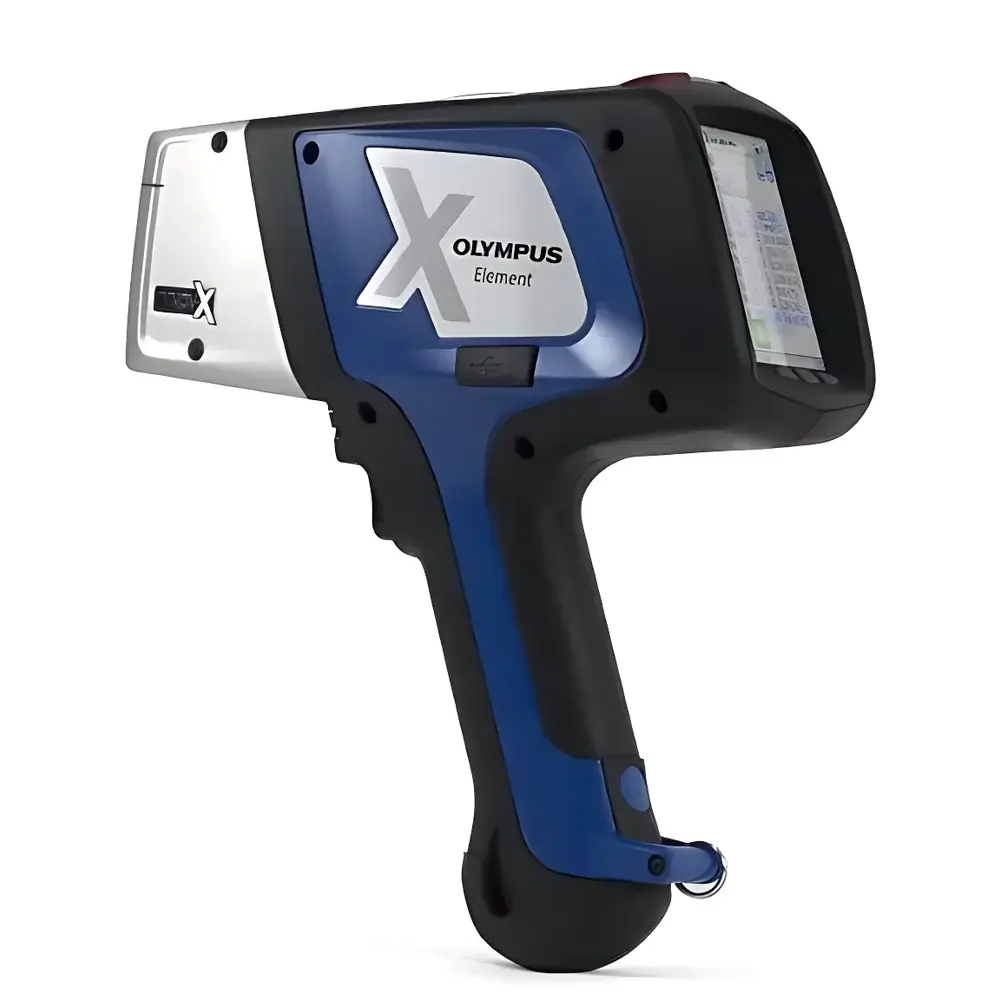
Olympus DELTA DE2000 Portable Energy Dispersive X-Ray Fluorescence (EDXRF) Spectrometer for Alloy Grade Identification
| Brand | Olympus |
|---|---|
| Origin | USA |
| Manufacturer Type | Authorized Distributor |
| Origin Category | Imported |
| Model | DE2000 |
| Application | Handheld / Portable |
| Industry-Specific Use | Non-Ferrous & Ferrous Metals |
| Elemental Range | Mg to U |
| Quantification Range | 1 ppm – 99.9 wt% |
| Energy Resolution | <140 eV (at Mn Kα) |
| Repeatability | ≤0.1% RSD (for major alloying elements under controlled conditions) |
Overview
The Olympus DELTA DE2000 is a field-deployable, handheld energy dispersive X-ray fluorescence (EDXRF) spectrometer engineered for rapid, non-destructive elemental analysis and positive material identification (PMI) of metallic alloys. Based on fundamental XRF physics—where primary X-rays from a micro-focus tube excite characteristic secondary (fluorescent) X-rays from sample atoms—the DE2000 delivers lab-grade compositional data in seconds, without sample preparation. Its core architecture integrates a high-stability Ta/Au anode X-ray tube (35 kV, 4 W), a thermoelectrically cooled Si-Pin detector, and real-time spectral deconvolution algorithms optimized for alloy matrices. Designed for industrial environments—from scrap yards and fabrication floors to pipeline inspection sites—the instrument meets the operational rigor demanded by QA/QC laboratories, NDT teams, and regulatory compliance officers requiring traceable, auditable results.
Key Features
- Single-beam Alloy Mode: Optimized excitation geometry and factory-calibrated spectral libraries ensure high-precision quantification of critical alloying elements (e.g., Cr, Ni, Mo, Cu, Al, Ti) across stainless steels, nickel-based superalloys, aluminum, titanium, and copper alloys.
- Thermal Management Architecture: Peltier-based detector cooling maintains stable operating temperature across ambient ranges from −35 °C to +50 °C, minimizing spectral drift and ensuring consistent resolution (<140 eV at Mn Kα).
- Hot-Swappable Dual-Battery System: Two user-replaceable Li-ion batteries support continuous operation; battery exchange requires no instrument shutdown, enabling uninterrupted field workflows.
- Intelligent Environmental Compensation: Integrated accelerometer and barometric sensor enable automatic atmospheric pressure correction during light-element measurement (e.g., Mg, Al, Si), improving accuracy in variable elevation or humidity conditions.
- Rugged Industrial Design: Die-cast aluminum chassis provides structural integrity, EMI shielding, and passive thermal dissipation; IP54-rated enclosure resists dust ingress and water splashing.
- High-Visibility Touch Interface: 5-inch Blanview transmissive LCD with capacitive touch enables glove-compatible operation and clear spectral visualization under direct sunlight.
Sample Compatibility & Compliance
The DE2000 accommodates flat, curved, or irregularly shaped metallic surfaces—including pipes, welds, castings, and scrap fragments—with minimal surface preparation (cleaning only). It supports ASTM E1508, ISO 21043, and GB/T 28762 for qualitative and quantitative metal analysis. While not intrinsically certified for hazardous locations, its low-power X-ray source (≤10 µSv/h at 5 cm) complies with IEC 62495 and FDA 21 CFR Part 1020.40 radiation safety standards. Data integrity protocols align with GLP/GMP documentation requirements, including timestamped result logs, operator ID tagging, and audit-trail-enabled firmware (optional USB export of raw spectra and metadata).
Software & Data Management
Olympus’ proprietary DeltaSync software enables PC-based instrument configuration, calibration update deployment, and offline spectral review. All measurements are stored locally on removable SD cards (up to 32 GB) with embedded CSV and .dxp file formats. Each record includes full spectrum, acquisition parameters, GPS coordinates (if enabled), and pass/fail flags against user-defined grade thresholds. The system supports optional 21 CFR Part 11-compliant electronic signatures via third-party validation packages. Firmware updates preserve historical calibration stability and extend library coverage—including custom alloy grade definitions (≥500 preloaded grades, expandable via XML import).
Applications
- Positive Material Identification (PMI): Verification of ASME B16.5, ASTM A959, and UNS specifications in petrochemical piping, valve bodies, and pressure vessels.
- Scrap Metal Sorting: Real-time differentiation of 300-series vs. 200-series stainless, Inconel 625 vs. 718, and aluminum 6061 vs. 7075 at recycling facilities.
- Quality Assurance: Incoming raw material inspection, weld filler verification, and heat-treat batch validation in aerospace and power generation supply chains.
- Regulatory Compliance: Screening for restricted substances (e.g., Pb, Cd, Cr⁶⁺) per RoHS Directive Annex II and EU REACH SVHC reporting thresholds.
- Field Archaeometry & Forensics: Non-invasive composition profiling of historic artifacts, coins, and recovered industrial components.
FAQ
Does the DE2000 require annual recalibration?
No—factory calibrations are traceable to NIST SRMs and remain stable for ≥12 months under normal use; however, daily verification using certified reference standards (e.g., SS316, Al 6061) is recommended per ISO/IEC 17025 guidelines.
Can it analyze coated or painted metals?
Surface coatings ≤25 µm thick (e.g., Zn, Cr, paint) typically do not interfere with bulk alloy analysis; thicker or multi-layer coatings may require removal or empirical correction.
Is light-element analysis (Mg, Al, Si) reliable outdoors?
Yes—barometric compensation and optimized low-energy excitation enhance repeatability for Mg–P in aluminum alloys and Si in cast irons, even at altitudes up to 3,000 m.
What data security features are included?
Local encryption of SD card storage, password-protected instrument access, and configurable auto-delete policies for sensitive measurement records.
How does it compare to benchtop EDXRF systems?
While benchtop units offer higher count rates and lower detection limits for trace elements, the DE2000 prioritizes portability, speed, and ruggedness—delivering ±0.1% repeatability for major alloy constituents in <5 s, making it optimal for high-throughput field screening rather than ultra-trace research.
Related Products







