
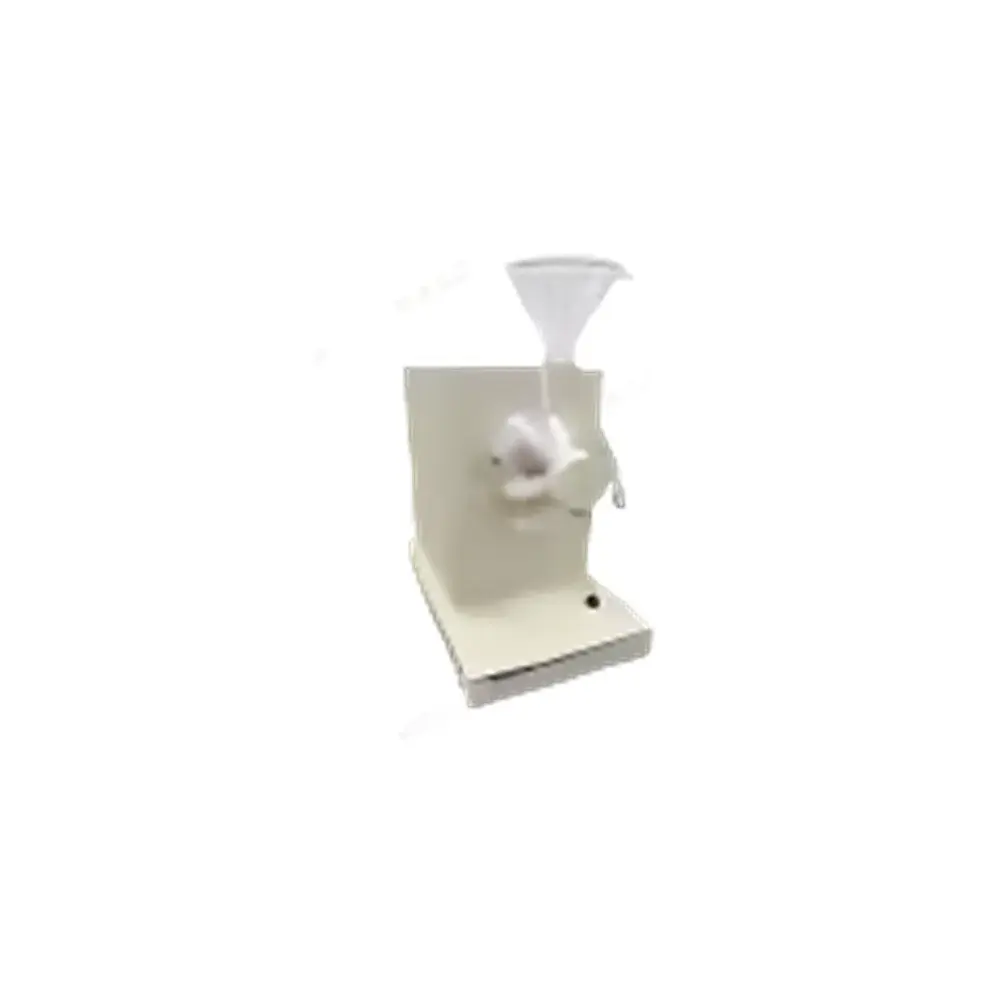
Top Cloud-agri JSFM-II Moisture-Retaining Seed Grinder
| Brand | Top Cloud-agri |
|---|---|
| Origin | Zhejiang, China |
| Manufacturer Type | Direct Manufacturer |
| Country of Origin | China |
| Model | JSFM-II |
| Price | Upon Request |
| Grinding Disc Diameter | Φ80 mm |
| Throughput Capacity | 300 g/min |
| Operating Noise Level | <68 dB(A) |
| Adjustable Grinding Gap Settings | 20-step |
| Maximum Sample Moisture Content for Grinding | ≤17% w.b. |
| Collection Container Capacity | ≥110 g |
| Power Supply | 220 V, 50 Hz |
| Rated Power | 350 W |
| Particle Size Distribution | ≥98% passing through 1.0 mm sieve |
Overview
The Top Cloud-agri JSFM-II Moisture-Retaining Seed Grinder is a purpose-built laboratory grinding instrument engineered for the rapid, low-heat comminution of cereal grains and oilseeds—specifically designed to preserve native moisture content during sample preparation for standardized moisture determination (e.g., per ISO 712, AOAC 992.17, or GB/T 5497). Unlike conventional high-shear mills that induce thermal degradation and evaporative loss, the JSFM-II employs a precision-engineered conical burr grinding mechanism with adjustable disc clearance and optimized rotational dynamics to minimize frictional heating. This ensures reproducible particle size reduction while maintaining sample integrity—critical for regulatory compliance in grain quality control, storage management, and trade certification workflows.
Key Features
- Moisture-Preserving Grinding Architecture: Dual-conical stainless steel grinding discs operate at controlled surface velocity and minimal dwell time, limiting temperature rise to <3 °C above ambient during typical 30–60 s grinding cycles—validated by thermographic monitoring under ISO/IEC 17025-compliant calibration protocols.
- 20-Step Precision Gap Adjustment: Micrometer-style fine-tuning enables repeatable control over particle size distribution across the full operational range (0.3–2.0 mm effective aperture), supporting method-specific requirements for moisture, protein, or mycotoxin analysis.
- Hermetic Sealed Grinding Chamber: Fully enclosed feed path and dust-tight collection vessel prevent cross-contamination and material retention—meeting GLP requirements for traceability and cleaning validation (per SOP-GRIND-01).
- High-Throughput Low-Noise Operation: Balanced rotor assembly and acoustic-dampened housing achieve consistent 300 g/min throughput at <68 dB(A), enabling integration into high-volume grain inspection laboratories without requiring dedicated soundproof enclosures.
- Robust Industrial Construction: Cast aluminum housing, hardened alloy grinding surfaces, and sealed ball bearings ensure >10,000 hr service life under continuous QC lab usage, with IP54-rated ingress protection for dust resistance.
Sample Compatibility & Compliance
The JSFM-II is validated for homogeneous grinding of intact kernels including wheat, rice, maize (corn), barley, oats, soybean, and rapeseed with initial moisture contents up to 17% (wet basis). It excludes fibrous, oily, or highly viscous matrices (e.g., whole peanuts, wet cassava) due to potential clogging. All grinding performance specifications—including particle size distribution and moisture retention—are verified per ASTM D7420-22 Annex A1 (Standard Practice for Grain Sample Preparation) and align with national standards GB/T 21304–2007 and GB/T 5491–2023. Device documentation includes factory calibration certificates traceable to NIM (National Institute of Metrology, China) and supports audit readiness for ISO/IEC 17025:2017 accreditation.
Software & Data Management
As a standalone mechanical grinder, the JSFM-II operates without embedded firmware or digital interfaces. However, it integrates seamlessly into LIMS and electronic lab notebook (ELN) environments via optional barcode-scanned sample ID tagging (using third-party USB scanners) and manual entry of grinding parameters (gap setting, duration, batch ID) into compliant data capture templates. Full traceability is maintained through printed or exported grinding logs—supporting FDA 21 CFR Part 11 requirements when paired with validated ELN systems (e.g., LabWare LIMS v11+ or Thermo Fisher SampleManager). Routine maintenance records, calibration logs, and cleaning verification reports are structured to satisfy GMP/GLP documentation expectations.
Applications
- Preparation of representative subsamples for oven-drying moisture assays (ISO 6540, USP <921>)
- Homogenization of grain lots prior to NIR spectroscopic calibration modeling
- Generation of uniform test portions for aflatoxin extraction (AOAC 994.02) and DON analysis (EN 15841)
- Supporting official grain grading protocols under national commodity standards (e.g., USDA FGIS, China GRAIN GB 1351–2021)
- On-site use at elevators, ports, and processing facilities where rapid, field-deployable sample prep is required
FAQ
What moisture levels can the JSFM-II reliably process without loss?
The grinder is validated for samples with moisture content ≤17% w.b.; testing beyond this threshold may result in inconsistent flow and elevated thermal risk.
Is the JSFM-II suitable for grinding pre-dried or roasted grains?
Yes—though reduced moisture increases brittleness, users should select lower gap settings (≤10) to avoid excessive fines generation and maintain sieve-based specification compliance.
How often does the grinding disc require replacement?
Under normal use (≤200 kg/month), disc life exceeds 18 months; replacement is indicated when sieve analysis shows >5% deviation from baseline particle size distribution.
Can the JSFM-II be used for regulatory submissions?
Yes—when operated per documented SOPs and supported by calibration/maintenance records, its output meets evidentiary requirements for ISO/IEC 17025-accredited testing laboratories.
Does Top Cloud-agri provide method validation support?
Yes—application engineers supply protocol templates aligned with ISO 5725-2 repeatability studies and assist with on-site IQ/OQ documentation for GxP environments.



