
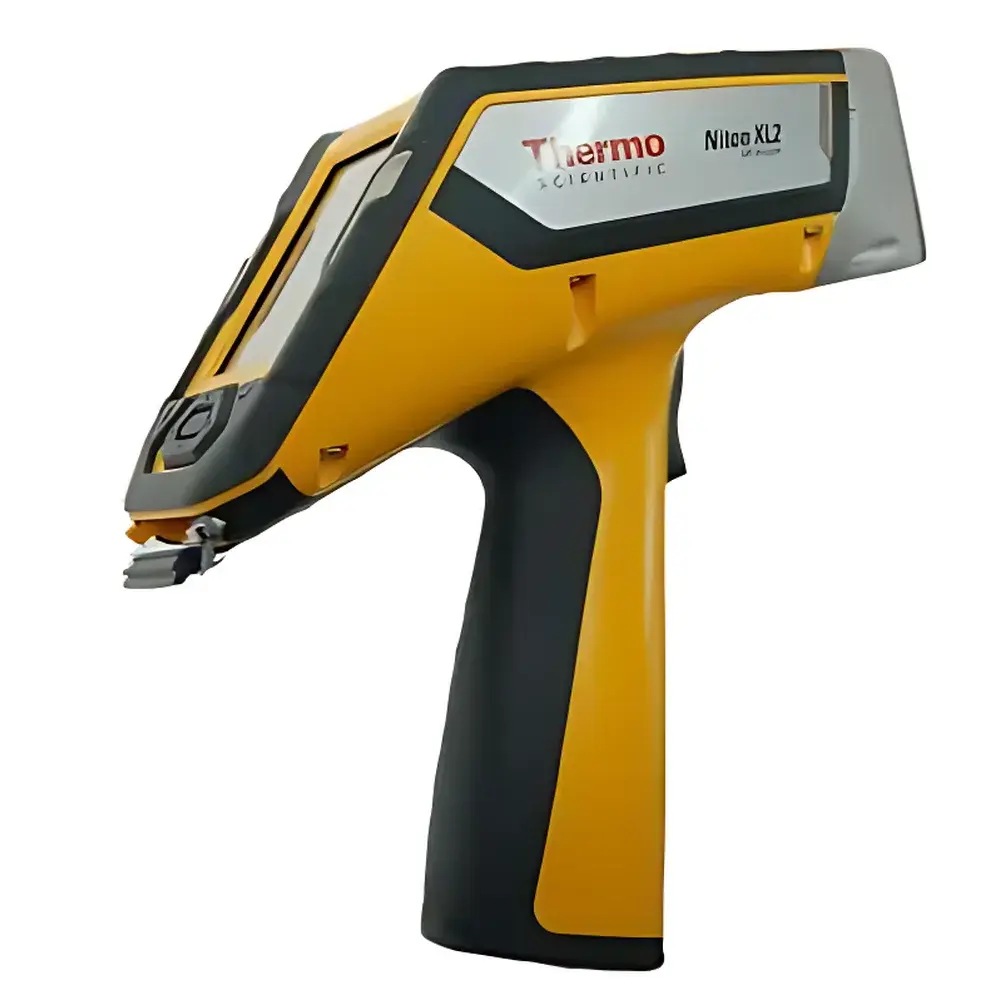
Thermo Fisher Niton XL2 700 Handheld Energy Dispersive X-Ray Fluorescence (ED-XRF) Spectrometer for RoHS & Halogen Compliance Testing
| Brand | Thermo Fisher |
|---|---|
| Origin | USA |
| Model | Niton XL2 700 |
| Portability | Handheld / Portable |
| Elemental Analysis Range | Na (Z=11) to U (Z=92) |
| Detection Limit | Sub-ppm to low-ppm (matrix-dependent, 300 s measurement) |
| Energy Resolution | <140 eV at Mn Kα |
| Repeatability | ≤0.1% RSD (for major elements in homogeneous standards) |
| Detector | Peltier-cooled Si-PIN |
| X-ray Tube | Au-anode, 40 kV / 50 µA |
| Measurement Spot Size | ≥4 mm × 4 mm |
| Data Storage | 4,000+ spectra + quantitative results |
| Battery Life | 6–12 h (dual rechargeable Li-ion) |
| Dimensions | 248 × 273 × 95 mm |
| Weight | 1.4 kg |
Overview
The Thermo Fisher Niton XL2 700 is a field-deployable, handheld energy dispersive X-ray fluorescence (ED-XRF) spectrometer engineered for rapid, non-destructive elemental quantification in industrial compliance screening. Operating on the fundamental principle of X-ray fluorescence—where primary X-rays from a micro-focus Au-anode tube excite characteristic secondary emissions from sample atoms—the instrument delivers laboratory-grade analytical performance outside controlled environments. Its design specifically addresses regulatory enforcement requirements under EU RoHS Directive 2011/65/EU, China RoHS II (SJ/T 11364-2014), IEC 61249-2-21 (halogen restrictions), and corporate green procurement policies (e.g., Apple’s Regulated Substances Specification, Dell’s Environmental Standards). Unlike benchtop ED-XRF systems, the XL2 700 integrates real-time spectral processing via a Hitachi SH-4 CPU and ASIC-based digital pulse processor with 4096-channel MCA, enabling robust quantification across heterogeneous matrices without vacuum or helium purge.
Key Features
- Optimized dual-filter system: Filter 2 enhances sensitivity for Cl and Cr detection—critical for halogen-free validation per IEC 61249-2-21 (Cl/Br < 900 ppm).
- Temperature-stabilized Peltier-cooled Si-PIN detector ensures consistent energy resolution (<140 eV at Mn Kα) across ambient operating temperatures (–10 °C to 50 °C).
- Dedicated analysis modes: Pre-calibrated “Plastics Mode” (quantification in ppm) and “Alloys Mode” (wt% + ppm), each with matrix-matched fundamental parameters algorithms.
- Integrated barcode scanner and on-device touchscreen interface enable traceable sample ID assignment without manual entry—supporting GLP-aligned data integrity.
- Thickness compensation algorithm allows direct analysis of thin polymer films (e.g., cable sheathing, PCB laminates) without stacking, minimizing operator-induced variability.
- Compliance-ready firmware: Password-protected user access levels, audit trail logging, and configurable pass/fail alerts based on user-defined threshold limits (e.g., Pb < 1000 ppm).
- Radiation safety certified to IEC 62495:2010; measured dose rate at handle position is ≤8 µSv/hr during operation—well below occupational exposure limits.
Sample Compatibility & Compliance
The XL2 700 accommodates solid, granular, and irregularly shaped samples—including solder joints, injection-molded plastics (ABS, PVC, PE), metal housings, printed circuit boards, and wire insulation—without sample preparation. Its 4 mm × 4 mm minimum analysis area supports high spatial resolution for localized screening. The instrument meets ASTM F2857-22 (Standard Guide for XRF Screening of RoHS Elements in Electrical and Electronic Equipment) and ISO 17025:2017 requirements when operated within validated methods. It is routinely deployed by EU customs authorities, SONY Green Partner auditors, and OEM supplier quality labs for first-article inspection and incoming material verification. All factory calibrations are traceable to NIST SRM reference materials (e.g., SRM 2582, SRM 2583), and method validation documentation aligns with FDA 21 CFR Part 11 expectations for electronic records.
Software & Data Management
Data acquisition and reporting are managed through Niton Data Transfer (NDT) software—a Windows-based application supporting raw spectrum export (ASCII, CSV), customizable report generation (PDF, Excel), and batch statistical analysis. NDT enforces secure data handling: all measurements include embedded timestamps, operator IDs, GPS coordinates (optional), and full spectral metadata. Audit logs record parameter changes, calibration events, and result modifications—enabling full traceability for internal audits or third-party certification (e.g., UL, TÜV). Optional Bluetooth 4.2 module enables remote instrument control and live spectrum streaming to tablets or laptops, facilitating collaborative troubleshooting on production floors. Firmware updates are delivered via encrypted USB key to maintain configuration integrity.
Applications
- RoHS-compliant screening of Pb, Cd, Hg, Cr(VI), and Br in electronics assemblies and packaging materials.
- Halogen verification (Cl, Br) in flame-retardant polymers per IEC 61249-2-21 and IPC-4101D.
- Supplier qualification: Rapid verification of material declarations against purchase specifications (e.g., “Pb-free solder,” “halogen-free epoxy”).
- In-process QC: Real-time monitoring of plating baths, recycled metal feedstocks, and compound batches prior to molding or extrusion.
- Regulatory enforcement: On-site testing by customs and environmental agencies for border compliance checks.
- Failure analysis: Identification of contaminant ingress (e.g., Pb contamination in medical device housings) without destructive sectioning.
FAQ
Is the Niton XL2 700 compliant with EU RoHS Directive testing requirements?
Yes—the instrument implements measurement protocols aligned with EN 62321-3-1:2013 (screening via XRF) and is validated for use in conformity assessment per EU Commission Notice 2018/C 272/01.
Can it quantify bromine in FR-4 PCB substrates?
Yes—using Filter 2 and 300-second dwell time, typical LOD for Br in glass-reinforced epoxy is ~5 ppm (2σ), sufficient for IEC 61249-2-21 compliance verification.
Does it require annual recalibration?
No—factory calibrations are stable for 12 months under normal use; however, daily verification with check standards (e.g., Niton Certified Reference Sample CR-1) is recommended per ISO/IEC 17025.
Is spectral data export compatible with LIMS integration?
Yes—NDT software supports ODBC-compliant database exports and structured XML output for seamless ingestion into enterprise LIMS platforms.
What safety certifications does the device hold?
It carries CE marking per EU Directive 2014/30/EU (EMC) and 2014/53/EU (RED), plus compliance with ANSI N43.3-2022 for portable X-ray devices in the US.
Related Products






