
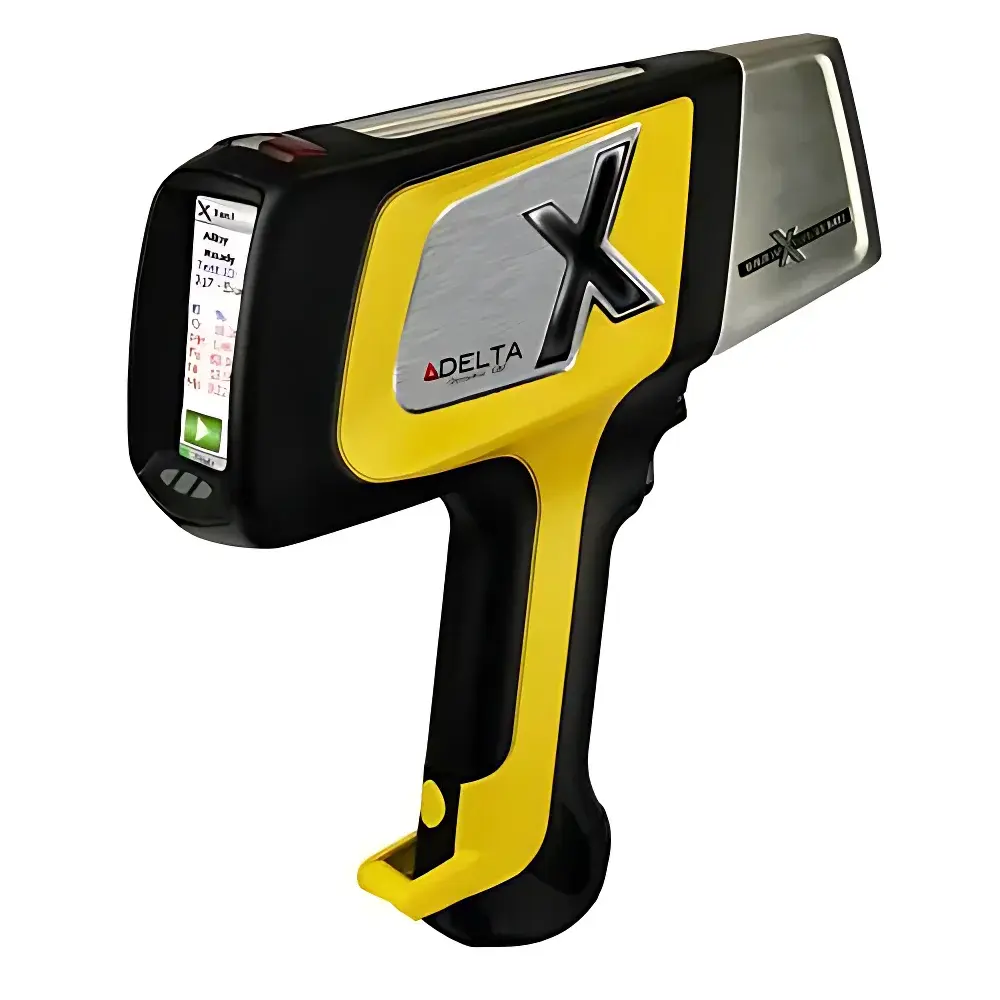
Olympus Delta DPO4000 Portable Energy Dispersive X-Ray Fluorescence (EDXRF) Analyzer
| Brand | Olympus |
|---|---|
| Origin | USA |
| Model | DPO4000 |
| Element Range | Na (11) to U (92) |
| Detection Range | 1 ppm – 100% |
| Energy Resolution | <140 eV |
| Repeatability | 0.1% |
| Dimensions | 245 × 250 × 88 mm |
| Weight | <1.5 kg |
| Operating Temperature | −10 °C to 50 °C |
| Relative Humidity | 0–95% RH |
| Excitation Source | High-power micro-focus X-ray tube (15–40 kV) |
| Detector | 25 mm² Silicon Drift Detector (SDD) |
| Cooling | Peltier thermoelectric cooling (down to −35 °C) |
| Filters | 8-position automatic filter wheel |
| Battery | Dual hot-swappable Li-ion batteries |
| Display | High-resolution transflective color touchscreen |
| OS | Windows CE 6.0 |
| Data Storage | MicroSD card (≥100,000 spectra) |
| Connectivity | USB 2.0, Bluetooth 2.1 + EDR |
| Analytical Modes | Up to 25 user-configurable modes |
Overview
The Olympus Delta DPO4000 is a field-deployable, handheld Energy Dispersive X-Ray Fluorescence (EDXRF) spectrometer engineered for rapid, non-destructive elemental analysis of soils, sediments, dust, coatings, and environmental matrices. Based on fundamental XRF physics—where primary X-rays excite characteristic secondary (fluorescent) X-rays from sample atoms—the DPO4000 delivers quantitative and semi-quantitative results in seconds. Its optimized geometry, high-efficiency SDD detector, and multi-kV excitation source enable robust detection of elements from sodium (Na, Z=11) through uranium (U, Z=92), with sub-ppm sensitivity for heavy metals and reliable quantification across five orders of magnitude (1 ppm to 100 wt%). Designed specifically for environmental site assessment, the instrument meets analytical requirements defined in EPA Method 6200 for field screening of RCRA metals and supports regulatory workflows under OSHA, NIOSH, and ASTM standards.
Key Features
- High-performance micro-focus X-ray tube with selectable kV (15–40 kV), enabling optimized excitation for light elements (e.g., Al, Si, P, S) and heavy metals (Pb, As, Cr, Cd, Hg) in a single measurement.
- 25 mm² large-area Silicon Drift Detector (SDD) with Peltier-based thermoelectric cooling to −35 °C, ensuring stable spectral resolution (<140 eV at Mn Kα) under variable ambient conditions.
- Eight-position automated filter wheel for dynamic background suppression and peak-to-background enhancement—critical for low-concentration soil analysis in complex matrices.
- Hot-swappable dual Li-ion battery system: uninterrupted operation during battery replacement; both batteries and host support simultaneous direct charging for maximum field uptime.
- Ruggedized industrial enclosure with IP54-rated ingress protection, integrated aluminum heat-sink channeling, and interlocking groove-and-rib sealing—validated for operation in −10 °C to 50 °C, 0–95% RH environments.
- Single-button trigger interface with ergonomic balance design: no hand support required during extended use; tactile feedback and visual confirmation minimize operator fatigue and misfires.
- Dedicated Windows CE 6.0 operating system with real-time spectrum processing, onboard calibration management, and support for up to 25 application-specific analytical modes—including soil, paint, dust, and filter media configurations.
Sample Compatibility & Compliance
The DPO4000 is validated for direct analysis of heterogeneous, unprepared solid samples including moist or dry soils, surface wipes, air filters, paint chips, corrosion products, and construction debris. No grinding, pressing, or chemical digestion is required—enabling true in-situ decision-making. The instrument complies with key regulatory frameworks governing environmental and occupational health testing: EPA Method 6200 (field screening of metals in soils/sediments), NIOSH Method 7702 (lead in air filters), OSHA Lead in Paint Standards (29 CFR 1926.62), and ASTM D6708 (statistical validation of field XRF data). Its firmware supports audit-ready data logging—including GPS metadata, operator ID, time stamps, and instrument configuration—facilitating GLP-compliant reporting and integration into LIMS environments.
Software & Data Management
Data acquisition, processing, and reporting are managed via the proprietary Delta PC Software Suite (Windows-compatible), which enables remote instrument control, method development, spectral library management, and statistical QA/QC review. All measurements are stored with full spectral metadata on removable MicroSD cards (capacity ≥32 GB), supporting >100,000 spectra per card. Raw spectra, quantified results, and calibration parameters are exportable in CSV, XML, and PDF formats. Bluetooth 2.1 + EDR and USB 2.0 interfaces support secure, driverless connectivity with Microsoft-certified mobile and desktop platforms. The embedded digital pulse processor implements real-time dead-time correction, peak deconvolution, and matrix-effect compensation using fundamental parameter (FP) algorithms—ensuring consistent accuracy across varying soil textures and organic content.
Applications
- Environmental Site Assessment: Rapid delineation of contamination plumes (e.g., Pb, As, Cr, Ni, Zn) at brownfields, landfills, and industrial sites; real-time boundary mapping and risk-based corrective action planning.
- Regulatory Monitoring: Compliance screening for RCRA-listed metals in soils and sediments; verification of remediation endpoints prior to site closure; routine surveillance of mine tailings, smelter emissions, and stormwater runoff sediments.
- Occupational Health & Safety: Lead-in-paint surveys per OSHA guidelines; analysis of airborne particulate collected on PVC or mixed-cellulose ester (MCE) filters per NIOSH 7702; surface swipe testing for toxic metals in manufacturing and demolition zones.
- Hazardous Waste Characterization: On-site classification of drums, debris, and sludges per TCLP surrogate protocols; identification of hazardous constituents in construction/demolition waste streams prior to disposal or recycling.
- Research & Education: Field-based geochemical profiling, pedological studies, atmospheric deposition tracking, and teaching applications in environmental science curricula requiring portable, hands-on elemental analysis tools.
FAQ
Does the DPO4000 require sample preparation for soil analysis?
No—soil samples may be analyzed directly in situ or in loose, unprocessed form. For highest precision in heterogeneous matrices, users may optionally homogenize subsamples or use a calibrated soil cup accessory.
Is the instrument compliant with FDA 21 CFR Part 11 for electronic records?
While the DPO4000 itself does not include Part 11–specific audit trail or electronic signature modules, its data export architecture and Delta PC Software support integration into validated LIMS or ELN systems that implement full Part 11 controls.
How is atmospheric pressure compensated during light-element analysis?
The integrated barometric sensor automatically adjusts spectral acquisition parameters—including tube current and live time—to correct for air absorption effects on low-energy X-rays (e.g., Mg, Al, Si), ensuring reproducible quantification of light elements across elevation gradients.
Can the DPO4000 be calibrated for site-specific soil types?
Yes—users may develop and deploy custom calibrations using certified reference materials (CRMs) representative of local geology, organic content, and moisture levels. Up to 25 independent methods can be stored onboard.
What maintenance is required for long-term field reliability?
Routine maintenance includes periodic cleaning of the X-ray window and detector aperture, battery health monitoring, and annual performance verification using check sources (e.g., Fe/Mn/Cu alloy). No consumables or vacuum pumps are required.





