
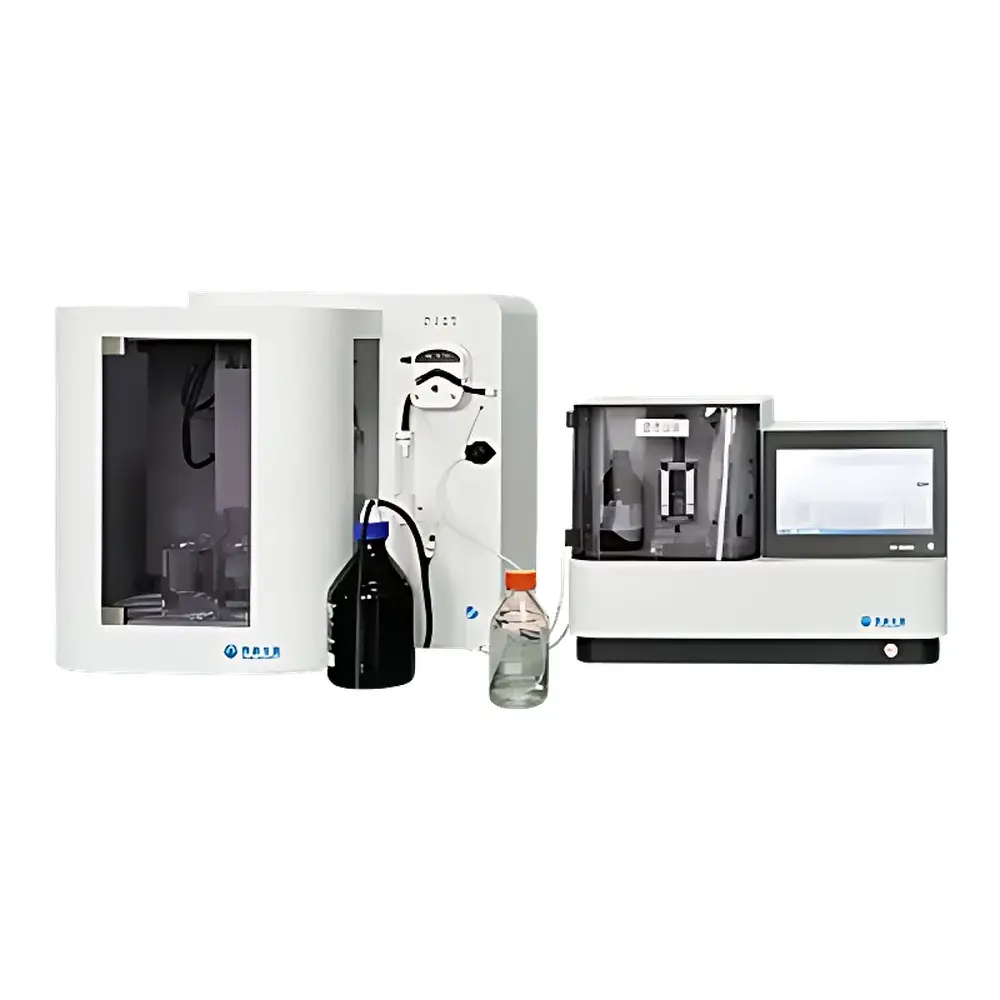
Online Instrument OL1020 Fully Automated Infrared Oil Content Analyzer
| Brand | Online Instrument |
|---|---|
| Origin | Shanghai, China |
| Manufacturer Type | Direct Manufacturer |
| Regional Classification | Domestic (China) |
| Model | OL1020 |
| Instrument Category | Laboratory-Based |
| Measurement Principle | Infrared Spectrophotometry (C–H Stretch Absorption at 2930 cm⁻¹, 2960 cm⁻¹, and 2850 cm⁻¹) |
| Measurement Range | 0–50,000 mg/L |
| Detection Limit | 0.03 mg/L |
| Accuracy | ±2% of reading |
| Resolution | 0.001 mg/L |
| Analysis Time per Sample | <5 minutes |
Overview
The Online Instrument OL1020 Fully Automated Infrared Oil Content Analyzer is a laboratory-grade, EPA- and ISO-aligned instrument engineered for precise quantification of total petroleum hydrocarbons (TPH), petroleum hydrocarbons (oil & grease), and non-polar extractable organic matter—including animal and vegetable oils—in aqueous matrices. It operates on the principle of infrared spectrophotometry, measuring absorbance intensities of C–H stretching vibrations in the mid-infrared region (2960 cm⁻¹, 2930 cm⁻¹, and 2850 cm⁻¹) to differentiate and quantify hydrocarbon classes according to standardized spectral subtraction algorithms. Designed for regulatory compliance workflows, the OL1020 implements ASTM D7066-22, ISO 9377-2:2000, and China’s HJ 637–2018 and HJ/T 91–2002 methodologies—enabling direct analysis of raw water samples without manual volume transfer or glassware handling.
Key Features
- Fully automated sample processing from extraction to quantification, including non-contact volumetric recognition of wide-mouth sampling bottles (compliant with HJ/T 91–2002)
- Integrated dual-channel measurement: simultaneous determination of petroleum hydrocarbons and animal/vegetable oils in a single run, delivering three independent concentration values (total oil, petroleum hydrocarbons, and ester-based oils)
- Real-time silica gel column monitoring: embedded sensor system tracks magnesium silicate adsorbent depletion and triggers visual alerts prior to breakthrough
- Triple-phase separation architecture: sequential extraction, phase separation via dedicated separation tube, and final dehydration using hydrophobic membrane filtration or anhydrous Na₂SO₄—ensuring complete removal of residual water from the organic extract
- Reverse-pressure solvent flush mechanism: programmable backflushing of separation components with tetrachloroethylene prevents channel clogging and eliminates cross-contamination between samples
- Hermetically sealed operational pathway: all solvent-handling steps occur within closed-loop tubing and sealed reaction chambers; operator exposure to tetrachloroethylene is eliminated
- Onboard activated carbon exhaust treatment: volatile organic vapors are continuously adsorbed and retained, meeting OSHA PEL and EU Directive 2004/37/EC occupational safety requirements
- Automated reagent recovery module: spent tetrachloroethylene is collected in designated containment vessels for off-site recycling or incineration per local hazardous waste regulations
Sample Compatibility & Compliance
The OL1020 accepts standard 250 mL or 1 L wide-mouth HDPE or glass sampling bottles used in municipal wastewater, industrial effluent, surface water, and groundwater monitoring programs. It supports heterogeneous samples containing suspended solids, emulsified oil droplets, and variable salinity—common in petrochemical discharge, power plant cooling water, and agricultural runoff. Regulatory alignment includes full traceability to HJ 637–2018 (China), EPA Method 1664A (for n-hexane extractable material, adapted for CCl₄-based IR), and ISO 9377-2 Annex A (infrared determination of hydrocarbon content). Data integrity meets GLP and GMP documentation standards, with optional 21 CFR Part 11-compliant audit trail and electronic signature modules available upon configuration.
Software & Data Management
The embedded Linux-based control software provides touchscreen-driven operation with intuitive workflow navigation. All analytical parameters—including calibration curve coefficients, blank subtraction protocols, peak integration windows, and spectral baseline correction settings—are stored with timestamped metadata. Raw interferograms and processed absorbance spectra are exportable in ASTM E131-compliant .SPA format. Remote access is enabled via secure HTTPS interface, supporting real-time instrument status monitoring, method recall, and historical data retrieval from mobile devices or desktop clients. Audit logs record user login events, method changes, calibration actions, and result modifications—fully compliant with ISO/IEC 17025 clause 7.7 and CNAS-CL01:2018 data governance requirements.
Applications
The OL1020 serves as a primary analytical platform across environmental compliance laboratories, municipal wastewater treatment facilities, and industrial QA/QC departments. Typical use cases include routine monitoring of influent and effluent streams at sewage treatment plants; leak detection and discharge verification in petrochemical refineries and storage terminals; regulatory reporting for NPDES and discharge permits; research into biodegradation kinetics of hydrocarbons in aquatic systems; and method validation studies supporting ISO/IEC 17025 accreditation. It is widely deployed by provincial environmental monitoring centers, university environmental engineering labs, hydrological survey bureaus, thermal power generation stations, steel manufacturing complexes, and marine pollution research institutes.
FAQ
What extraction solvent does the OL1020 use, and is it compatible with international regulatory methods?
The instrument uses tetrachloroethylene (perchloroethylene) as the primary extraction solvent, fully aligned with HJ 637–2018 and ISO 9377-2 requirements. Alternative solvents such as n-hexane may be accommodated with hardware and software recalibration.
Can the OL1020 analyze samples with high turbidity or particulate load?
Yes—the integrated triple-phase separation system effectively decouples organic extract from suspended solids and free water, enabling robust performance even in raw wastewater or stormwater runoff samples.
Is method validation support provided for laboratory accreditation?
Online Instrument supplies comprehensive validation documentation packages—including precision/recovery studies, LOD/LOQ verification reports, linearity assessments, and inter-laboratory comparison datasets—to support ISO/IEC 17025, CNAS, and UKAS accreditation processes.
How is calibration maintained across extended operational periods?
The system supports multi-point standard curve calibration, single-point rapid recalibration, and drift correction using certified reference materials traceable to NIST SRM 1642e (Traceable Hydrocarbon Standard).
Does the instrument comply with data integrity requirements for regulated environments?
When configured with optional audit trail and electronic signature modules, the OL1020 satisfies 21 CFR Part 11, EU Annex 11, and WHO TRS 992 Annex 5 requirements for electronic records and signatures in GxP environments.
Related Products







