
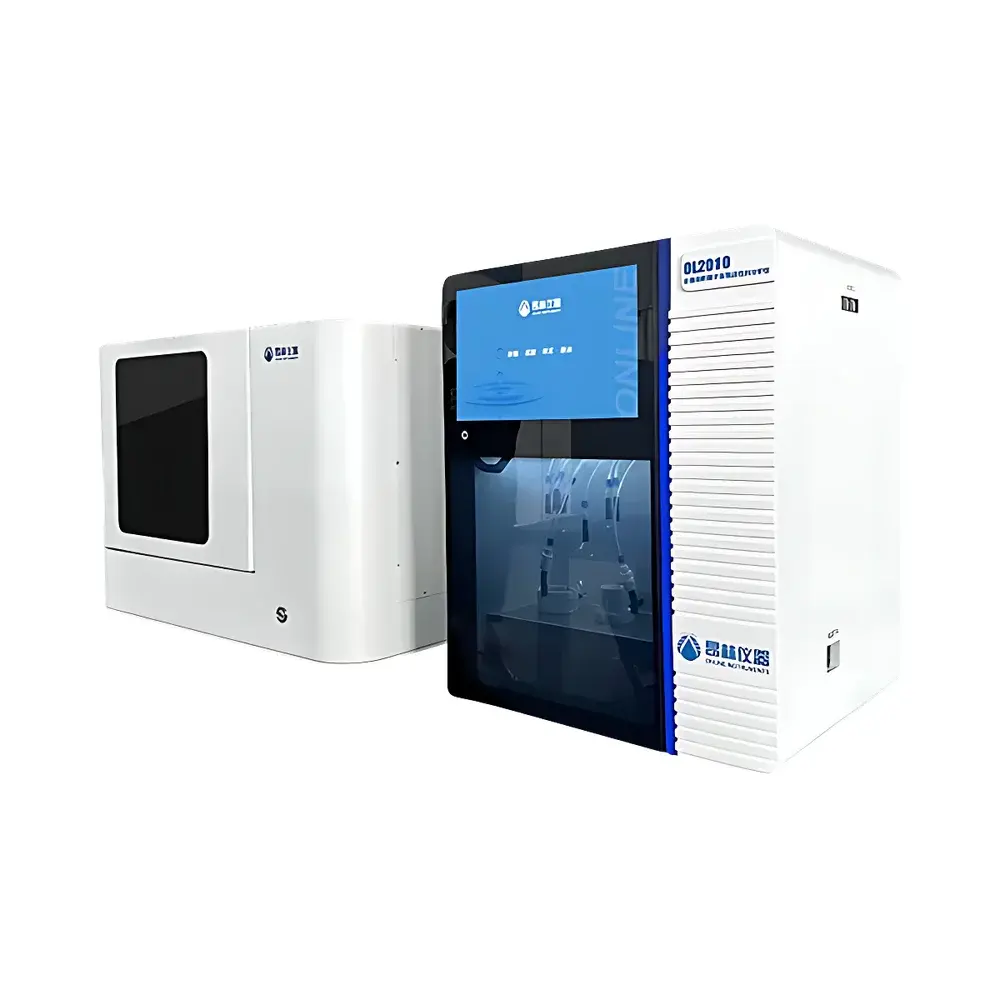
Online Instrument OL2010N Anionic Surfactant Analyzer
| Brand | Online Instrument |
|---|---|
| Origin | Shanghai, China |
| Manufacturer Type | Manufacturer |
| Product Category | Domestic |
| Model | OL2010N |
| Instrument Type | Benchtop |
| Ion Detection Capability | Multi-ion |
| Measurement Range | 0.05–2 mg/L |
| Limit of Detection (LOD) | 0.01 mg/L |
| Response Time | Real-time |
| Measurement Accuracy | ±2% |
| Operating Temperature Range | 5–35 °C |
Overview
The Online Instrument OL2010N Anionic Surfactant Analyzer is a fully automated benchtop analytical system engineered for precise, reproducible quantification of anionic surfactants—including linear alkylbenzene sulfonates (LAS), alkyl sulfates (AS), and alkyl ether sulfates (AES)—in aqueous environmental matrices. It operates on the principle of methylene blue active substances (MBAS) spectrophotometric detection following standardized liquid–liquid extraction, as defined in internationally harmonized methods including ISO 7875-2, ASTM D2330, and the Chinese national standards GB 7494–1987, GB/T 5750.4–2023, GB 17378.4–2007, GB 8538–2016, and GB/T 39302–2020. The instrument implements a closed-loop chloroform-based extraction protocol with sequential forward extraction and back-extraction (reverse transfer), ensuring high analyte recovery (>95%) while minimizing emulsion formation and phase separation variability. Its architecture integrates fluidic precision, optical stability, and process automation to meet regulatory-grade performance requirements for routine water quality laboratories operating under GLP or ISO/IEC 17025 frameworks.
Key Features
- Fully automated sample processing: Integrated disk-type autosampler supports configurable sample racks (25-, 50-, or 55-position; scalable upon request), enabling unattended batch analysis.
- Multi-stage extraction control: Programmable forward and reverse extraction cycles—adjustable per method requirements—to optimize surfactant recovery across diverse water matrices (e.g., seawater, wastewater, drinking water).
- Precision fluid handling: Dual-mode reagent delivery combining high-accuracy syringe pumps and calibrated peristaltic pumps ensures consistent reagent dosing, phase transfer, and wash sequence execution.
- Closed-system safety design: All organic solvents (chloroform, isoamyl alcohol) and waste streams are handled within sealed pathways; spent reagents are automatically collected in dedicated containment vessels; exhaust gases pass through activated carbon filters prior to venting.
- Self-calibrating operation: Onboard standard preparation module generates multi-point calibration curves using certified reference materials; automatic blank subtraction and drift correction maintain long-term measurement integrity.
- Intelligent reagent management: Real-time monitoring of reagent volume levels with audible and visual alerts; low-reagent status triggers system pause to prevent invalid runs.
Sample Compatibility & Compliance
The OL2010N is validated for direct analysis of raw and treated waters without pre-filtration in most cases, including potable water, surface water, groundwater, seawater, municipal wastewater, industrial effluents, reclaimed water, and bottled natural mineral water. It complies with statutory method equivalence requirements under China’s Ministry of Ecology and Environment (MEE) and National Center for Food Safety Risk Assessment (CFSA) guidelines. Method validation data confirm linearity (R² ≥ 0.999), repeatability (RSD ≤ 3.2% at 0.5 mg/L), and robustness across turbidity (≤ 100 NTU) and salinity (≤ 35 g/L NaCl) ranges. Instrument output meets traceability requirements for ISO/IEC 17025-accredited testing laboratories and supports audit-ready electronic records compliant with FDA 21 CFR Part 11 when deployed with optional secure user authentication and electronic signature modules.
Software & Data Management
The OL2010N runs on a dedicated Windows-based control platform with intuitive touchscreen interface and optional external PC connectivity via Ethernet or USB. Software features include method library management, customizable report templates (PDF/CSV), real-time chromatogram-like extraction progress visualization, and full audit trail logging (user actions, calibration events, error codes, maintenance timestamps). Native LIMS integration is supported through ASTM E1384-compliant HL7 or CSV export protocols, enabling bidirectional data exchange with laboratory information management systems such as Thermo Fisher SampleManager, LabVantage, or Waters Empower. All raw absorbance data, peak integration parameters, and QC metrics are stored with timestamped metadata and immutable file hashing to ensure data integrity and regulatory defensibility.
Applications
This analyzer serves environmental monitoring agencies, municipal water utilities, industrial pretreatment facilities, third-party testing laboratories, academic research centers, and regulatory compliance departments requiring routine surveillance of surfactant contamination. Typical use cases include discharge permit verification (e.g., NPDES, MEE Order No. 15), source water vulnerability assessment, detergent formulation QA/QC, biodegradation kinetics studies, and wastewater treatment plant performance evaluation. Its ability to handle high-salinity and high-turbidity samples makes it especially suitable for coastal monitoring programs and textile/pharmaceutical effluent characterization.
FAQ
Does the OL2010N support method customization beyond the listed Chinese national standards?
Yes—the software allows users to define custom extraction sequences, reagent volumes, dwell times, and calibration protocols aligned with internal SOPs or emerging international methods.
Is operator training included with system installation?
Standard commissioning includes on-site hardware verification, software configuration, and two-day hands-on operational training for up to three laboratory personnel.
What maintenance intervals are recommended for sustained accuracy?
Daily system flush and weekly optical path inspection are advised; quarterly pump tubing replacement and annual photometer wavelength calibration are documented in the maintenance logbook.
Can the instrument be integrated into an existing network with centralized IT security policies?
Yes—it supports domain authentication, TLS 1.2 encrypted data transmission, and configurable firewall port settings compatible with enterprise-grade network infrastructure.
Is technical support available outside business hours for urgent operational issues?
Online Instrument provides 24/7 remote diagnostics access and escalation paths to field service engineers in APAC, with SLA-defined response windows based on contract tier.
Related Products







