
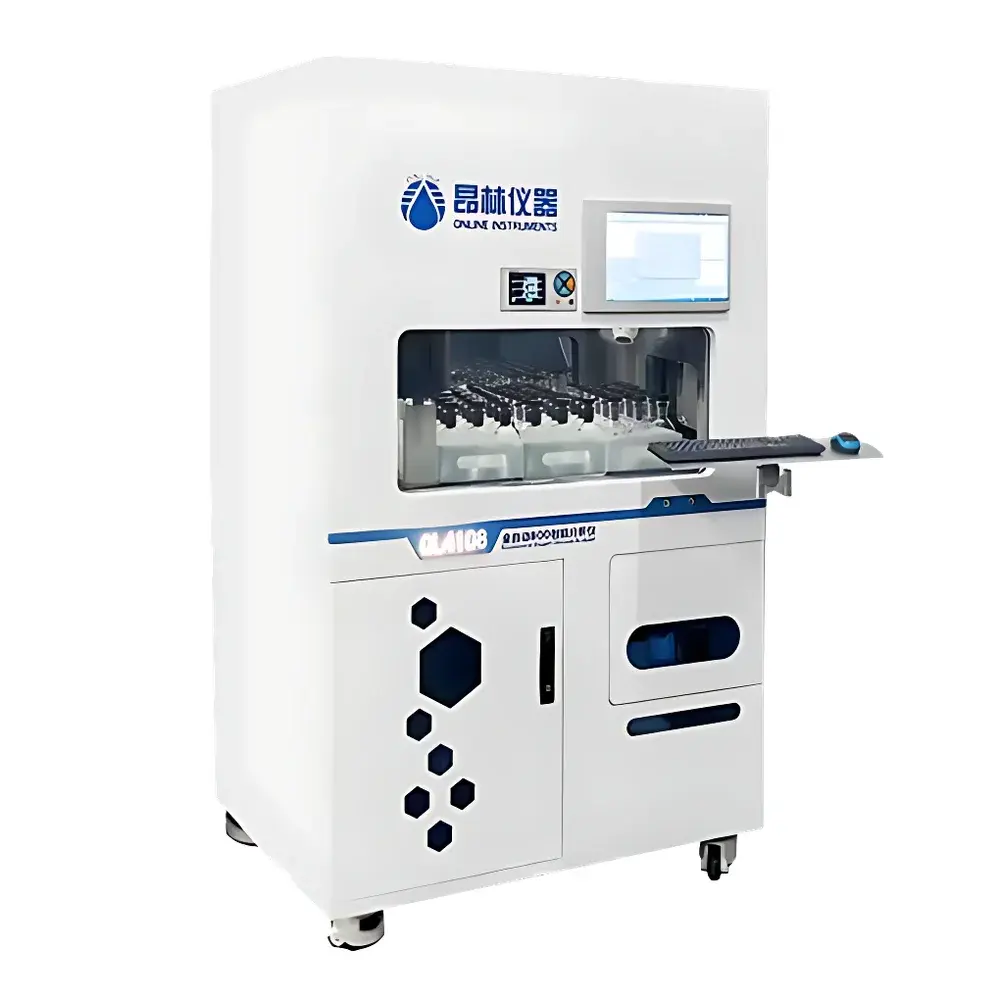
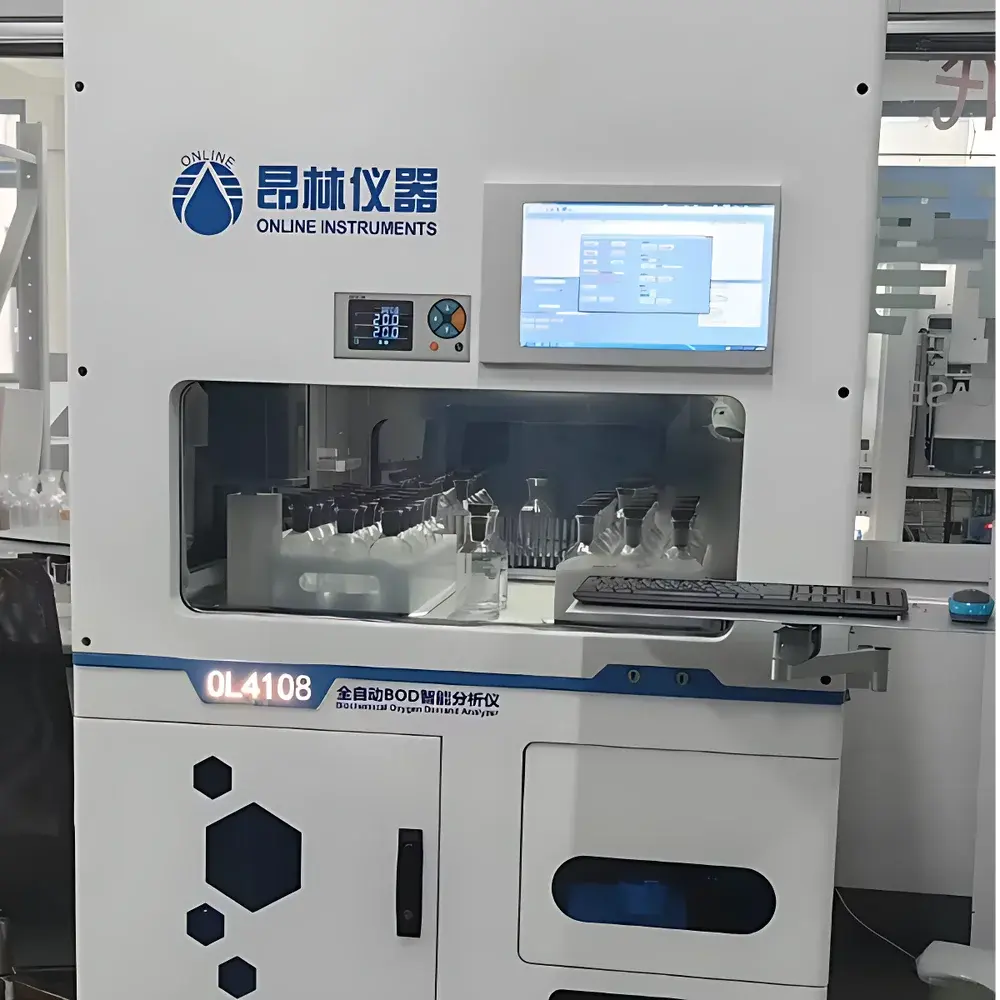
Online Instrument OL4054/OL4108 Automated BOD Analyzer (Microbial Electrode Method)
| Brand | Online Instrument |
|---|---|
| Origin | Shanghai, China |
| Manufacturer | Yes |
| Type | Laboratory BOD Analyzer |
| Model | OL 4054 / OL 4108 |
| Measurement Principle | Microbial Electrode Method |
| Measurement Range | 0–6000 mg/L |
| Detection Limit | 0.5 mg/L |
| Accuracy | ±0.3 mg/L (≤6 mg/L) |
| Incubation Duration | 5-day standard BOD₅ protocol |
| Sample Capacity | 54 or 108 positions (customizable) |
| Compliance Standard | HJ 505–2009 (China Environmental Protection Standard) |
Overview
The Online Instrument OL4054 and OL4108 Automated BOD Analyzers are laboratory-grade, fully automated systems engineered for precise, reproducible, and regulatory-compliant measurement of five-day biochemical oxygen demand (BOD5) in water and wastewater samples. These instruments implement the microbial electrode method — a rapid, electrochemical alternative to the conventional dilution-and-inoculation technique — enabling real-time monitoring of oxygen consumption by a fixed-biofilm microbial sensor under controlled aerobic conditions. Unlike respirometric manometric or titrimetric methods, the microbial electrode approach delivers continuous signal output proportional to metabolic activity, minimizing manual intervention while maintaining alignment with the conceptual foundation of BOD5 as defined in HJ 505–2009. The system is designed for unattended operation over the full 120-hour incubation period, integrating temperature-stabilized incubation, programmable dilution, and automatic dissolved oxygen (DO) quantification at endpoint.
Key Features
- Fully automated workflow: Integrated robotic sampling, precision dilution water dispensing, auto-capping of 250 mL standard BOD bottles, and water-seal addition — eliminating operator-dependent variability.
- Intelligent dilution optimization: Algorithm-driven selection of up to three optimal dilution ratios per sample based on preliminary conductivity and DO screening, ensuring measurements fall within the linear dynamic range (0.5–6000 mg/L).
- Microbial electrode sensor with self-regenerating biofilm: Factory-calibrated amperometric transducer with immobilized nitrifying and heterotrophic bacteria; provides stable response with <0.5 mg/L detection limit and <±0.3 mg/L absolute error at low concentrations (≤6 mg/L).
- Active thermal management: PID-controlled incubation chamber with door-open compensation logic and ±0.2 °C stability across 20 °C ±1 °C — meeting ISO 5815-1:2019 requirements for BOD incubation uniformity.
- Automated sensor maintenance: Scheduled electrolyte refresh, membrane cleaning cycle, and waste evacuation to sustain long-term electrode sensitivity and reduce downtime.
- Time-synchronized calibration: User-definable or periodic zero/span verification using certified air-saturated water and sodium sulfite standards, logged with full audit trail.
Sample Compatibility & Compliance
The OL4054/OL4108 accommodates standard 250 mL glass or PET BOD bottles conforming to ISO 5815-1 and HJ 505–2009 dimensional specifications. It supports diverse matrices including surface water, municipal wastewater, industrial effluents, and pretreated leachate — provided samples are free of cytotoxic inhibitors (e.g., heavy metals, residual chlorine) above threshold levels specified in ASTM D5210. All operational parameters — incubation duration (120 h), temperature setpoint (20 °C), and dilution protocol — are configurable to satisfy national and international regulatory frameworks, including US EPA Method 405.1 (microbial electrode variant), ISO 5815-2:2022, and GLP-compliant environmental testing workflows. Data integrity safeguards comply with ALCOA+ principles and support 21 CFR Part 11 readiness when deployed with validated LIMS integration.
Software & Data Management
The embedded control software (v3.2+) offers dual-mode operation: local touchscreen interface and secure remote access via TLS-encrypted web portal or native iOS/Android application. Real-time dashboards display incubation progress, DO decay curves, intermediate dilution logs, and pass/fail status against user-defined acceptance criteria. All raw sensor outputs, timestamps, environmental metadata (chamber temp, humidity), and operator actions are stored in immutable SQLite databases with SHA-256 hashing. Export formats include CSV, PDF analytical reports (with digital signature), and structured XML for seamless ingestion into LIMS platforms via HL7 or RESTful API. Audit trails record every parameter change, calibration event, and result override — supporting internal QA reviews and external accreditation audits (e.g., CNAS, UKAS).
Applications
- Regulatory compliance monitoring for wastewater treatment plants discharging to receiving waters (e.g., permits under China’s GB 8978–1996 or EU Urban Wastewater Treatment Directive).
- Process control in activated sludge and MBR systems, where rapid BOD5 feedback informs aeration optimization and sludge retention time adjustments.
- Environmental impact assessments (EIA) requiring high-throughput analysis of river, lake, and groundwater samples across seasonal campaigns.
- Research laboratories investigating biodegradability kinetics of emerging contaminants (e.g., pharmaceuticals, PFAS precursors) using modified 5-day or extended incubation protocols.
- Third-party testing labs serving ISO/IEC 17025-accredited services, where traceability, inter-laboratory reproducibility, and electronic record retention are mandatory.
FAQ
What regulatory standards does the OL4054/OL4108 validate against?
It is configured to meet HJ 505–2009 (China), ISO 5815-1:2019, and ASTM D5210, with optional firmware modules for US EPA 405.1 alignment.
Can the system handle samples with high suspended solids or toxicity?
Yes — the intelligent dilution algorithm and optional pre-filtration module mitigate interference; however, samples exceeding 500 mg/L TSS or containing >0.5 mg/L free chlorine require quenching or dilution prior to loading.
Is remote data export compatible with common LIMS vendors?
Yes — certified connectors exist for Thermo Fisher SampleManager, LabVantage, and STARLIMS; custom mapping is supported via documented JSON schema.
How frequently must the microbial electrode be replaced?
Under typical use (≤200 samples/month), the sensor maintains performance for ≥12 months; replacement kits include recalibration certificates traceable to NIM (China National Institute of Metrology).
Does the instrument support non-standard incubation durations (e.g., 2-day or 7-day BOD)?
Yes — incubation time, temperature, and endpoint logic are fully programmable, enabling research-grade kinetic modeling beyond standard BOD5.







