
Redback Systems RS10k High-Resolution Echelle Spectrometer
| Brand | Redback Systems |
|---|---|
| Origin | Australia |
| Model | RS10k |
| Spectral Range | 450–1030 nm |
| Resolution (R = λ/Δλ) | 17,000–10,000 |
| Wavelength Stability | <10 pm/°C |
| Wavelength Accuracy | <50 pm |
| SNR | 350:1 |
| Detector | Uncooled Sony STARVIS CMOS |
| Pixel Read Noise | <2 e⁻/pixel (rms) |
| Dark Current | <0.5 e⁻/pixel/s |
| Exposure Time | 1 ms–60 s |
| Data Acquisition Rate | Up to 10 Hz |
| Input Interface | Single-mode fiber, FC/PC |
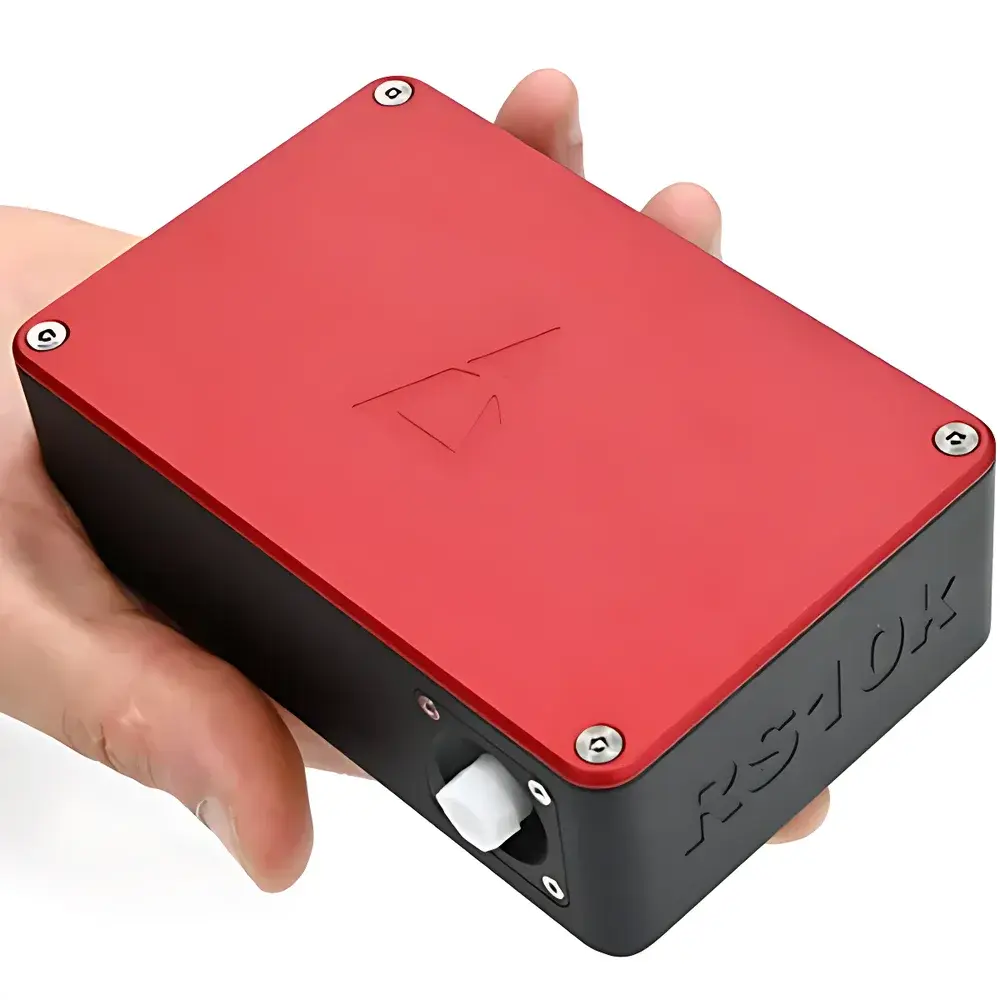
| Dimensions (H×W×L) | 40 mm × 78 mm × 120 mm |
| Polarization Independence | Yes |
| Software | RedSolve (license-free) |
| API | Python-based RedMote SDK |
Overview
The Redback Systems RS10k is a compact, high-resolution echelle spectrometer engineered for demanding spectroscopic applications requiring simultaneous broad spectral coverage and fine wavelength discrimination. Unlike conventional Czerny–Turner or grating monochromators, the RS10k employs a crossed-dispersion optical architecture: a high-line-density echelle grating provides primary dispersion along one axis, while a secondary prism or grating—oriented orthogonally—introduces cross-dispersion along the perpendicular axis. This two-dimensional spectral encoding enables full spectrum acquisition (450–1030 nm) in a single exposure on a 2D CMOS sensor, eliminating mechanical scanning and preserving temporal fidelity. The instrument leverages the Sony STARVIS generation of back-illuminated CMOS sensors, delivering exceptional quantum efficiency across the visible and near-infrared (NIR), particularly critical for low-light applications such as plasma diagnostics, fluorescence lifetime studies, and weak Raman signal detection. Its echelle design achieves resolving power (R = λ/Δλ) between 10,000 and 17,000—corresponding to sub-picometer resolution at 633 nm—without cryogenic cooling or vacuum enclosures, making it suitable for benchtop integration in academic, industrial, and field-deployable environments.
Key Features
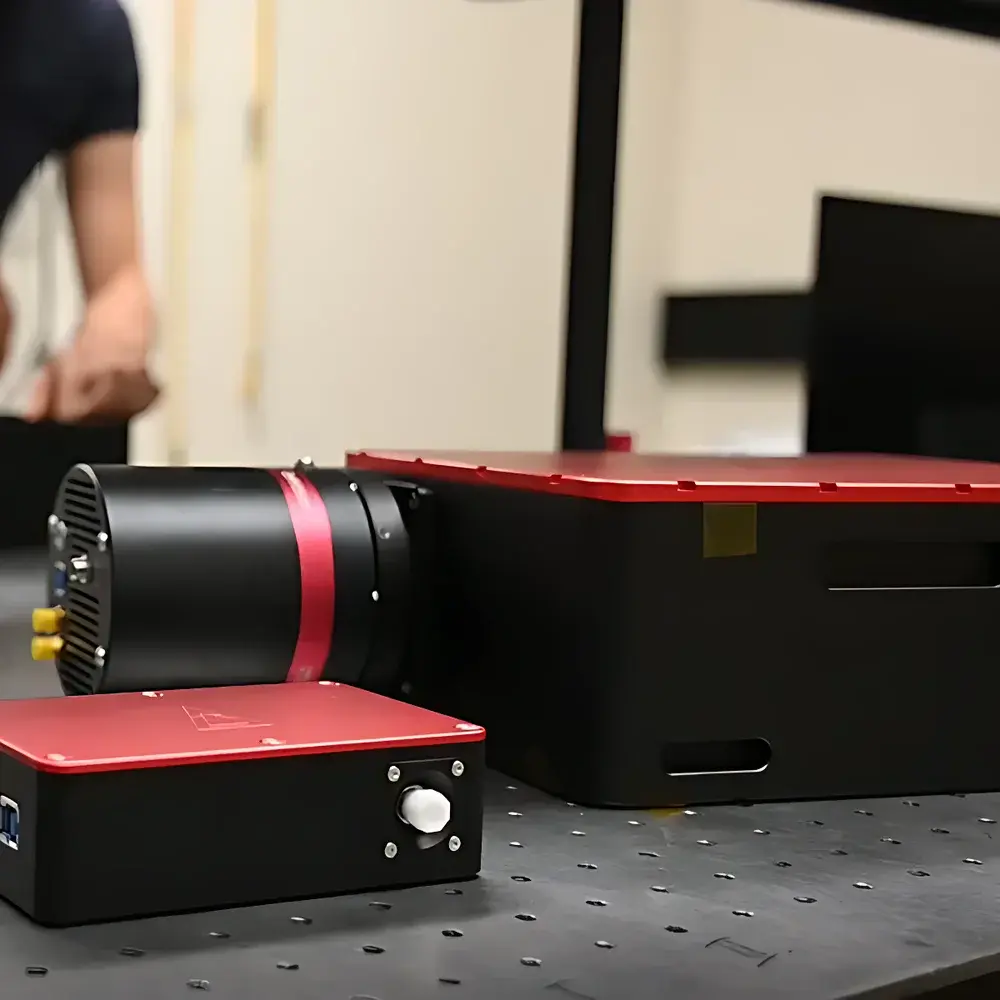
- Compact footprint (40 × 78 × 120 mm) — fits within standard optical breadboard spacing and integrates seamlessly into OEM systems or portable measurement platforms.
- Polarization-insensitive optical path — eliminates need for polarization control optics or realignment when characterizing unpolarized or randomly polarized sources (e.g., plasmas, LEDs, incandescent sources).
- Uncooled Sony STARVIS CMOS detector — delivers >80% peak QE from 500–900 nm, with ultra-low read noise (<2 e⁻/pixel rms) and dark current (<0.5 e⁻/pixel/s), enabling high-fidelity acquisition of transient or low-intensity spectra.
- Thermally stabilized optical bench — wavelength drift maintained below 10 pm/°C, ensuring measurement repeatability over extended acquisition sessions without active thermal regulation.
- Single-mode fiber input (FC/PC) — optimized for spatial mode filtering and coupling efficiency; compatible with standard SMF-28 and similar fibers used in laser characterization and fiber-sensor interrogation.
- Real-time acquisition up to 10 Hz — supports dynamic process monitoring, including plasma evolution, pulsed laser mode analysis, and time-resolved fluorescence decay profiling.
Sample Compatibility & Compliance
The RS10k accepts light via single-mode fiber input, making it inherently compatible with any source that can be coupled into SMF — including diode lasers, supercontinuum sources, arc lamps, plasma emission ports, and fiber-coupled Raman probes. Its wide 450–1030 nm spectral window covers key atomic lines (e.g., Na D-doublet at 589 nm, H-alpha at 656 nm), molecular vibrational overtones, and NIR telecom bands (O-, E-, S-, C-, L-bands). The system complies with general laboratory safety standards for Class 1 optical instruments (IEC 60825-1:2014) and meets electromagnetic compatibility requirements per CISPR 11 Group 1, Class B. While not certified for GMP/GLP environments out-of-the-box, its deterministic data capture, timestamped metadata logging, and software audit trail capabilities (via RedSolve’s export history and parameter snapshots) support alignment with ISO/IEC 17025 documentation requirements for calibration laboratories. All firmware and software binaries are digitally signed and version-controlled to ensure traceability in regulated workflows.
Software & Data Management
RedSolve — the native, license-free acquisition and analysis suite — is built on a modular Qt-based framework and designed for both novice users and automated integration. It provides live preview with adjustable gain, exposure, and ROI selection; real-time spectral plotting with logarithmic intensity scaling; and multi-ROI tracking synchronized to acquisition triggers. All raw and processed data are saved in plain-text CSV format (no proprietary binary containers), with header rows specifying wavelength calibration coefficients, exposure parameters, and hardware timestamps — facilitating direct import into MATLAB, Python (NumPy/Pandas), or LabVIEW. The included plotting engine supports overlay, normalization, baseline subtraction, and peak centroiding using centroid-weighted or Gaussian fitting algorithms. For compliance-driven environments, RedSolve optionally logs user actions, parameter changes, and acquisition events to a local SQLite database — supporting rudimentary 21 CFR Part 11 readiness when deployed with network-authenticated login and write-protected storage. The RedMote Python SDK exposes full instrument control (exposure, ROI, trigger mode, calibration loading) and raw frame access, enabling scripted batch acquisition, closed-loop feedback in adaptive optics setups, or integration into CI/CD pipelines for spectral model training.
Applications
- Plasma diagnostics: Real-time monitoring of SF6/O2 etch chemistry in microfabrication reactors via atomic line ratios (e.g., O I 777 nm, F I 685 nm) and rotational band analysis.
- Laser longitudinal mode analysis: Resolving sub-GHz mode spacing in Fabry–Pérot diode lasers (e.g., 650 nm fault detectors) without external interferometry.
- Solar and stellar spectroscopy: Capturing Fraunhofer absorption features (e.g., Na doublet, Ca II H&K) for elemental abundance modeling and photospheric temperature estimation.
- Fiber-optic sensing: Interrogating wavelength-encoded FBG or interferometric sensors in structural health monitoring or distributed temperature sensing systems.
- Raman spectroscopy: Coupling with 785 nm excitation sources to resolve narrow Raman shifts (<1 cm−1) in pharmaceutical crystallinity assays or carbon nanotube chirality mapping.
- Quantum light source characterization: Measuring spectral purity, linewidth, and Hong–Ou–Mandel dip visibility in SPDC and quantum dot emitters.
FAQ
Is the RS10k calibrated at the factory? What calibration standards are used?
Yes — each unit ships with NIST-traceable wavelength calibration performed using Hg/Ar hollow-cathode lamp emission lines across the full 450–1030 nm range. Intensity response is characterized using a calibrated tungsten-halogen source (NIST SRM 2031), and calibration files are embedded in firmware and accessible via RedSolve.
Can the RS10k operate in vacuum or high-humidity environments?
The RS10k is rated for operation in ambient laboratory conditions (15–30 °C, <80% RH non-condensing). It is not hermetically sealed and is not rated for vacuum or corrosive atmospheres. For controlled-environment integration, external environmental enclosures are recommended.
Does RedSolve support scripting or third-party automation?
Yes — RedMote, the official Python SDK, provides synchronous and asynchronous control interfaces, including trigger synchronization, ROI streaming, and real-time background subtraction. Example notebooks and CI-tested GitHub repositories are provided for common use cases.
What is the effective pixel resolution in wavelength space?
With typical calibration, the RS10k achieves ~0.5–1.2 pm/pixel RMS uncertainty in wavelength assignment depending on spectral order and region — sufficient to resolve hyperfine structure in atomic transitions and narrow-linewidth laser emissions.
Is fiber coupling efficiency affected by input polarization?
No — the optical train is intentionally designed to be polarization-insensitive. Coupling efficiency remains stable regardless of input polarization state, simplifying integration with unpolarized sources like plasmas or broadband LEDs.




