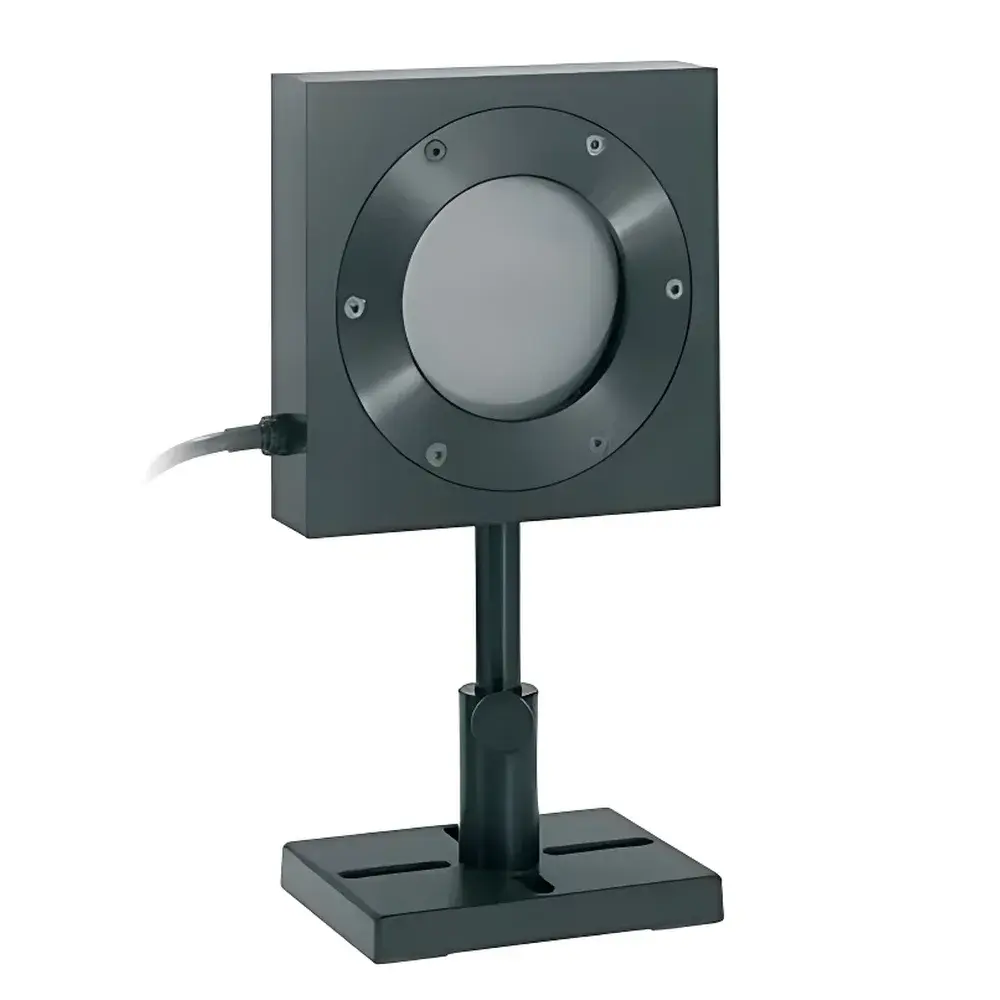
Ophir 30(150)A-BB-18 Medium-Power Thermopile Sensor Head
| Brand | Ophir |
|---|---|
| Origin | Israel |
| Model | 30(150)A-BB-18 |
| Cooling | Conductive |
| Power Range | 30 mW–150 W (CW up to 50 W, Intermittent up to 150 W) |
| Wavelength Range | 0.15–20 µm |
| Absorber Type | Broadband BB Coating |
| Output | Analog via BNC |
| Optional Accessories | Fiber Adapters, IPL-Specific Absorbers, Calibration Certificates (NIST-traceable) |
Overview
The Ophir 30(150)A-BB-18 is a medium-power thermopile-based optical power and energy sensor head engineered for high-fidelity radiometric measurement in industrial, R&D, and clinical laser applications. Utilizing a robust thermoelectric detection principle—where incident optical radiation is absorbed by a broadband black-body (BB) coating and converted into a proportional thermal gradient across a thermopile junction—the sensor delivers stable, wavelength-independent responsivity across an exceptionally wide spectral band (0.15–20 µm). This makes it suitable for characterizing continuous-wave (CW) lasers, long-pulse sources (ms–s duration), quasi-CW systems, excimer lasers (e.g., 193 nm, 248 nm), CO₂ lasers (10.6 µm), and intense pulsed light (IPL) devices used in dermatology. Its conductive cooling architecture eliminates reliance on forced airflow or liquid circuits, ensuring operational stability in enclosed or vibration-sensitive environments while maintaining thermal equilibrium during extended measurements.
Key Features
- Conductive heat dissipation design enables reliable operation without external cooling systems—ideal for integration into OEM laser platforms or benchtop metrology stations.
- Two-tier power handling capability: rated for continuous operation up to 50 W and intermittent (duty-cycle–limited) exposure up to 150 W, supporting both steady-state process monitoring and high-peak-energy pulse characterization.
- Broadband absorber (BB coating) ensures flat spectral response from deep UV (150 nm) through visible and NIR to far-IR (20 µm), minimizing calibration dependency on source wavelength.
- High sensitivity range spanning three decades—from 30 mW minimum detectable power to full-scale 150 W—enabling traceable measurement across low-power alignment beams and mid-power processing lasers.
- Modular interface support: standard BNC analog output (10 mV/W typical) for direct connection to digital power meters (e.g., Ophir StarLite, Vega) or DAQ systems; optional fiber-optic adapters accommodate collimated or focused beam delivery via SMA905 or FC/PC connectors.
- Dedicated IPL-optimized variants available with tailored absorber thermal mass and rise-time characteristics to meet IEC 60601-2-57 requirements for medical light-based equipment verification.
Sample Compatibility & Compliance
The 30(150)A-BB-18 accommodates free-space beams with diameters ≥3 mm and power densities up to 10 kW/cm² (with appropriate beam homogenization or defocusing), making it compatible with focused Nd:YAG, diode, and fiber laser outputs. It supports single-shot energy measurement for pulses ≥10 ms, complying with ISO 11554 (laser beam parameters) and ASTM E1082 (radiant power measurement of lasers). When used with NIST-traceable calibration certificates (available upon request), the sensor meets GLP documentation requirements for quality-controlled manufacturing environments. Its mechanical housing conforms to IP54 ingress protection standards, and all electrical interfaces comply with IEC 61000-6-3 (EMC emission limits) and IEC 61010-1 (safety for electrical equipment).
Software & Data Management
When paired with Ophir’s StarLab or BeamGage software suites, the sensor enables real-time power logging, statistical analysis (min/max/avg/stdev), trend charting, and automated pass/fail threshold reporting. Data export supports CSV, XML, and HDF5 formats for integration into LIMS or MES platforms. Audit trails—including operator ID, timestamp, calibration expiration date, and sensor serial number—are retained per FDA 21 CFR Part 11 guidelines when configured with user authentication and electronic signature modules. Firmware updates are delivered via USB or Ethernet, ensuring long-term compatibility with evolving regulatory data integrity expectations.
Applications
- Laser system commissioning and periodic performance verification in semiconductor lithography, laser welding, and additive manufacturing cells.
- Medical device validation for IPL, Nd:YAG, and diode-based aesthetic systems—supporting compliance with ISO 13485 and IEC 62304.
- R&D labs measuring broadband thermal sources (e.g., globars, synchrotron IR beamlines) and ultrafast amplifier outputs after pulse stretching.
- Calibration laboratories performing secondary standard transfer according to ISO/IEC 17025, using the sensor as a transfer standard within accredited power measurement chains.
- Defense and aerospace testing of directed-energy weapon subsystems operating in multi-spectral bands (UV to LWIR).
FAQ
What is the recommended maximum beam diameter for accurate measurement with the 30(150)A-BB-18?
The active aperture measures 18 mm in diameter; for uniform spatial responsivity, incident beams should be fully contained within this area and ideally ≤15 mm to avoid edge effects.
Can this sensor measure pulsed lasers with nanosecond durations?
No—it is optimized for pulses ≥10 ms due to thermal time constant limitations; for ns–µs pulses, Ophir PE50BF or 3A-FS pyroelectric sensors are recommended.
Is NIST-traceable calibration included by default?
Calibration is performed at Ophir’s ISO/IEC 17025-accredited facility, but NIST-traceable certificates require explicit selection at time of order.
Does the sensor require warm-up time before use?
Yes—a 15-minute thermal stabilization period is recommended prior to high-accuracy measurements to minimize drift from ambient thermal transients.
Can the BB absorber be replaced in the field?
Absorber replacement is a factory-only service; damage to the coating voids calibration and requires return for refurbishment and recalibration.