
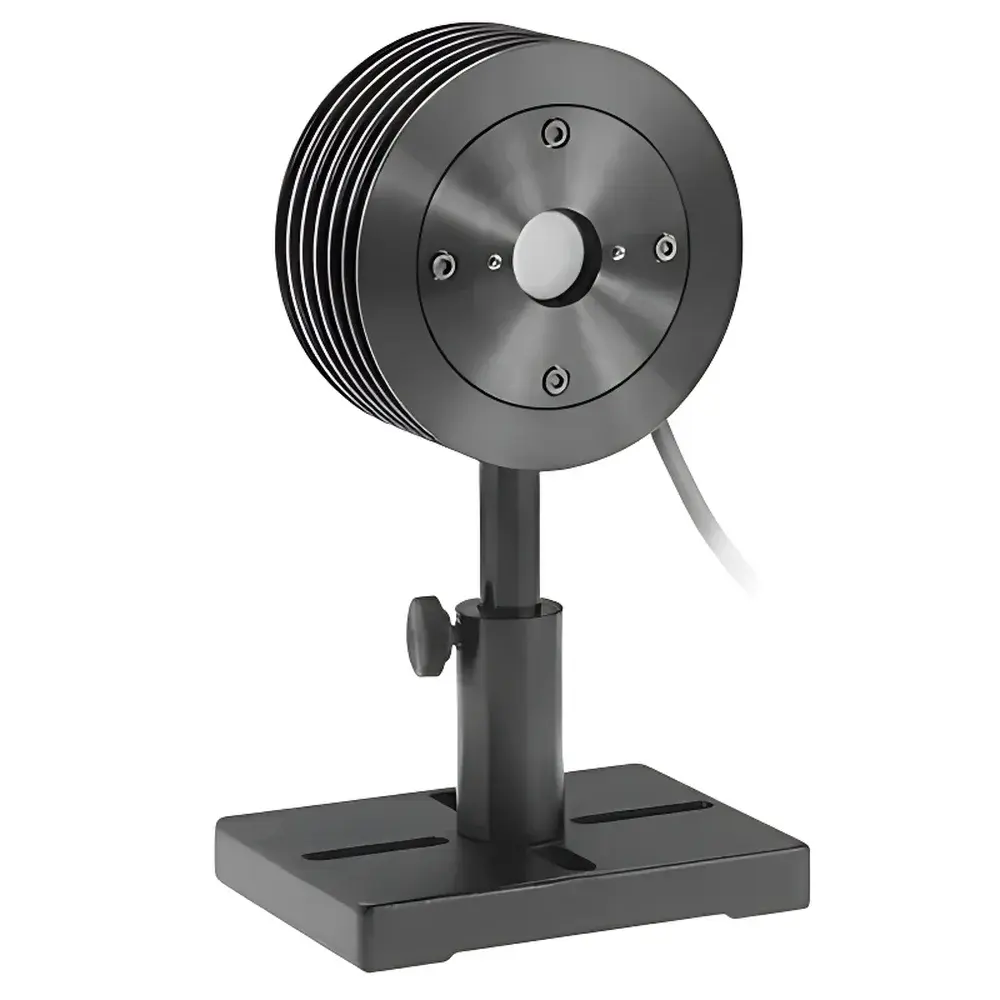
Ophir 3A-FS/30A-BB-18 Low-Power Thermopile Laser Power Sensor Head
| Brand | Ophir |
|---|---|
| Origin | USA |
| Model | 3A-FS/30A-BB-18 |
| Power Range | 2 mW – 150 W (50 W continuous, 150 W intermittent) |
| Energy Range | 20 µJ – 30 J |
| Spectral Range | 0.19 – 20 µm |
| Noise Level | 2 µW (RMS) |
| Drift | 2–10 µW over 30 min |
| Response Time | as fast as 0.8 s |
| Cooling | Conductive (no fan or water required) |
| Output | Analog BNC (±1 V full scale), compatible with Ophir StarLite, Vega, Juno, and Nova II meters |
Overview
The Ophir 3A-FS/30A-BB-18 is a high-sensitivity, conductively cooled thermopile-based laser power and energy sensor head engineered for precision measurement of low-power continuous-wave (CW) and pulsed laser sources across an exceptionally broad spectral band—from deep ultraviolet (190 nm) to far-infrared (20 µm), including the technologically critical terahertz (THz) region. Unlike photodiode-based sensors, this thermopile architecture operates on the principle of thermal conversion: incident optical radiation is absorbed by a spectrally uniform coating, generating a temperature gradient across a multi-junction thermopile array, which produces a proportional millivolt-level output voltage. This fundamental physics ensures wavelength-independent responsivity—eliminating calibration drift due to spectral shifts—and enables traceable, absolute power measurement without reliance on reference standards at each wavelength. The sensor’s conductive thermal path—integrated into a robust aluminum housing—ensures stable baseline performance without active cooling, making it ideal for integration into vibration-sensitive optical tables, vacuum-compatible enclosures, or compact OEM systems where airflow or liquid cooling is impractical.
Key Features
- Ultra-low noise floor of 2 µW RMS, enabling reliable detection and quantification of sub-milliwatt CW beams with high signal-to-noise ratio
- Thermally stabilized design with typical drift of only 2–10 µW over 30 minutes, supporting long-duration stability-critical applications such as laser diode aging tests or cavity ring-down calibration
- Flat spectral response across 0.19–20 µm, validated via NIST-traceable calibration at discrete wavelengths and extended through interpolation; includes explicit THz calibration points (e.g., 1–3 THz) for metrology-grade characterization of quantum cascade lasers and photoconductive emitters
- Optimized thermocouple geometry achieves response times as short as 0.8 seconds (t90), balancing speed and thermal inertia for accurate single-pulse energy capture up to 30 J
- Dual-range capability: supports both CW operation up to 50 W and intermittent (pulsed or duty-cycled) loads up to 150 W, with automatic range switching compatibility in supported meter platforms
- Modular absorber options—including FS (fast response, UV-VIS-NIR optimized), BB-18 (broadband, high-damage-threshold), and custom coatings—allow tailoring to specific beam profiles, pulse durations (ns to CW), and peak power densities
Sample Compatibility & Compliance
The 3A-FS/30A-BB-18 accommodates free-space beams up to Ø18 mm (BB-18 aperture) or Ø3 mm (FS variant), with optional fiber adapters (FC/PC, SMA905) enabling direct coupling to multimode fibers up to 600 µm core diameter. Its absorber surface withstands irradiance levels exceeding 10 kW/cm² for nanosecond pulses and >100 W/cm² for CW operation—validated per ISO 11551:2022 (Laser and laser-related equipment — Test methods for laser beam parameters). All factory calibrations are performed in accordance with ISO/IEC 17025:2017 requirements and include uncertainty budgets traceable to NIST Standard Reference Materials. The sensor meets electromagnetic compatibility (EMC) requirements per EN 61326-1:2013 and carries CE marking for use within the European Economic Area. For regulated environments, its analog BNC output supports integration into FDA 21 CFR Part 11-compliant data acquisition workflows when paired with Ophir’s StarLite or Vega meters featuring audit trail and electronic signature functionality.
Software & Data Management
The sensor interfaces seamlessly with Ophir’s proprietary software suite—including StarLab v4.x and LabVIEW-compatible drivers—enabling real-time power logging, statistical analysis (min/max/avg/std dev), and automated pass/fail thresholding. Raw analog output (±1 V full-scale, linear over entire dynamic range) permits integration with third-party DAQ systems (e.g., National Instruments PXI, Keysight DAQ970A) using user-defined scaling factors provided in the certificate of calibration. Each unit ships with a unique, NIST-traceable calibration certificate listing wavelength-specific responsivity values, combined standard uncertainty (k=2), and date of validity. Firmware-upgradable meters support automatic sensor recognition and embedded calibration file loading—eliminating manual coefficient entry and reducing operator error risk in GLP/GMP laboratories.
Applications
- Calibration and verification of low-power diode lasers, VCSEL arrays, and fiber-coupled pump sources in semiconductor manufacturing
- THz source characterization in time-domain spectroscopy (TDS) setups and synchrotron beamlines
- Energy-per-pulse validation for ultrafast oscillators (Ti:sapphire, Yb-fiber) operating at repetition rates from single-shot to 10 MHz
- In-line process monitoring of UV curing lamps and excimer sources in display and PCB fabrication
- Reference-standard transfer between national metrology institutes (NMIs) and accredited calibration labs under CIPM MRA framework
- Academic research requiring broadband, absolute radiometric measurement without spectral correction factors
FAQ
Is this sensor suitable for measuring femtosecond laser pulses?
Yes—when configured with the FS absorber variant and used with appropriate pulse energy settings (20 µJ–30 J), it accurately captures single-shot energies from fs to ms pulses. Pulse width does not affect calibration, though peak irradiance must remain below damage thresholds.
Can I use this probe in vacuum environments?
Yes—the all-metal, epoxy-free construction and conductive cooling design are compatible with high-vacuum (≤10⁻⁶ mbar) and UHV conditions. Optional vacuum feedthrough BNC connectors are available.
Does the calibration cover the entire 0.19–20 µm range?
Calibration is performed at ≥12 discrete wavelengths across UV, VIS, NIR, MIR, and FIR bands—including THz frequencies—and interpolated per ISO 11554 Annex B. Full spectral responsivity data is supplied digitally with each unit.
How often should recalibration be performed?
Annual recalibration is recommended for ISO/IEC 17025 compliance; however, stability testing per internal SOP may extend intervals to 24 months if historical drift remains within ±0.5% of full scale.
Is fiber-optic coupling supported natively?
Yes—Ophir offers threaded fiber adapters (e.g., FVA-3A-FS) with integrated collimation optics for efficient coupling from FC/PC or SMA-terminated fibers; insertion loss and mode-field mismatch corrections are included in the calibration certificate.





