
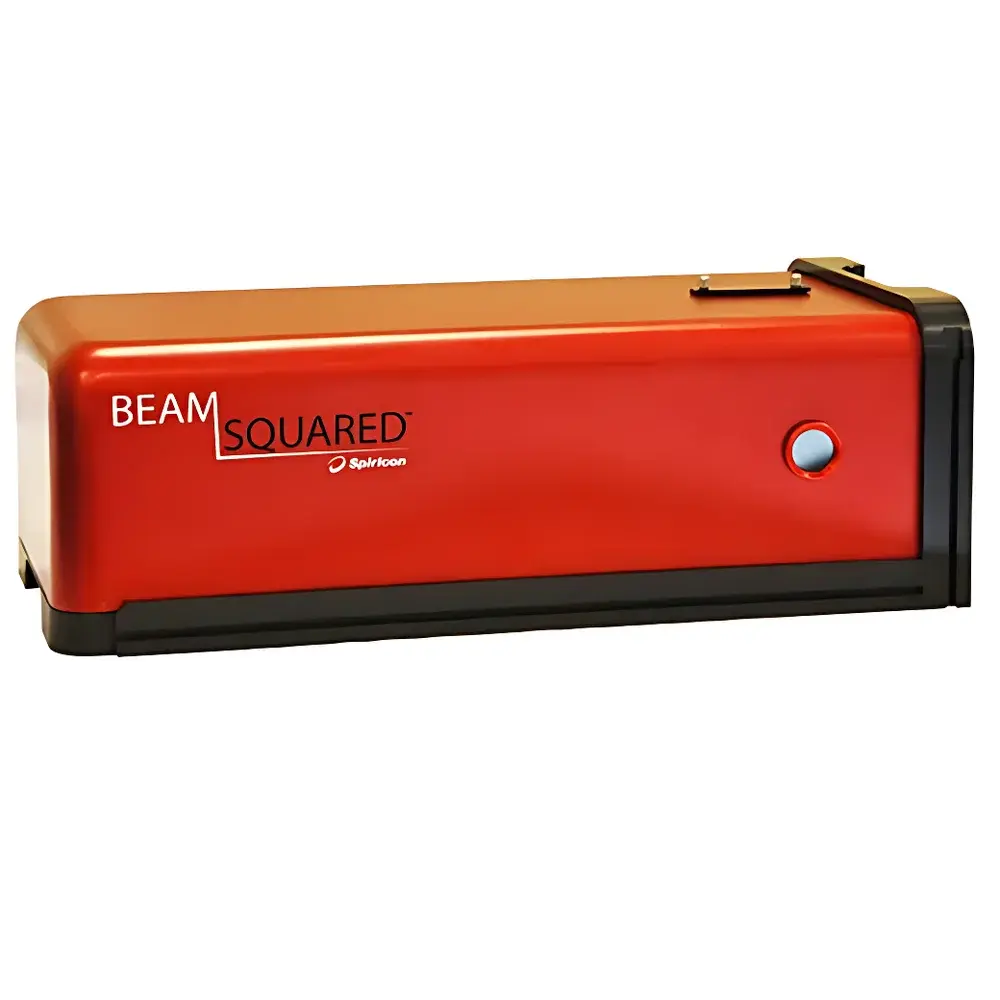
OPHIR BeamSquared Advanced Laser M² Analyzer
| Brand | OPHIR |
|---|---|
| Origin | Israel |
| Manufacturer Type | Authorized Distributor |
| Product Origin | Imported |
| Model | BeamSquared |
| Wavelength Range | 266–1100 nm (Si), 650–1700 nm (InGaAs), 355–1640 nm & 10.6 µm–3 mm (Pyroelectric) |
| Detector Pixel Pitch | 3.69 µm (Si), 30 µm (InGaAs), 80 µm (Pyroelectric) |
| Resolution | 1928 × 1448 (Si), 320 × 256 / 320 × 320 / 160 × 160 (InGaAs & Pyroelectric) |
| Frame Rate | 26 fps (full-res Si), up to 100 Hz (binned/ROI modes) |
| Interface | USB 2.0 & USB 3.0 |
| Dimensions | 45.9 cm × 21.7 cm × 11.5 cm |
| Weight | 11.7 kg (26 lbs) |
| Compliance | Fully compliant with ISO 11146-1:2005 & ISO 11146-2:2005 |
| Traceability | NIST-traceable calibration |
| Measurement Capabilities | Beam width (D4σ, knife-edge, 1/e²), centroid, peak position, intensity distribution (1D/2D/3D), Gaussian fit quality, beam pointing stability, M² factor, divergence angle, astigmatism, ellipticity |
Overview
The OPHIR BeamSquared Advanced Laser M² Analyzer is a precision-engineered optical instrument designed for rigorous, standards-compliant characterization of laser beam quality in R&D, manufacturing, and metrology laboratories. Based on the ISO 11146-1 and ISO 11146-2 methodology, it employs a scanning-slit or camera-based multi-plane measurement architecture—depending on detector configuration—to determine the second-moment (D4σ) beam widths across a series of axial positions. From these profiles, the system computes the fundamental beam propagation parameters: the Rayleigh range, confocal parameter, waist location and size, divergence angle, and ultimately the dimensionless M² factor—the definitive metric of non-ideal beam propagation relative to a diffraction-limited Gaussian beam. Unlike single-shot profilers, BeamSquared performs full spatial and temporal analysis across multiple z-planes, enabling robust reconstruction of the beam’s paraxial propagation behavior under real-world operating conditions—including CW, pulsed (nanosecond to femtosecond), Q-switched, and modulated sources.
Key Features
- Full ISO 11146-1:2005 and ISO 11146-2:2005 compliance—validated for M², beam waist, divergence, and propagation parameter extraction
- Multi-detector support: Silicon (266–1100 nm), InGaAs (650–1700 nm), and pyroelectric (355–1640 nm & 10.6 µm–3 mm) sensors—enabling broad spectral coverage across UV, VIS, NIR, SWIR, and CO₂ laser lines
- Ultracal™ single-point background subtraction technology—patented algorithm that eliminates thermal drift and ambient offset without requiring dark-frame acquisition, ensuring measurement stability over extended 24/7 operation
- Compact folded-optics cavity design with integrated motorized attenuator—reducing footprint by >30% versus legacy systems while maintaining alignment integrity and vibration immunity
- Simultaneous 1D, 2D, and 3D beam visualization—real-time intensity mapping, cross-sectional slice analysis, and volumetric reconstruction from multi-plane acquisitions
- Automated M² workflow: fully guided setup, auto-focus, dynamic range optimization, and pass/fail thresholding against user-defined specifications
Sample Compatibility & Compliance
The BeamSquared analyzer accommodates continuous-wave (CW) lasers from 10 W (with appropriate attenuation), and pulsed lasers with repetition rates from single-shot to >100 kHz and pulse energies spanning µJ to J-levels—subject to detector saturation limits and thermal loading constraints. It supports TEM₀₀, multimode, asymmetric, astigmatic, and partially coherent beams. All measurement algorithms are implemented per ISO 11146 definitions, including D4σ beam width calculation, centroid tracking, and M² regression using least-squares fitting of the measured 1/z² dependence. Calibration certificates include NIST-traceable uncertainty budgets for beam width (±0.5% typical), M² (±0.05 for M² < 3), and divergence (±1.2%). The system meets GLP documentation requirements and supports audit-ready reporting for regulated environments (e.g., medical laser validation per IEC 60825-1, industrial laser safety per ANSI Z136.1).
Software & Data Management
BeamSquared Control Software (v5.x) provides a deterministic, deterministic GUI built on Qt with deterministic acquisition timing and hardware synchronization. It features embedded scripting (Python API), batch processing queues, and configurable report templates exporting PDF, CSV, XML, and HDF5 formats. Raw image data and metadata—including timestamp, exposure, gain, filter position, and environmental sensor readings (optional)—are stored with SHA-256 checksums. The software complies with FDA 21 CFR Part 11 requirements when deployed with optional electronic signature and audit trail modules. Data export supports integration with LabVIEW, MATLAB, and Python-based analysis pipelines via standardized HDF5 schema and RESTful API endpoints.
Applications
- Laser resonator optimization and cavity alignment verification
- QC testing of fiber-coupled diodes, DPSS lasers, ultrafast amplifiers, and CO₂ slab lasers
- Beam delivery system validation—including fiber output, scanning galvanometers, and focusing optics
- Medical laser certification for dermatology, ophthalmology, and surgical platforms
- Defense & aerospace: directed energy system characterization and beam control loop validation
- Academic research in nonlinear optics, ultrafast science, and quantum photonics where beam parameter product (BPP) and M² govern experimental fidelity
FAQ
What laser types and pulse regimes does BeamSquared support?
It supports CW, quasi-CW, nanosecond, picosecond, and femtosecond lasers—provided average power and pulse energy remain within detector damage thresholds and dynamic range specifications.
Is M² measurement traceable to national standards?
Yes—each system ships with a NIST-traceable calibration certificate covering beam width, position, and M² uncertainty budgets, aligned to ISO/IEC 17025-accredited procedures.
Can BeamSquared operate unattended for long-duration stability tests?
Yes—its thermally stabilized mechanical platform, Ultracal background compensation, and watchdog-timed acquisition enable continuous 7-day monitoring with <0.2% M² drift under controlled lab conditions.
Does the software support automated pass/fail evaluation against internal specifications?
Yes—users define tolerances for M², beam diameter, pointing stability, and ellipticity; the software generates annotated reports with color-coded status indicators and configurable alerts.
How is detector selection determined for a given laser source?
Selection depends on wavelength, average power, pulse energy, and required spatial resolution—OPHIR provides application-specific detector recommendation matrices based on ISO 11551 and detector damage threshold models.



