OPHIR FluxGage LED Luminous Flux and Photometric Testing System
| Brand | OPHIR |
|---|---|
| Origin | Israel |
| Manufacturer Type | Authorized Distributor |
| Origin Category | Imported |
| Model | FluxGage |
| Pricing | Upon Request |
Overview
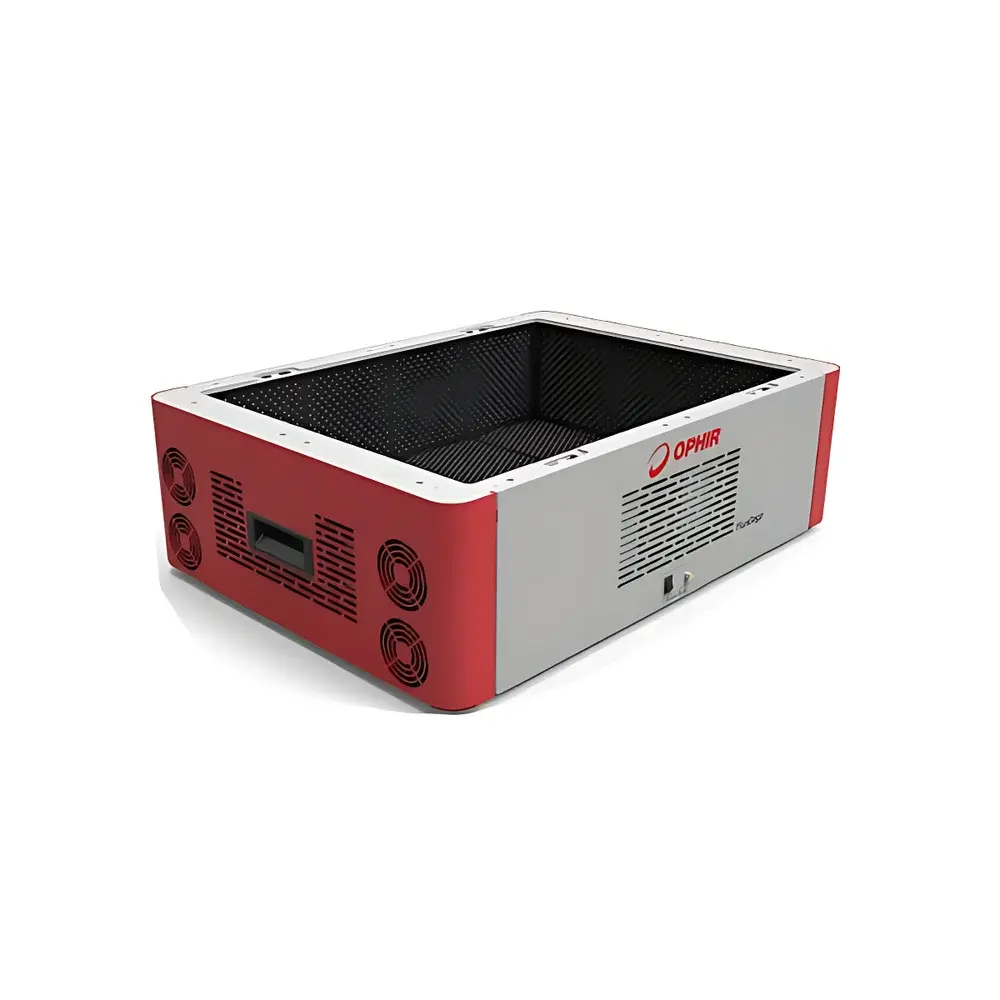
The OPHIR FluxGage is a compact, production-grade photometric testing system engineered specifically for the rapid, repeatable characterization of LED luminaires. Unlike conventional integrating sphere-based systems—which require physical enclosure dimensions several times larger than the device under test (DUT)—the FluxGage employs an open-aperture optical architecture that eliminates spatial constraints. Its core measurement principle relies on calibrated silicon photovoltaic (PV) sensor arrays—functionally replacing the integrating sphere—combined with a high-stability portable spectrometer and a fast-response photodiode. This hybrid photometric-spectroradiometric approach enables simultaneous acquisition of total luminous flux (lumens), chromaticity coordinates (x, y, u’, v’), correlated color temperature (CCT), color rendering index (CRI), spectral power distribution (SPD), and flicker metrics (including percent flicker, flicker index, and SVM) in a single, synchronized measurement cycle. Designed for industrial environments, the system operates within a controlled thermal envelope (20–35 °C) and integrates active air cooling to ensure long-term photometric stability during extended production-line duty cycles.
Key Features
- Open-aperture design accommodates luminaires up to 610 mm × 450 mm without geometric restriction—no need for oversized integrating spheres
- Integrated dual-sensor architecture: calibrated PV array for absolute luminous flux (1000–40,000 lm), plus fiber-coupled spectrometer (400–800 nm) and fast photodiode for spectral and temporal analysis
- Automated DUT detection: system triggers measurement upon source activation and applies user-defined delay to capture stabilized output, ensuring inter-batch repeatability
- Compact footprint (770 × 563 × 225 mm) — approximately one-third the volume of equivalent sphere-based systems
- USB 2.0 and Ethernet interfaces support both standalone operation and integration into automated test stations
- Comprehensive SDK included for custom software development, enabling seamless integration with MES, SPC, or factory automation platforms
- No routine recalibration required under stable ambient conditions; traceable calibration maintained via NIST-traceable reference lamps
Sample Compatibility & Compliance
The FluxGage supports full-geometry testing of directional and omnidirectional LED luminaires—including downlights, troffers, streetlights, and architectural fixtures—without requiring repositioning or auxiliary optics. It complies with key international photometric standards including CIE S 025/E:2015 (LED lamp and module testing), IES LM-79-19 (Electrical and Photometric Measurements of Solid-State Lighting Products), and ISO/CIE 19476:2014 (Flicker metrics). The system’s firmware and data logging architecture are designed to support GLP/GMP-aligned workflows, with optional audit trail configuration for regulated manufacturing environments. CE marking and RoHS compliance confirm adherence to EU safety and environmental directives.
Software & Data Management
The FluxGage Control Software provides real-time visualization of spectral curves, chromaticity diagrams (CIE 1931 and 1976 u’v’), CCT/CRI histograms, and time-resolved flicker waveforms. All raw and processed data are stored in vendor-neutral formats (CSV, XML, JSON) with embedded metadata (timestamp, operator ID, DUT serial number, ambient conditions). The SDK supports Python, C#, and LabVIEW APIs and includes sample code for automated pass/fail evaluation against user-defined specification limits (e.g., CCT ±200 K, R9 > 90, flicker index < 0.05). Data export modules comply with ASTM E308-22 spectral conversion conventions and support direct import into JMP, Minitab, or MATLAB for statistical process control.
Applications
- Final quality assurance in LED luminaire manufacturing lines
- R&D validation of driver-luminaire interactions under dynamic dimming profiles
- Long-duration aging tests monitoring lumen depreciation and chromaticity shift (L70/B50 tracking)
- Design verification of secondary optics and thermal management efficacy
- Supplier qualification and incoming inspection of LED modules and COBs
- Compliance pre-testing for ENERGY STAR, DLC, and ERP Directive submissions
FAQ
Does the FluxGage require periodic recalibration?
Calibration is traceable to NIST standards at time of shipment. Under stable laboratory or factory conditions, no routine recalibration is necessary; however, annual verification using a certified reference lamp is recommended per ISO/IEC 17025 guidelines.
Can the system measure non-LED light sources?
Yes—it supports any steady-state or modulated visible-light source (400–800 nm) including OLEDs, fluorescent tubes, and halogen lamps, though accuracy specifications assume LED-specific SPD characteristics.
Is flicker measurement compliant with IEEE 1789-2015?
Yes—the system calculates all primary flicker parameters defined in IEEE 1789-2015 and IEC TR 61547-1, including SVM, percent flicker, and flicker index, using synchronized high-speed photodiode sampling at ≥20 kHz.
What is the minimum measurable luminous flux?
The lower limit is application-dependent; with optimized integration time and signal averaging, reliable measurements begin at ~100 lm under controlled low-noise conditions.
How does the system handle thermal drift during extended testing?
Internal temperature sensors monitor PV array and spectrometer housing; real-time compensation algorithms adjust gain and offset based on thermal feedback, maintaining flux repeatability within ±1% over 8-hour continuous operation.