
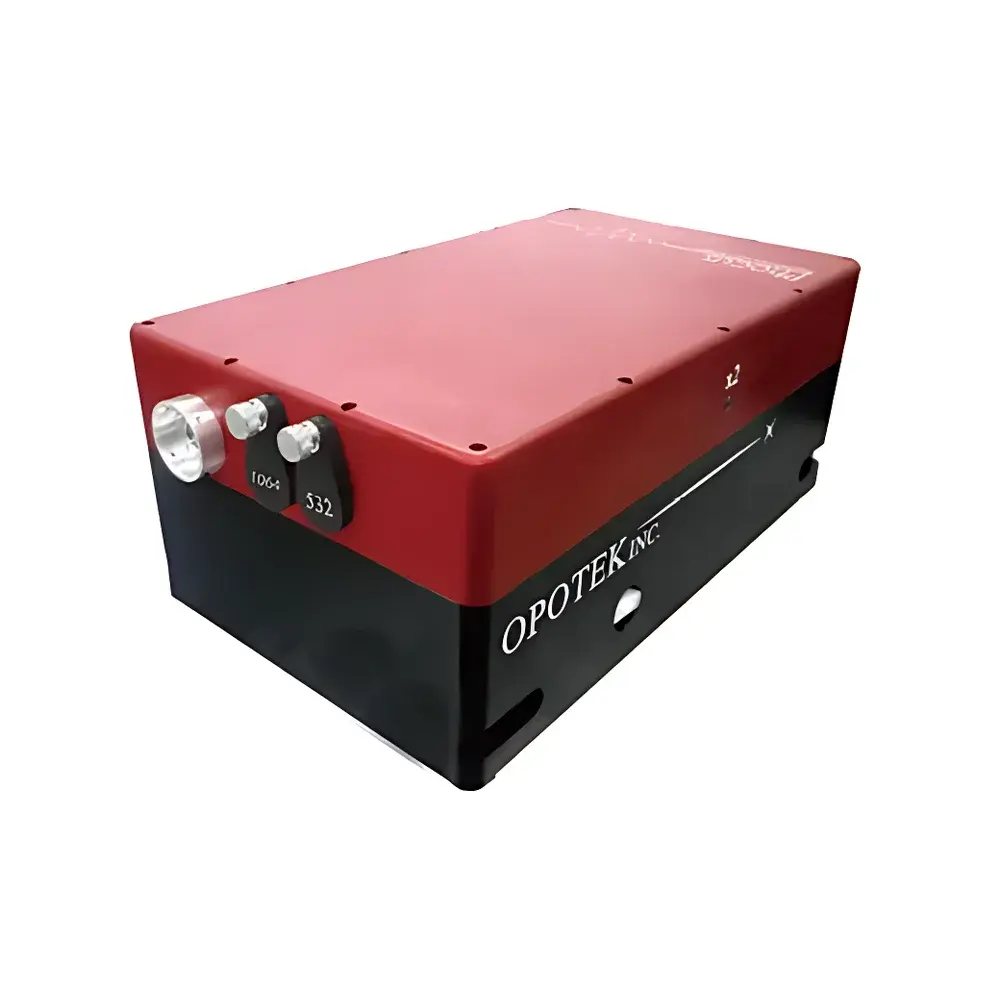
OPOTEK Phocus Series High-Energy Optical Parametric Oscillator Laser for Photoacoustic Imaging
| Brand | OPOTEK |
|---|---|
| Origin | USA |
| Manufacturer Type | Authorized Distributor |
| Product Category | Imported |
| Model | Phocus Series |
| Core Technology | Solid-State Pumped OPO System |
| Max Pulse Energy | 120 mJ |
| Tuning Range | Visible to Mid-IR (e.g., 410–2400 nm, depending on configuration) |
| Pump Source | Integrated Q-Switched Nd:YAG Laser |
| Pulse Width | ~5–8 ns |
| Repetition Rate | 10–100 Hz (configurable) |
| Beam Quality | M² < 1.3 |
| Cooling | Air or Water (model-dependent) |
| Control Interface | USB/Ethernet with SDK for LabVIEW, Python, MATLAB |
Overview
The OPOTEK Phocus Series is a high-energy, solid-state pumped optical parametric oscillator (OPO) laser system engineered specifically for demanding photoacoustic imaging (PAI) applications in preclinical and translational research. Based on patented ring-cavity OPO architecture, the Phocus leverages intracavity frequency conversion to deliver tunable, narrow-linewidth nanosecond pulses across a broad spectral range—from visible (410 nm) through near-infrared (NIR) to mid-infrared (up to 2400 nm). Its core design integrates a high-stability, diode-pumped Q-switched Nd:YAG pump laser with a thermally managed OPO crystal stage, enabling exceptional pulse-to-pulse stability (<1.5% RMS), high damage-threshold optics, and long-term operational reliability. Unlike conventional linear OPOs, the ring geometry minimizes spatial hole burning and thermal lensing effects—critical for maintaining beam quality and conversion efficiency over extended duty cycles. The system operates at repetition rates from 10 to 100 Hz, with pulse energies up to 120 mJ at the signal output and scalable idler energy in the 1200–2400 nm band—optimally matching the optical absorption windows of endogenous chromophores (e.g., hemoglobin, melanin, lipids) and exogenous contrast agents used in functional and molecular PAI.
Key Features
- Patented ring-cavity OPO design: Enhances optical damage threshold, improves pump-to-signal conversion efficiency (>25% typical), and extends crystal lifetime under high-energy operation.
- Integrated pump + OPO architecture: Compact monolithic chassis eliminates alignment drift and reduces footprint—ideal for integration into commercial or custom-built PAI scanners.
- Automated wavelength tuning: Motorized grating and crystal angle control enable precise, repeatable spectral selection across the full tuning range; software-calibrated step resolution ≤0.1 nm.
- Real-time pulse energy monitoring and feedback: Internal photodiode-based energy meter enables closed-loop attenuation control via optional motorized variable attenuator module.
- Flexible output configurations: Standard free-space beam delivery with optional fiber coupling (e.g., SMA905 or FC/PC multimode fibers), independent pump beam extraction, dedicated idler port (1200–2400 nm), and electronic shutter synchronization (TTL/CMOS).
- Fully programmable control interface: Native support for USB 2.0 and Gigabit Ethernet; includes comprehensive SDK with APIs for LabVIEW, Python (PyVISA), and MATLAB—enabling seamless integration into automated imaging workflows and compliance with lab automation standards.
Sample Compatibility & Compliance
The Phocus series is routinely deployed in ISO 13485-aligned preclinical imaging facilities and GLP-compliant pharmacokinetic studies. Its NIR/MIR output supports high-resolution, depth-resolved imaging of murine models, zebrafish embryos, and ex vivo human tissue specimens without ionizing radiation. All firmware and control software comply with FDA 21 CFR Part 11 requirements for electronic records and signatures when configured with audit trail logging and user access controls. System calibration certificates traceable to NIST standards are provided with each unit. Mechanical and electrical safety conform to IEC 60825-1:2014 (Laser Product Safety) and IEC 61000-6-3:2019 (EMC Emission Standards). Optional CE marking available upon request for EU-based installations.
Software & Data Management
The Phocus Control Suite is a Windows-based application offering intuitive GUI-driven operation for wavelength scanning, energy profiling, pulse timing setup, and hardware diagnostics. It features built-in spectral database templates for common PAI biomarkers (e.g., oxy/deoxy-hemoglobin, water, collagen), enabling rapid protocol selection. Raw parameter logs—including timestamped wavelength, energy, repetition rate, and cavity temperature—are exported in CSV and HDF5 formats for downstream analysis in ImageJ, MATLAB, or Python-based reconstruction pipelines (e.g., back-projection, model-based inversion). Audit trail functionality records all user actions, parameter changes, and system events with SHA-256 hashing—supporting regulatory submissions under ICH-GCP and FDA IND/IDE frameworks.
Applications
- Functional photoacoustic tomography (fPAT) of cerebral oxygenation dynamics in rodent brain models
- Molecular PAI using targeted gold nanorods or organic dyes in tumor angiogenesis studies
- Label-free histology of fresh tissue sections via multispectral PAI at 700–900 nm and 1200–1400 nm bands
- Quantitative lipid mapping in atherosclerotic plaques using 1720 nm idler output
- Time-resolved PAI for studying microvascular flow kinetics with synchronized ultrafast ultrasound detection
- Calibration source for NIST-traceable optical absorption spectroscopy systems
FAQ
What is the typical tuning speed between wavelengths?
Wavelength switching takes ≤150 ms between adjacent points within the same crystal orientation range; full-range scan (e.g., 680–950 nm) requires <2.5 s with continuous motorized control.
Is the system compatible with fiber-coupled PAI scanners?
Yes—optional SMA905 or FC/PC multimode fiber launch modules are available with AR-coated collimators optimized for 532 nm pump and 680–950 nm signal bands.
Can the idler output be used simultaneously with the signal beam?
Yes—the dual-output configuration provides simultaneous signal (e.g., 680–950 nm) and idler (1200–2400 nm) beams with independent spatial filtering and energy monitoring.
Does OPOTEK provide application support for PAI method development?
Yes—OPOTEK’s Applications Engineering team offers remote and on-site technical assistance, including protocol optimization, spectral deconvolution guidance, and integration support with commercial PAI platforms (e.g., FUJIFILM VisualSonics, Endra Nexus128).
What maintenance is required during routine operation?
No consumables or periodic realignment are needed; recommended preventive maintenance includes quarterly optical path inspection and annual calibration verification using supplied reference detectors and spectral filters.





