
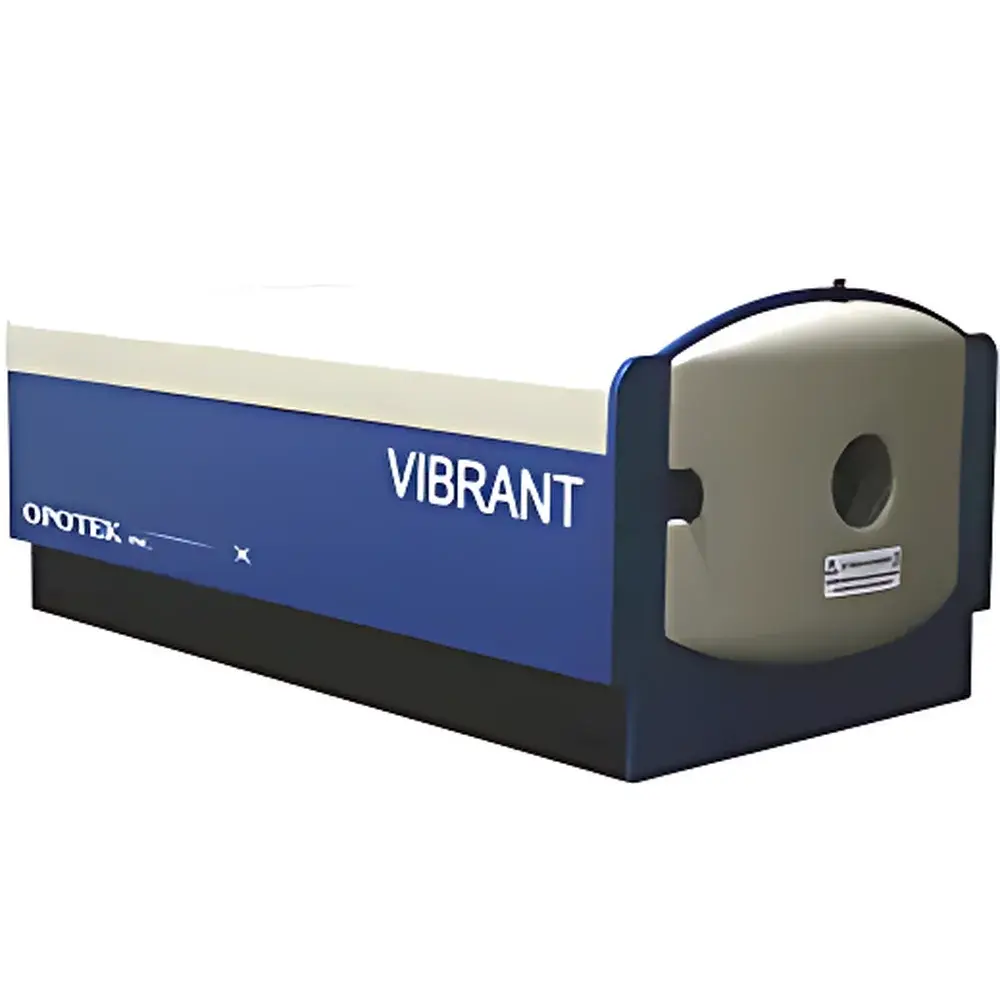
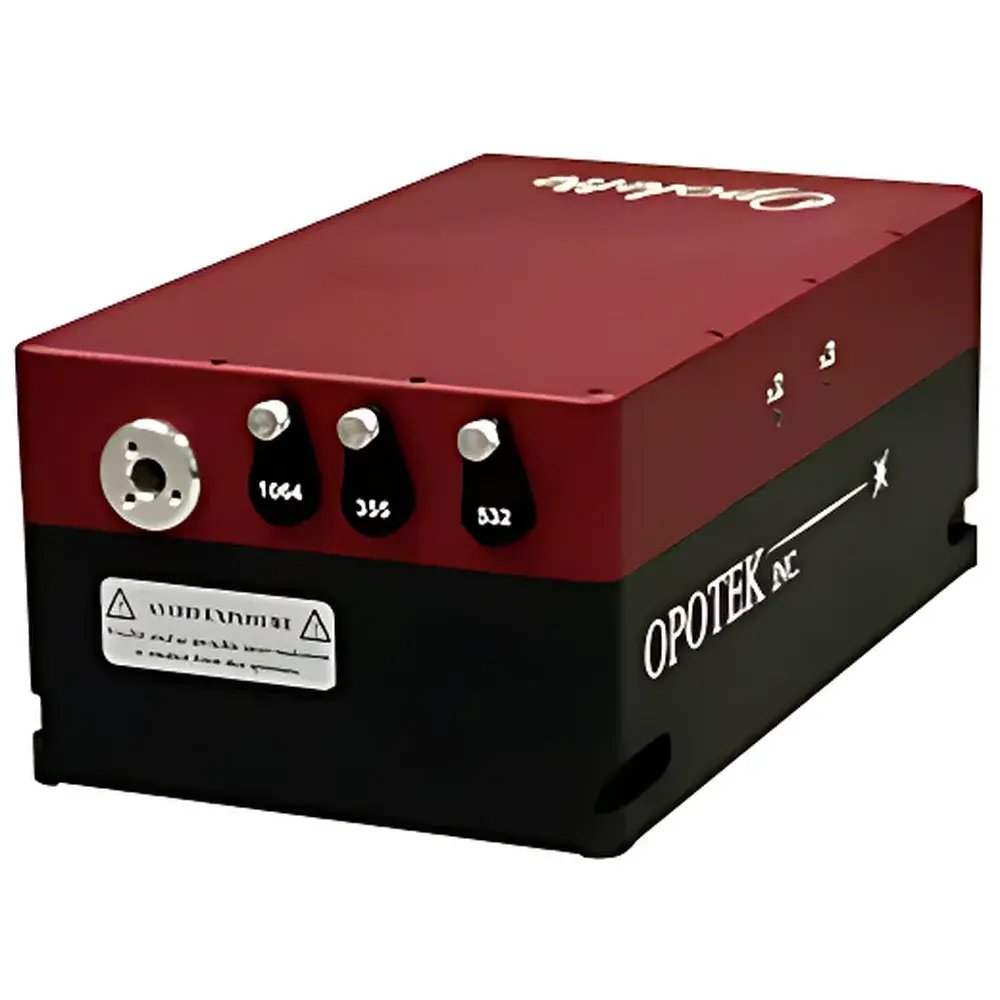
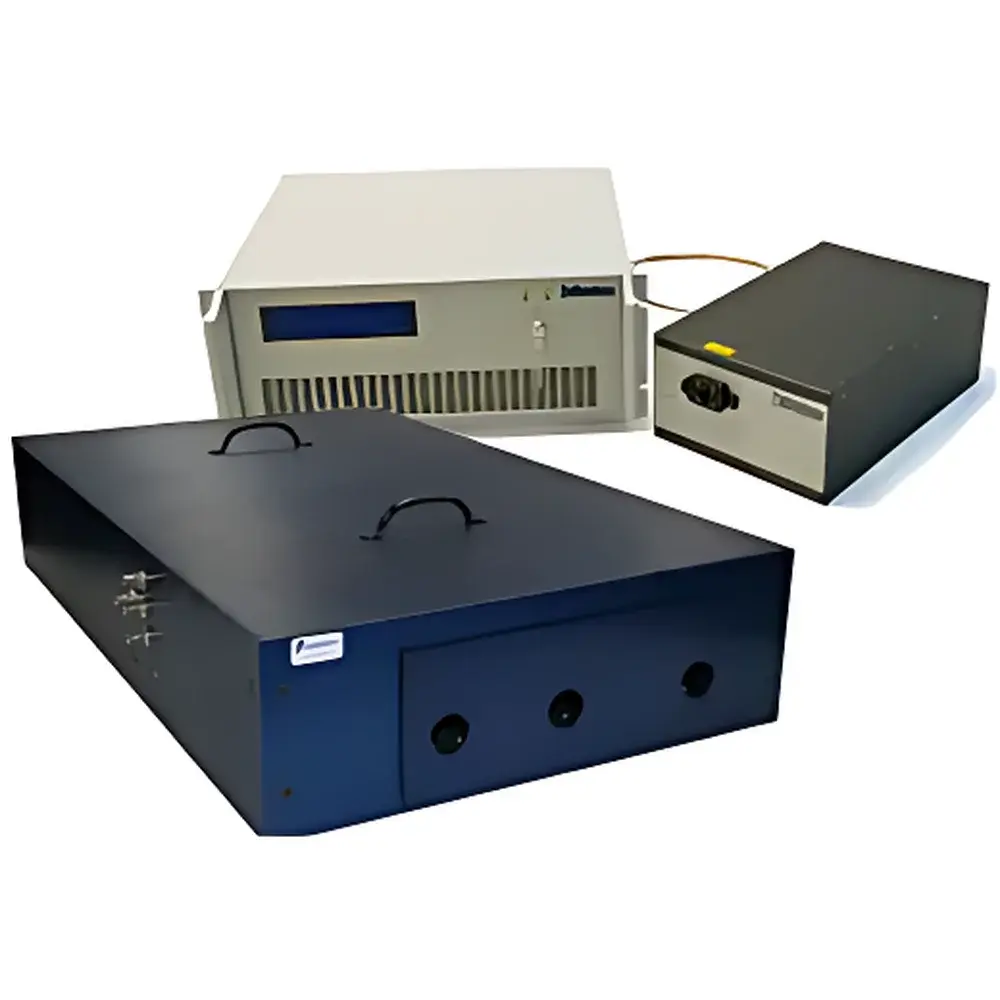
OPOTEK VIBRANT High-Energy Integrated Optical Parametric Oscillator Laser System
| Brand | OPOTEK |
|---|---|
| Origin | USA |
| Manufacturer Type | Authorized Distributor |
| Product Category | Imported |
| Model | VIBRANT (HE) Series |
| Core Architecture | Solid-State Pump Laser + Monolithic OPO Cavity + Integrated Control Electronics |
| Wavelength Range | 210–3450 nm (tunable, model-dependent) |
| Pulse Energy | Up to 75 mJ (IR), 47 mJ (visible), 35 mJ (UV-capable models) |
| Repetition Rate | 100 Hz |
| Pump Source | Diode-Pumped Solid-State (DPSS) Nd:YAG (355 nm or 532 nm) |
| Output Configuration | Free-space beam (fiber-coupling optional) |
| Control Interface | Fully automated software control with SDK for custom integration |
| Compliance | CE-marked |
| designed to meet IEC 60825-1 | 2014 Class 4 laser safety requirements |
Overview
The OPOTEK VIBRANT High-Energy Integrated Optical Parametric Oscillator (OPO) Laser System is a turnkey, solid-state tunable laser platform engineered for demanding scientific and industrial applications requiring broad spectral coverage with high pulse energy and excellent beam stability. Based on OPOTEK’s proprietary ring-cavity OPO architecture—first commercialized in 1993—the VIBRANT series integrates the pump laser (Q-switched, diode-pumped Nd:YAG at 355 nm or 532 nm), the OPO crystal assembly, harmonic generation stages (where applicable), and real-time electronic control into a single rigid optical bench. This monolithic integration eliminates alignment drift, minimizes thermal lensing effects, and ensures long-term operational reproducibility. The system operates on the principle of non-linear optical parametric amplification: a fixed-wavelength pump photon is converted within a temperature- and angle-tuned nonlinear crystal (e.g., BBO, KTA, or ZnGeP₂ depending on wavelength range) into signal and idler photons whose sum energy equals that of the pump. This enables continuous, stepless tuning across ultraviolet (210 nm), visible (410–680 nm), near-infrared (740–2400 nm), and mid-infrared (2700–3450 nm) bands—subject to model configuration.
Key Features
- Monolithic integrated design: Pump laser, OPO cavity, harmonic generators (if UV-enabled), and thermal management subsystems are co-aligned and permanently mounted on a low-expansion optical baseplate—reducing sensitivity to environmental vibration and thermal gradients.
- Patented ring-cavity OPO architecture: Enhances damage threshold by distributing optical intensity over multiple crystal passes, improving conversion efficiency and extending crystal lifetime beyond 10⁹ shots under nominal operating conditions.
- High pulse energy output: Delivers up to 75 mJ per pulse in the IR (2700–3450 nm), 47 mJ in the visible/near-IR (410–2400 nm), and up to 35 mJ in the UV (210–410 nm) with optional second-harmonic generation modules.
- Automated wavelength scanning: Motorized crystal rotation and temperature control enable precise, software-driven tuning with <±0.1 nm repeatability and <10 ms settling time between setpoints.
- OEM-ready interface: Includes Ethernet and USB 2.0 connectivity, full SCPI command set, and a documented C/C++/Python SDK supporting custom GUI development, synchronization with external detectors (e.g., lock-in amplifiers, streak cameras), and integration into automated metrology or imaging workflows.
- Field-serviceable modular architecture: Critical subassemblies—including pump module, OPO crystal mount, and harmonic separator—are accessible without realignment tools, enabling rapid maintenance under ISO/IEC 17025-compliant service protocols.
Sample Compatibility & Compliance
The VIBRANT system is compatible with standard optical tables, breadboard-mounted beam delivery optics, and fiber-coupled accessories (e.g., collimators, polarization rotators, and spectral filters). It supports both free-space and fiber-coupled output configurations (FC/APC or SMA-905 connectors, subject to model-specific power handling limits). All variants comply with IEC 60825-1:2014 for Class 4 laser product safety, including interlock circuits, key-controlled emission enable, and integrated beam shutter with status feedback. For regulated environments, the system’s firmware logs all operational parameters (wavelength, energy, repetition rate, crystal temperature) with timestamping and supports audit-trail export—facilitating compliance with GLP, GMP, and FDA 21 CFR Part 11 requirements when deployed in analytical or preclinical research settings.
Software & Data Management
The VIBRANT is controlled via OPOTEK’s cross-platform VIBRANT Control Suite (Windows/macOS/Linux), providing intuitive graphical interfaces for wavelength selection, energy attenuation (via motorized neutral density wheels), pulse repetition rate adjustment, and real-time energy monitoring via built-in photodiode calibration. All instrument states are recorded in HDF5-formatted log files containing metadata compliant with FAIR data principles. The SDK exposes low-level access to hardware registers, enabling synchronization with external timing controllers (e.g., DG645 delay generators) and integration into LabVIEW, MATLAB, or Python-based data acquisition pipelines. Optional add-ons include spectral calibration routines traceable to NIST-standard reference lamps and automated alignment diagnostics using beam profiler feedback.
Applications
- Laser-based photoacoustic tomography (PAT): High pulse energy in the NIR-II window (1000–1350 nm) and mid-IR (2700–3450 nm) enables deep-tissue optical absorption contrast with micron-scale spatial resolution.
- Time-resolved spectroscopy: Tunability across vibrational and electronic transitions supports pump-probe studies of carrier dynamics in semiconductors, molecular photophysics, and catalytic surface reactions.
- Remote gas sensing: Mid-IR output matches fundamental rovibrational absorption lines of CH₄, CO₂, NOₓ, and volatile organic compounds—enabling open-path differential absorption LIDAR (DIAL) and cavity-enhanced absorption spectroscopy (CEAS).
- Nonlinear microscopy: UV–visible output powers multiphoton excitation of genetically encoded fluorophores (e.g., DAPI, GFP variants), while IR wavelengths support coherent anti-Stokes Raman scattering (CARS) and stimulated Raman scattering (SRS) imaging.
- Standards development & metrology: Used in national metrology institutes for radiometric calibration transfer, line-width validation of tunable lasers, and characterization of detector quantum efficiency across extended spectral ranges.
FAQ
What is the typical warm-up time required before stable output is achieved?
The system achieves thermal equilibrium and wavelength stability within 30 minutes of cold start, with active temperature stabilization maintaining crystal oven setpoints to ±0.05 °C.
Is vacuum or purged operation required for mid-IR models?
Yes—VIBRANT IR models (2700–3450 nm) require continuous dry nitrogen purge (<1% H₂O) to suppress atmospheric water vapor absorption; an integrated mass-flow controller and moisture sensor are included.
Can the system be upgraded from HE-I to HE-II configuration in the field?
Hardware upgrades (e.g., crystal replacement, harmonic module addition) are supported under OPOTEK’s certified service program, subject to optical path requalification and recalibration.
Does the control software support scripting for unattended spectral sweeps?
Yes—the SDK includes Python bindings for defining multi-segment wavelength ramps with variable dwell times, energy scaling, and trigger-synchronized data capture.
What is the expected lifetime of the nonlinear crystals under nominal operating conditions?
BBO and KTA crystals demonstrate >10⁹ shots at rated pulse energy; ZnGeP₂ crystals in the mid-IR exhibit >5×10⁸ shots with proper purge and thermal management.




