
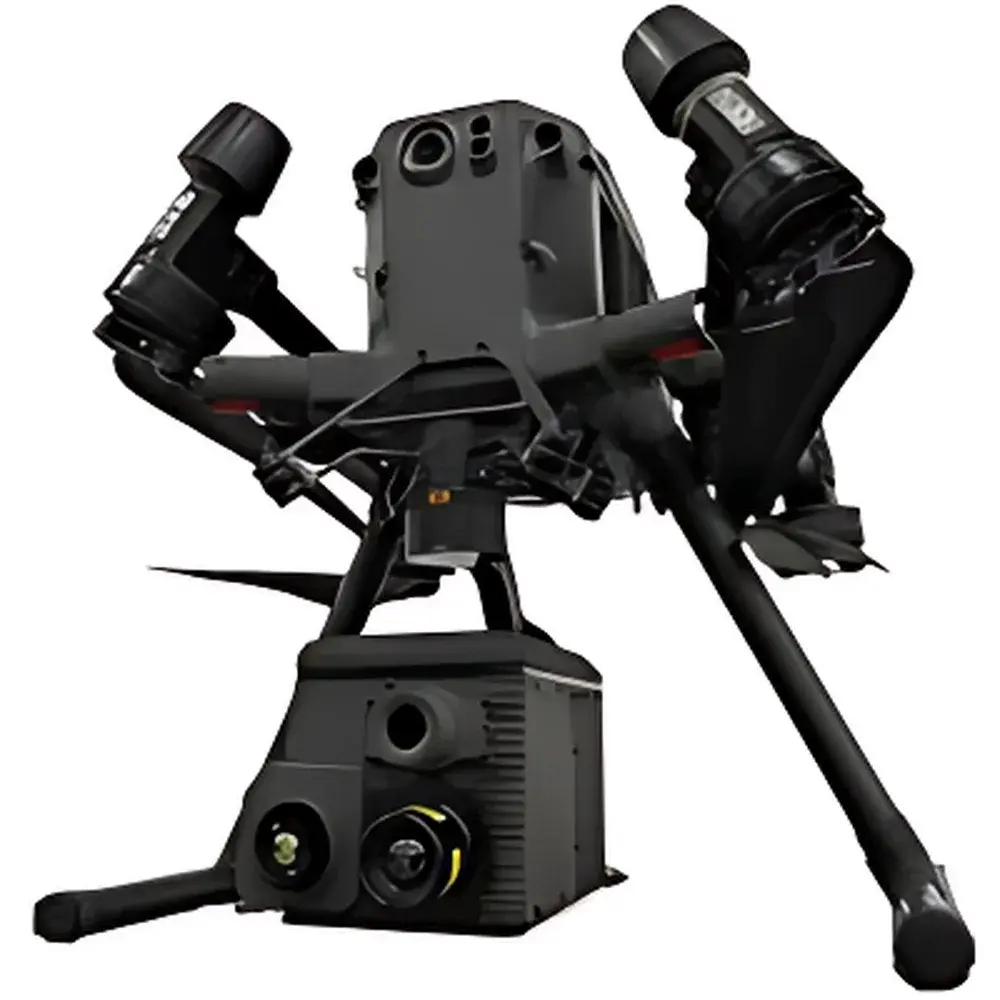
Optop GW-MCT-15A Cooled Mid-Wave Infrared Thermal Imaging Camera for UAV Integration
| Brand | Optop |
|---|---|
| Origin | Beijing, China |
| Manufacturer Type | Authorized Distributor |
| Origin Category | Domestic (China) |
| Model | GW-MCT-15A |
| Price | Upon Request |
| Detector Type | Mercury Cadmium Telluride (MCT), Stirling-cooled |
| Resolution | 640 × 512 pixels |
| Pixel Pitch | 15 µm |
| Spectral Range | 3.7–4.8 µm (MWIR) / 1.5–5.2 µm (MWIR Wide) / 7.7–9.5 µm (LWIR) |
| NETD | <20 mK |
| Cooling Time | <7 min |
| Lens Options | 12 mm / 25 mm / 50 mm (F/2 or F/4) |
| Temperature Range | −10 °C to +110 °C |
| Accuracy | ±2 °C or ±2% of reading |
| Frame Rate | 1–100 Hz (adjustable) |
| Image Output | 14-bit RAW via RJ45 |
| Storage | Internal 512 GB SSD |
| Power | 24 VDC, ≤20 W |
| Weight | ≤1.5 kg (with housing and 25 mm lens) |
| Operating Temp. | −40 °C to +60 °C |
| Vibration | 5–500 Hz, 2.1 gRMS, 30 min/axis |
| Shock | 30 g, 11 ms half-sine, ±3 shocks/axis |
| Gimbal Compatibility | DJI Matrice 300 RTK / M350 RTK |
| GPS Logging | Embedded UAV-derived geotagging support |
| Software Interface | DJI Payload SDK (PSDK) compliant |
| Optional Dual-Sensor Config | 4K Visible-light or uncooled LWIR camera |
Overview
The Optop GW-MCT-15A is a high-performance, Stirling-cooled mid-wave infrared (MWIR) thermal imaging camera engineered specifically for airborne remote sensing applications on professional-grade UAV platforms. It utilizes a mercury cadmium telluride (MCT) focal plane array detector with 640 × 512 resolution and a 15 µm pixel pitch, operating within the 3.7–4.8 µm spectral band—optimized for atmospheric transmission windows and high-contrast thermal contrast in both daytime and low-background nighttime conditions. Unlike uncooled microbolometer systems, the actively cooled MCT detector delivers superior thermal sensitivity (<20 mK NETD), exceptional spatial resolution, and high temporal stability—critical for quantitative thermography, target signature analysis, and radiometric calibration workflows. Its compact, lightweight enclosure (≤1.5 kg) and modular quick-release mechanical interface are designed to meet the stringent SWaP-C (Size, Weight, Power, and Cost) requirements of rotary-wing UAVs such as the DJI Matrice 300 RTK and M350 RTK. The system integrates seamlessly via DJI’s Payload SDK (PSDK), enabling synchronized telemetry, real-time image streaming, and precise geo-referenced data capture.
Key Features
- Stirling-cooled MCT detector with <20 mK noise-equivalent temperature difference (NETD), ensuring high-fidelity radiometric accuracy and low temporal drift
- Configurable spectral response: selectable MWIR (3.7–4.8 µm), MWIR-wide (1.5–5.2 µm), or LWIR (7.7–9.5 µm) variants—each factory-calibrated for quantitative temperature measurement
- Full 14-bit RAW digital output stored internally on a 512 GB industrial-grade SSD, preserving maximum dynamic range for post-processing and algorithmic analysis
- Dual-sensor expansion capability: optional integration of a 4K visible-light imager or an uncooled LWIR module for multi-spectral fusion and contextual annotation
- Real-time analog video streaming via DJI SkyPort interface, supporting low-latency thermal feed to ground control stations without external encoders
- Flexible frame rate control (1–100 Hz) with programmable trigger modes, enabling synchronization with motion-capture systems or pulsed illumination sources
- Onboard non-uniformity correction (NUC) with 1-point and 2-point calibration routines, supporting field-updatable reference tables for long-term measurement consistency
Sample Compatibility & Compliance
The GW-MCT-15A is designed for use in scientific, defense, and industrial remote sensing applications where traceable, repeatable thermal measurements are required. Its radiometric calibration supports compliance with ISO 18434-1 (condition monitoring — thermography) and ASTM E1933 (standard test methods for measuring and compensating for emissivity using infrared imaging systems). While not certified under FDA 21 CFR Part 11 or IEC 62304, its firmware architecture includes audit-trail-capable logging of calibration events, sensor health diagnostics, and GPS-tagged metadata—enabling GLP-aligned documentation for research-grade data acquisition. The system meets MIL-STD-810H environmental stress criteria for vibration (5–500 Hz, 2.1 gRMS), shock (30 g, 11 ms half-sine), and extended temperature operation (−40 °C to +60 °C), making it suitable for deployment in harsh field environments.
Software & Data Management
Data acquisition and configuration are managed through a combination of embedded firmware and host-side tools compatible with Windows and Linux. The camera supports PSDK-based command-and-control over UART or Ethernet, allowing full parameterization—including gain mode (auto/manual), polarity (white-hot/black-hot/ironbow), frame averaging, and digital zoom (2×/4×)—via UAV flight controller APIs. All captured 14-bit RAW frames include embedded GPS coordinates, UTC timestamps, IMU orientation data, and lens-specific radiometric coefficients. Post-acquisition processing is facilitated by Optop’s proprietary SDK, which provides C/C++, Python, and MATLAB bindings for batch NUC application, emissivity compensation, temperature mapping, and spatio-temporal ROI analysis. Export formats include TIFF, HDF5, and custom binary containers compatible with ENVI, MATLAB Image Processing Toolbox, and open-source thermal analytics pipelines.
Applications
- Aerial thermography for power line inspection, solar farm fault detection, and building envelope diagnostics
- Defense and security: long-range target identification, signature characterization, and counter-UAS surveillance
- Environmental monitoring: volcanic activity tracking, wildfire perimeter mapping, and methane plume visualization (when paired with spectral filters)
- Research & development: material emissivity studies, combustion dynamics analysis, and aerothermal testing of UAV airframes
- Industrial predictive maintenance: real-time thermal trending of rotating machinery, transformers, and process piping under operational load
FAQ
What cooling technology does the GW-MCT-15A use, and how long does cooldown take?
The system employs a miniature Stirling-cycle cryocooler integrated directly with the MCT detector, achieving stable operating temperature in under 7 minutes.
Is radiometric calibration traceable to national standards?
Yes—each unit undergoes two-point blackbody calibration at Optop’s Beijing facility using NIST-traceable sources; calibration certificates include uncertainty budgets per ISO/IEC 17025 guidelines.
Can the camera operate independently of a DJI flight controller?
No—the GW-MCT-15A is designed exclusively as a PSDK-compliant payload; standalone operation requires third-party integration of the PSDK host library and compatible telemetry interface.
Does the system support time-synchronized dual-sensor capture?
Yes—when configured with the optional 4K visible-light camera, both sensors share a common hardware trigger and timestamp reference, enabling sub-millisecond alignment for pixel-level fusion.
What level of post-processing support is provided for thermal data?
Optop supplies a comprehensive SDK with source code examples, radiometric correction libraries, and documentation for developing custom analytics—no proprietary viewer lock-in is enforced.




