
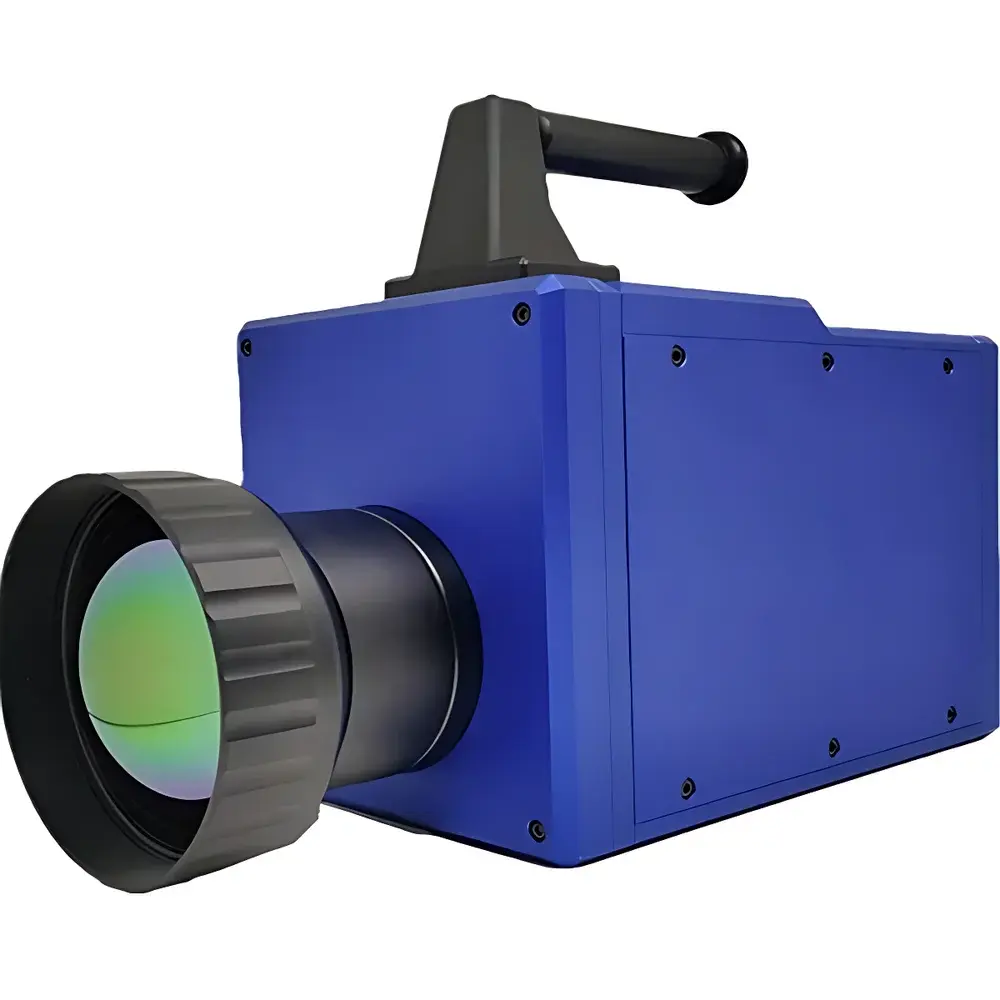
Optoprecise GW-STL Series Cryogenically Cooled Infrared Thermal Imaging Camera
| Brand | Optoprecise |
|---|---|
| Origin | Beijing, China |
| Manufacturer Type | Authorized Distributor |
| Country of Origin | PRC |
| Model | GW-STL Series |
| Pricing | Upon Request |
| Detector Type | Stirling-cooled MCT or InSb focal plane array |
| Spectral Bands | MWIR (3.7–4.8 µm), Extended MWIR (1.5–5.2 µm), LWIR (7.7–9.5 µm) |
| Resolution | 640 × 512 pixels |
| Pixel Pitch | 15 µm or 25 µm |
| Thermal Sensitivity (NETD) | <20 mK to <18 mK |
| Frame Rate | ≥100 Hz full-frame, up to 200 Hz @ 640×512 |
| Cooling Time | <7 min to operating temperature |
| Temperature Range | −10 °C to +1000 °C (extendable to +2500 °C with high-temp calibration) |
| Accuracy | ±2 °C or ±2% of reading |
| Dynamic Range | 14-bit |
| Spectral Filter Wheel | 5-position, 1″ format, user-replaceable filters |
| Lens Options | Standard (25 mm), Wide-angle (12 mm), Telephoto (50/100/200 mm), Macro (0.5×/1.0×), Microscope (1.0×/3.0×/5.0×/8.0×) |
| Spatial Resolution | 0.08–1.2 mrad (lens-dependent) |
| Minimum Focus Distance | 0.1–4.0 m |
| Interface | Camera Link, GigE Vision, analog BNC video output, TTL trigger I/O, RS232/RS422 serial control |
| Onboard Storage | Up to 512 GB SSD (optional) |
| Power | 24 ±2 VDC, <25 W (cooling phase), <15 W (steady state) |
| Environmental Rating | Operating −40 °C to +60 °C |
| Dimensions & Weight | ≤310 × 135 × 180 mm, ≤4.5 kg (with standard lens) |
Overview
The Optoprecise GW-STL Series is a high-performance, Stirling-cooled infrared thermal imaging camera engineered for demanding scientific, industrial, and defense applications requiring precise radiometric measurement across multiple spectral bands. Utilizing cryogenically cooled mid-wave (MWIR) and long-wave (LWIR) focal plane arrays—typically mercury cadmium telluride (MCT) or indium antimonide (InSb)—the system achieves exceptional thermal sensitivity (NETD <18–25 mK), high frame rates (up to 200 Hz at full 640 × 512 resolution), and broad spectral flexibility. Its dual-band capability (e.g., 3.7–4.8 µm and 7.7–9.5 µm) supports multi-spectral thermography, enabling discrimination of combustion signatures, gas emission lines, material emissivity variations, and transient thermal phenomena. The integrated Stirling cooler delivers stable detector operation within <7 minutes, ensuring rapid deployment in field and laboratory environments where thermal stability and repeatability are critical.
Key Features
- Cryogenic Stirling cooling architecture for low-noise, high-stability detector operation and superior NETD performance
- Multi-spectral adaptability via motorized 5-position filter wheel compatible with industry-standard 1″ optical filters
- Modular lens system including wide-angle, telephoto, macro, and microscope objectives—supporting spatial resolutions down to 1.9 µm (at object plane)
- Real-time radiometric calibration with high-temperature blackbody traceability up to 2500 °C
- Dual digital interfaces: Camera Link and GigE Vision compliant—enabling deterministic synchronization and high-throughput data streaming
- Onboard 512 GB SSD storage for lossless, high-speed thermal image capture without host dependency
- Robust mechanical design rated for harsh environments: IP54-equivalent sealing, MIL-STD-810G vibration and shock compliance
- Fully programmable triggering (TTL, differential), external sync, and serial (RS232/RS422) control for integration into automated test benches
Sample Compatibility & Compliance
The GW-STL Series accommodates diverse sample geometries and thermal regimes—from microscale semiconductor junctions (using 8× microscope optics) to large-area industrial furnaces or open-flame combustion studies. Its calibrated temperature range (−10 °C to +1000 °C, extendable to +2500 °C) and spectral band options align with ASTM E1256 (Standard Test Methods for Radiation Thermometers), ISO 18434-1 (Condition monitoring — Thermography), and IEC 62906-5-2 (Laser display devices). The system supports GLP/GMP-compliant workflows through IR-SVision R2.0’s audit-trail-enabled calibration logging, timestamped metadata embedding, and FDA 21 CFR Part 11–ready optional electronic signature modules. All factory calibrations are NIST-traceable and documented per ISO/IEC 17025 requirements.
Software & Data Management
IR-SVision software suite provides comprehensive acquisition, analysis, and reporting capabilities tailored for research-grade thermography. IR-SVision M2.0 offers real-time multi-camera monitoring with configurable visual/audio/trigger alarms, event-based recording, and relational alarm database logging. IR-SVision R2.0 delivers advanced offline analysis: region-of-interest statistics (min/max/mean/std dev), dynamic masking, emissivity mapping, blackbody self-correction, and sequential thermal profile export. Raw thermal data is stored in non-proprietary, unencrypted 14-bit RAW format—fully compatible with MATLAB, Python (via NumPy/OpenCV), and third-party thermal analysis platforms. The included SDK enables full API-level integration—including ROI definition, spectral wheel control, and real-time metadata injection—using C/C++, C#, or Python bindings. ASCII export ensures seamless interoperability with statistical and computational modeling tools.
Applications
- Combustion diagnostics: Flame temperature profiling, soot radiation analysis, and burner optimization using narrowband spectral filtering (e.g., CO₂ or H₂O absorption bands)
- Materials science: Transient thermal conductivity mapping, phase transition detection, and microstructural defect identification in composites and ceramics
- Aerospace: Turbine blade thermal fatigue monitoring, hypersonic boundary layer characterization, and thermal protection system validation
- Electronics reliability: Junction temperature mapping of GaN/SiC power devices, solder joint integrity assessment, and PCB hot-spot localization
- Defense & security: Long-range target identification, missile plume tracking, and covert surveillance under low-visibility conditions
- Energy infrastructure: Substation component thermography, solar cell EL/PL correlation, and geothermal reservoir surface anomaly detection
FAQ
What spectral bands are supported by the GW-STL Series?
The system supports three primary configurations: MWIR (3.7–4.8 µm), extended MWIR (1.5–5.2 µm), and LWIR (7.7–9.5 µm), selectable via interchangeable detectors and spectral filter wheels.
Can I perform quantitative temperature measurements on highly reflective surfaces?
Yes—emissivity compensation is fully configurable per pixel or ROI; optional reference blackbody calibration and reflectance correction algorithms are embedded in IR-SVision R2.0.
Is the filter wheel position synchronized with calibration data?
Yes—each filter position is mapped to its own radiometric calibration matrix, and switching triggers automatic loading of corresponding gain/offset/NUC parameters.
Does the system support triggering from external equipment such as lasers or oscilloscopes?
Yes—TTL-compatible trigger input (5 V, optionally differential 3.3 V) enables precise synchronization with pulsed sources, high-speed motion stages, or data acquisition systems.
How is data integrity ensured during long-duration acquisitions?
All thermal frames include embedded timestamps, detector temperature telemetry, lens ID, and spectral configuration metadata; onboard SSD write verification and cyclic redundancy checks (CRC32) prevent silent corruption.





