
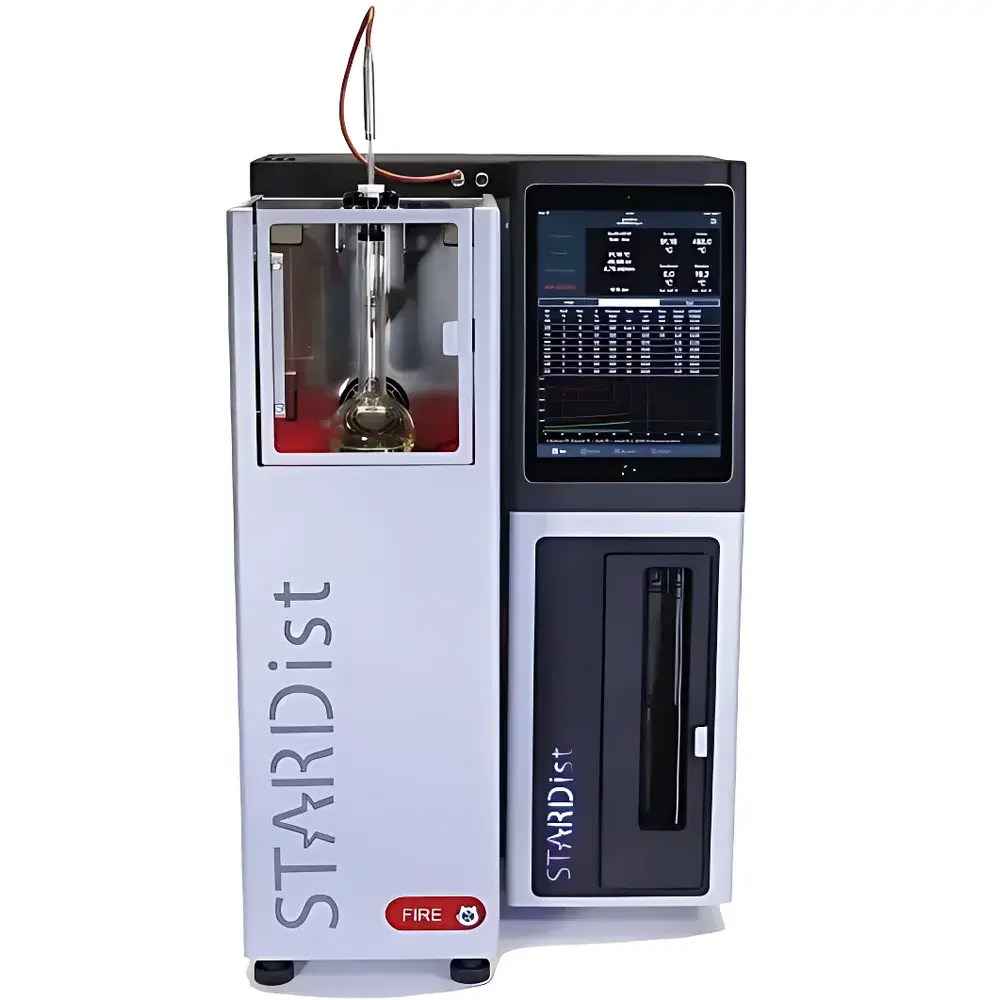
ORBIS BV STARDist Fully Automated Distillation Analyzer
| Brand | ORBIS BV |
|---|---|
| Origin | Netherlands |
| Manufacturer Type | Authorized Distributor |
| Origin Category | Imported Instrument |
| Model | STARDist |
| Operating Pressure | Atmospheric |
| Temperature Range | Ambient to 450 °C |
| Temperature Accuracy | ±0.1 °C |
| Condenser Temperature Range | 0–65 °C |
| Recovery Chamber Temperature Range | 0–45 °C |
| Distillation Rate | 2–11 mL/min |
| Volume Detection Range | 0–105% (v/v) |
| Volume Resolution | 0.01 mL |
| Volume Accuracy | ±0.01 mL |
| Residue Measurement | Automatic or Manual |
| Barometric Range | 70–110 kPa (0.1 kPa resolution) |
| Safety System | Integrated Flame Detection with Nitrogen-Actuated Extinguishing |
| Data Interface | Ethernet (LIMS-compatible) |
| Dimensions | 40 × 40 × 63 cm |
| Weight | 40 kg |
| Power Supply | 100–240 VAC, 50/60 Hz |
| Power Consumption | 1.2 kW |
Overview
The ORBIS BV STARDist Fully Automated Distillation Analyzer is an advanced, ASTM- and ISO-compliant distillation system engineered for precise, repeatable determination of boiling point distributions in petroleum products and related hydrocarbon mixtures. Based on standardized batch distillation principles under atmospheric pressure (as defined in ASTM D86, ISO 3405, GB/T 6536, and IP 123/1), the STARDist implements a fully automated, closed-loop process that integrates real-time optical volume measurement, adaptive heating control, and thermometric traceability. Unlike conventional systems relying on mechanical float sensors or manual meniscus reading, the STARDist employs a high-resolution CCD-based volumetric scanning system that continuously captures and analyzes the entire distillate meniscus profile—enabling sub-milliliter detection accuracy and eliminating parallax or operator-induced bias. Its architecture is designed for laboratory environments requiring regulatory compliance, long-term method reproducibility, and seamless integration into quality control workflows across refineries, independent testing labs, and R&D centers.
Key Features
- Optical Meniscus Detection System: Full-scale CCD camera scans the entire graduated cylinder surface at 30 fps, identifying the true lower meniscus edge with 0.01 mL resolution and ±0.01 mL volumetric accuracy—eliminating mechanical wear and calibration drift.
- Adaptive Heating Control: Dual-zone ceramic heating mantle with PID-regulated power delivery ensures stable, programmable ramp rates and minimizes thermal overshoot during critical boiling stages (e.g., initial boiling point, 10%, 50%, 90% recovery).
- Integrated Safety Architecture: Real-time flame detection via UV sensor coupled with nitrogen-triggered suppression module; automatic shutdown on overtemperature, pressure anomaly, or condenser failure.
- Self-Calibrating Thermometry: PT100 platinum resistance thermometers with built-in self-diagnostic routines and auto-compensation for ambient drift; traceable to NIST-certified references.
- Barometric Compensation: Onboard digital barometer (70–110 kPa range, 0.1 kPa resolution) automatically corrects distillation temperatures per ASTM D86 Annex A1 and ISO 3405 Clause 7.3.
- iPad-Based HMI: Intuitive touch interface with preloaded method templates for ASTM D86, D1078, D850, GB/T 6536, GB/T 26984, and ISO 3405; supports user-defined protocols and audit-trail-enabled operation logs.
Sample Compatibility & Compliance
The STARDist is validated for use with gasoline, diesel, jet fuel, naphtha, kerosene, light cycle oil, and other volatile petroleum fractions meeting ASTM D1298 density and D4057 sampling requirements. It complies with GLP and GMP data integrity standards through secure, time-stamped electronic records, role-based user access control, and full 21 CFR Part 11–compliant audit trails—including operator ID, method version, raw sensor timestamps, and manual intervention logs. All temperature and volume measurements are traceable to national metrology institutes (NMI) via documented calibration certificates. The system meets electromagnetic compatibility (EMC) requirements per EN 61326-1 and safety standards per IEC 61010-1.
Software & Data Management
Control and analysis are managed through ORBIS’s proprietary STARDist Suite v3.2, installed on the embedded iPad platform. The software provides real-time graphical display of temperature vs. recovered volume curves, automatic endpoint detection (IBP, FBP, dry point), and residue calculation. Raw data—including time-series temperature, volume, condenser temperature, and barometric pressure—is exported in CSV and XML formats compliant with LIMS interfaces (ASTM E1384, ISO/IEC 17025 Annex A.2). Data archiving includes SHA-256 hashing for integrity verification, and all method parameters are digitally signed to prevent unauthorized modification. Optional cloud backup and remote diagnostic support are available under extended service agreements.
Applications
- Determination of boiling range distribution for gasoline (ASTM D86) and aviation turbine fuels (ASTM D1655 Annex A)
- Volatility assessment of reformulated gasoline blends per EPA Tier 3 specifications
- Quality control of crude assay fractions and refinery intermediate streams
- Research-grade distillation profiling for alternative fuel formulations (e.g., biojet, hydrotreated esters)
- Compliance testing for product specifications under GB/T 6536 (China), EN 12916 (EU), and JIS K 2254 (Japan)
- Residue and loss quantification in low-volatility feedstocks per ASTM D1078
FAQ
Does the STARDist support vacuum distillation?
No—the STARDist is configured exclusively for atmospheric-pressure distillation per ASTM D86, ISO 3405, and related standards. Vacuum-capable variants are not offered in the STARDist series.
Is PT100 probe calibration performed automatically during each test?
The system performs continuous self-diagnostics on PT100 sensors but requires periodic external calibration using certified reference thermometers per ISO/IEC 17025. Calibration intervals are configurable and logged in the audit trail.
Can the optical volume detection be validated independently?
Yes—built-in verification mode allows users to introduce NIST-traceable glass syringes (1 mL, 5 mL, 10 mL) for linearity and accuracy checks; results are saved as calibration verification reports.
What network security protocols does the Ethernet interface support?
The device implements TLS 1.2 encryption for LIMS data transmission and supports VLAN segmentation, MAC address filtering, and IEEE 802.1X authentication when deployed in regulated IT environments.
Is nitrogen supply mandatory for safe operation?
Nitrogen is required only when the optional flame detection and suppression module is activated. For non-flammable or low-flashpoint samples, the system may operate in “monitor-only” safety mode without nitrogen connection.
Related Products





