
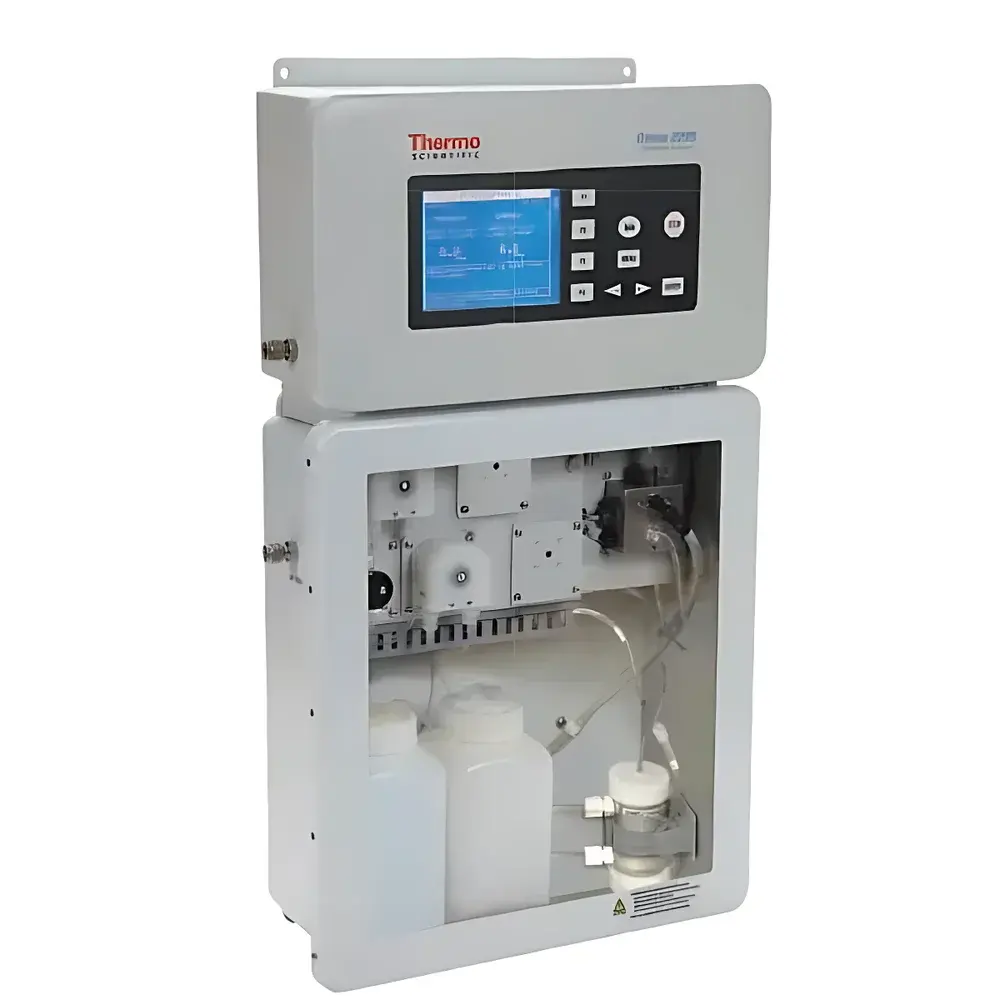
Orion 2295 Online Phosphate Analyzer
| Brand | Thermo Fisher Scientific |
|---|---|
| Origin | USA |
| Model | 2295 |
| Instrument Type | Online Analyzer |
| Detection Range | 0.2–50 ppm PO₄³⁻ (auto-ranging) |
| Reagent Consumption | 0.2 mL per reagent per analysis |
| Sample Temperature Control | Heated to 25 °C for low-temperature samples |
| Light Source | High-stability LED (no filters or optical fibers) |
| Pump Maintenance Interval | Every 6 months |
| Display | Backlit LCD with full status and measurement data |
| Data Storage | 31 days of calibration & analysis logs (timestamped, parameter-rich) |
| Enclosure Rating | NEMA 4 |
| Power Input | 100–240 VAC, 50–60 Hz |
| Installation | Panel-mount or wall-mount compatible |
| Auto-Restart Function | Configurable 30-minute timeout after STOP command |
Overview
The Orion 2295 Online Phosphate Analyzer is a fully automated, colorimetric photometric instrument engineered for continuous, real-time monitoring of orthophosphate (PO₄³⁻) concentration in high-purity water streams. It operates on the molybdenum blue method—where phosphate reacts with ammonium molybdate and ascorbic acid under acidic conditions to form a stable phosphomolybdenum blue complex—and quantifies absorbance at 880 nm using a solid-state LED light source. Designed specifically for critical boiler feedwater, condensate, and ultrapure process water applications, the 2295 delivers trace-level accuracy and long-term stability in power generation, semiconductor fabrication, pharmaceutical manufacturing, pulp & paper, and petrochemical facilities. Its integrated sample heating module ensures consistent reaction kinetics even with sub-ambient inlet water temperatures, eliminating cold-sample bias—a known source of underreporting in unheated analyzers.
Key Features
- Ultra-low reagent consumption: 0.2 mL per reagent per analysis cycle—reducing operational cost and waste disposal burden while extending cartridge life.
- Auto-ranging detection from 0.2 to 50 ppm PO₄³⁻, enabling seamless transition between low-ppb boiler monitoring and higher-concentration effluent or pretreatment stream verification.
- Integrated Peltier-heated sample path maintains precise 25 °C reaction temperature, ensuring stoichiometric completeness and inter-laboratory reproducibility per ASTM D859 and ISO 6878 standards.
- LED-based optical system with fixed-wavelength emission at 880 nm—no moving parts, no filter wheels, no fiber-optic degradation—providing >5-year photometric stability without recalibration.
- High-reliability peristaltic pumping architecture featuring chemically resistant tubing and optimized rotor geometry; service interval extended to 6 months under continuous operation.
- Intelligent auto-restart logic: configurable 30-minute timeout after manual STOP command, minimizing operator dependency and supporting unattended weekend operation.
- NEMA 4-rated enclosure with gasket-sealed front panel and internal pump compartment—protecting against dust ingress, moisture splash, and ambient corrosion in industrial control rooms or outdoor shelters.
Sample Compatibility & Compliance
The Orion 2295 accepts sample flow rates of 50–150 mL/min at pressures up to 100 psi, accommodating both pressurized loop and gravity-fed configurations. It is compatible with deionized water, reverse osmosis permeate, mixed-bed polishers, and steam condensate—with no interference from common anions (e.g., sulfate, chloride < 100 ppm) or organics (TOC < 0.5 ppm). The analyzer meets key regulatory and quality framework requirements including USP , EP 2.2.44, and ASTM D859 for phosphate determination in pharmaceutical and power industry water systems. Its audit-trail-capable data logging supports GLP/GMP compliance when integrated with LIMS or SCADA platforms via Modbus RTU/ASCII or 4–20 mA analog output.
Software & Data Management
Onboard firmware stores up to 31 days of time-stamped analytical records—including raw absorbance values, zero/reference checks, calibration coefficients, reagent lot numbers, and system diagnostics—in non-volatile memory. All entries are immutable and include user-accessible timestamps (YYYY-MM-DD HH:MM:SS), enabling retrospective root-cause analysis during QA investigations. Configuration and diagnostics are accessible via intuitive menu navigation on the backlit LCD interface—no PC required for routine operation. Optional RS-232 or Ethernet connectivity enables remote configuration, firmware updates, and secure data export compliant with FDA 21 CFR Part 11 when deployed with validated third-party data acquisition software.
Applications
- Boiler feedwater and turbine condensate monitoring in fossil fuel and nuclear power plants to prevent phosphate hideout and corrosion-induced tube failures.
- Ultrapure water (UPW) loop surveillance in semiconductor fabs—detecting micro-leaks from phosphate-containing cleaning agents or ion exchange resin degradation.
- Final rinse water QC in sterile pharmaceutical manufacturing, where residual phosphate may indicate inadequate cleaning validation.
- Process water control in pulp bleaching stages and caustic recovery circuits, where phosphate scaling impacts heat exchanger efficiency.
- Regulatory compliance reporting for EPA NPDES permits requiring monthly phosphate discharge summaries from industrial wastewater treatment units.
FAQ
Does the 2295 require daily manual calibration?
No—zero-point verification occurs automatically before each analysis cycle; full multi-point calibration is recommended weekly or after reagent replacement, per ASTM D859 protocol.
Can it operate reliably in outdoor enclosures with ambient temperatures below 5 °C?
Yes—the NEMA 4 housing combined with internal sample heating ensures stable performance down to -20 °C ambient, provided power and sample line insulation are maintained.
Is the LED light source field-replaceable?
No—the LED is soldered and thermally stabilized within the optical block; its rated lifetime exceeds 100,000 hours with no scheduled replacement needed.
What reagents are required, and are they supplied by Thermo Fisher?
Standard kit includes ammonium molybdate, ascorbic acid, and sulfuric acid solutions—all pre-formulated, certified, and shipped with lot-specific certificates of analysis.
How is data integrity ensured during power interruption?
Non-volatile flash memory retains all calibration history and measurement logs; system resumes normal operation upon power restoration without data loss or configuration reset.
Related Products







