
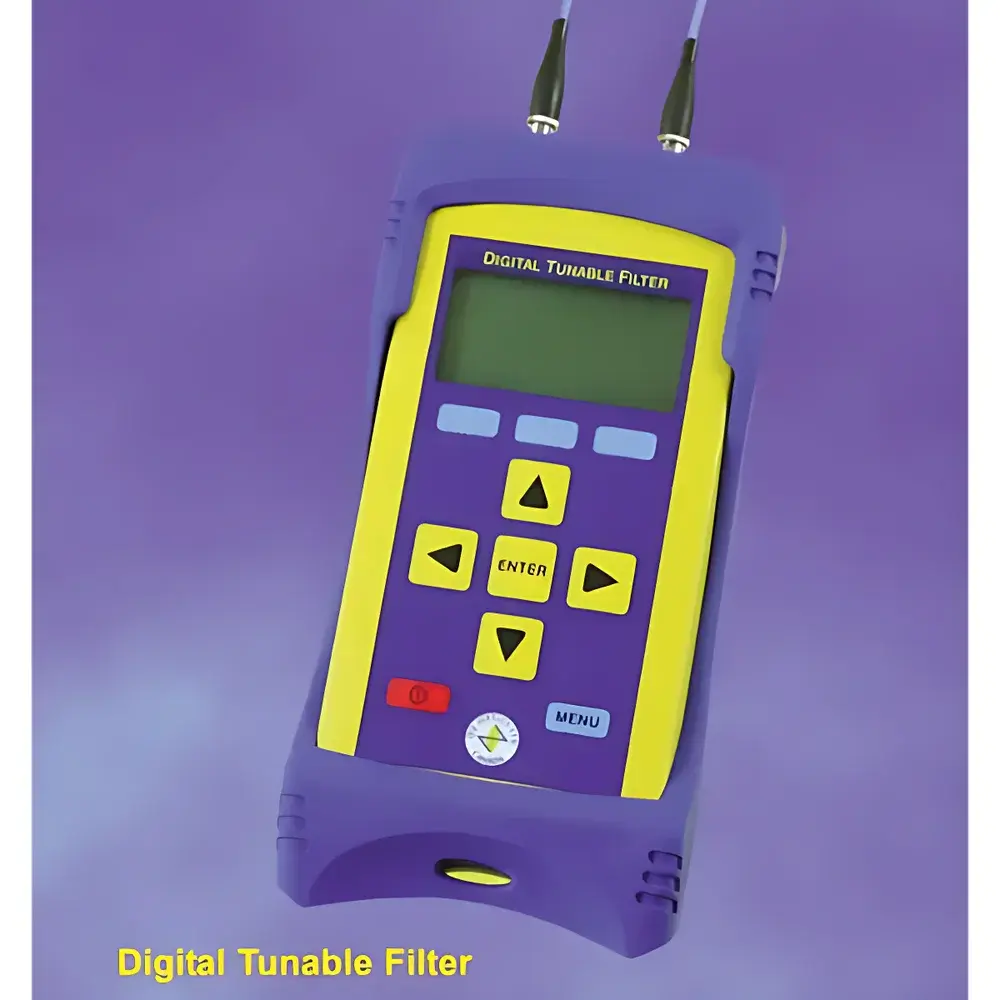
OZ Optics Digital Tunable Optical Filter
| Brand | OZ Optics |
|---|---|
| Model | DTFF Series |
| Type | Angle-Tuned Fabry–Pérot Interference Filter |
| Wavelength Range | 1470–1620 nm (S/C/L-bands) |
| Tuning Range | 50 nm per configuration |
| Linewidth (FWHM) | 1.1 ±0.1 nm (standard), down to 0.3 nm (optional) |
| Resolution | <0.1 nm |
| PDL | <0.3 dB |
| Insertion Loss | <2.5 dB (full tuning range) |
| Wavelength Accuracy | ±0.2 nm (repeatability) |
| Tuning Speed | <1 s for 50 nm, <0.1 s for 1 nm |
| Operating Temperature | −10 °C to +55 °C |
| Power Handling | ≤200 mW |
| Interface | USB 2.0 (class-compliant, no driver required) |
| Dimensions | 150 × 81 × 46 mm |
| Weight | 450 g (excl. protective boot) |
| Compliance | UL 61010-1, CSA C22.2 No. 61010-1-12, CE (RoHS/REACH) |
Overview
The OZ Optics Digital Tunable Optical Filter (DTFF) is a precision wavelength-selective instrument engineered for laboratory and telecom-grade spectral control. Based on a solid-angle-tuned Fabry–Pérot interference filter architecture, it achieves high-resolution spectral selection by dynamically adjusting the incidence angle of collimated light onto a thermally stabilized etalon element. Unlike mechanically scanned gratings or liquid-crystal-based tuners, this design delivers inherent polarization insensitivity and exceptional long-term wavelength stability—critical for dense wavelength division multiplexing (DWDM), optical component characterization, and high-fidelity spectral metrology. The device operates across three standard telecommunication bands: S-band (1470–1520 nm), C-band (1520–1570 nm), and L-band (1570–1620 nm), with custom band configurations available upon request. Its compact, handheld form factor integrates collimation, filtering, and re-focusing optics into a single robust aluminum housing, optimized for integration into automated test benches, R&D optical setups, and field-deployable measurement systems.
Key Features
- Angle-tuned Fabry–Pérot interference filter core enabling precise, repeatable wavelength selection without moving parts in the optical path
- Polarization-dependent loss (PDL) < 0.3 dB—achieved via novel birefringence-compensated cavity design, ensuring flat spectral response across arbitrary input polarization states
- Digital front panel interface with integrated LCD display and membrane keypad for local wavelength entry and real-time status monitoring
- USB 2.0 class-compliant interface supporting SCPI-style command sets for remote control via Python, LabVIEW, MATLAB, or custom applications—no proprietary drivers required
- Three fiber interface options: single-mode (SMF-28), multimode (50/125 µm or 62.5/125 µm), and polarization-maintaining (PM) variants using PANDA-type fiber; custom PM fiber types (e.g., Bow-tie, elliptical-clad) supported upon specification
- Thermal stabilization architecture minimizing wavelength drift to <0.002 nm/°C, enabling stable operation in uncontrolled lab environments
- High optical power handling up to 200 mW (CW), suitable for use downstream of amplified spontaneous emission (ASE) sources and tunable lasers
Sample Compatibility & Compliance
The DTFF series supports direct coupling to industry-standard fiber pigtails with FC/APC, FC/PC, SC/APC, or LC/PC connectors—custom connectorization available. All units undergo full spectral calibration traceable to NIST-traceable reference sources at time of shipment, with individual calibration reports provided. The device complies with international safety and electromagnetic compatibility standards including UL 61010-1, CSA C22.2 No. 61010-1-12 (Third Edition, updated 2016), and CE marking under Directive 2014/30/EU (EMC) and 2011/65/EU (RoHS), including full REACH SVHC compliance. While not inherently GLP/GMP-certified, its deterministic tuning behavior, audit-ready USB command logging, and repeatability better than ±0.2 nm support integration into regulated environments where instrument qualification protocols (e.g., IQ/OQ/PQ) are performed by end users.
Software & Data Management
OZ Optics provides a cross-platform GUI application (Windows/macOS/Linux) that enables wavelength scanning, step-and-hold sweeps, and real-time transmission monitoring. The underlying USB interface implements a vendor-neutral HID protocol compatible with standard VISA libraries, permitting seamless integration into existing test automation frameworks. All commands—including WAV:SET 1550.12, WAV:READ?, and STAT:ERR?—return ASCII-encoded responses with IEEE 488.2 syntax. Timestamped wavelength logs can be exported in CSV format; no proprietary file formats are used. For FDA-regulated applications, the system supports external audit trail generation through host-side logging—though native 21 CFR Part 11 electronic signature or audit trail functionality is not embedded in the device firmware.
Applications
- Dense Wavelength Division Multiplexing (DWDM) channel isolation and crosstalk measurement
- Characterization of optical amplifiers (EDFA, Raman), filters, isolators, and circulators
- Construction of agile, narrowband tunable laser sources when combined with broadband ASE or superluminescent diodes
- Spectral purity verification in quantum optics experiments requiring polarization-insensitive filtering
- In-line process monitoring during fiber Bragg grating (FBG) inscription and thin-film coating deposition
- Automated pass/fail testing of transceivers and active optical cables (AOCs) in manufacturing QA workflows
- Calibration reference for optical spectrum analyzers (OSAs) and wavelength meters
FAQ
What wavelength ranges are supported out-of-the-box?
Standard configurations cover the S-band (1470–1520 nm), C-band (1520–1570 nm), and L-band (1570–1620 nm). Non-standard bands—including O-band (1260–1360 nm) and extended L-band (1620–1670 nm)—are available as custom orders with lead-time adjustment.
Can I specify a custom linewidth (FWHM)?
Yes. While 1.1 ±0.1 nm is standard, optional versions with FWHM as narrow as 0.3 nm are offered. Narrower linewidths reduce maximum tuning range per unit; consult engineering for trade-off analysis.
Is the device compatible with polarization-maintaining fiber systems?
Yes. PM versions preserve extinction ratio >20 dB and align the filter’s principal axis to the slow axis of the input fiber. Alignment accuracy is ±1°; angular offset calibration data is included in the delivery report.
What is the maximum allowable input power?
The standard package supports up to 200 mW CW. For pulsed operation, peak power must remain below 500 mW with duty cycle <1% to avoid thermal lensing in the etalon substrate.
Does the unit require external temperature control or warm-up time?
No. Internal thermal regulation maintains cavity temperature within ±0.2 °C of setpoint. Full spectral stability is achieved within 5 minutes of power-on at room temperature (23 °C).




