
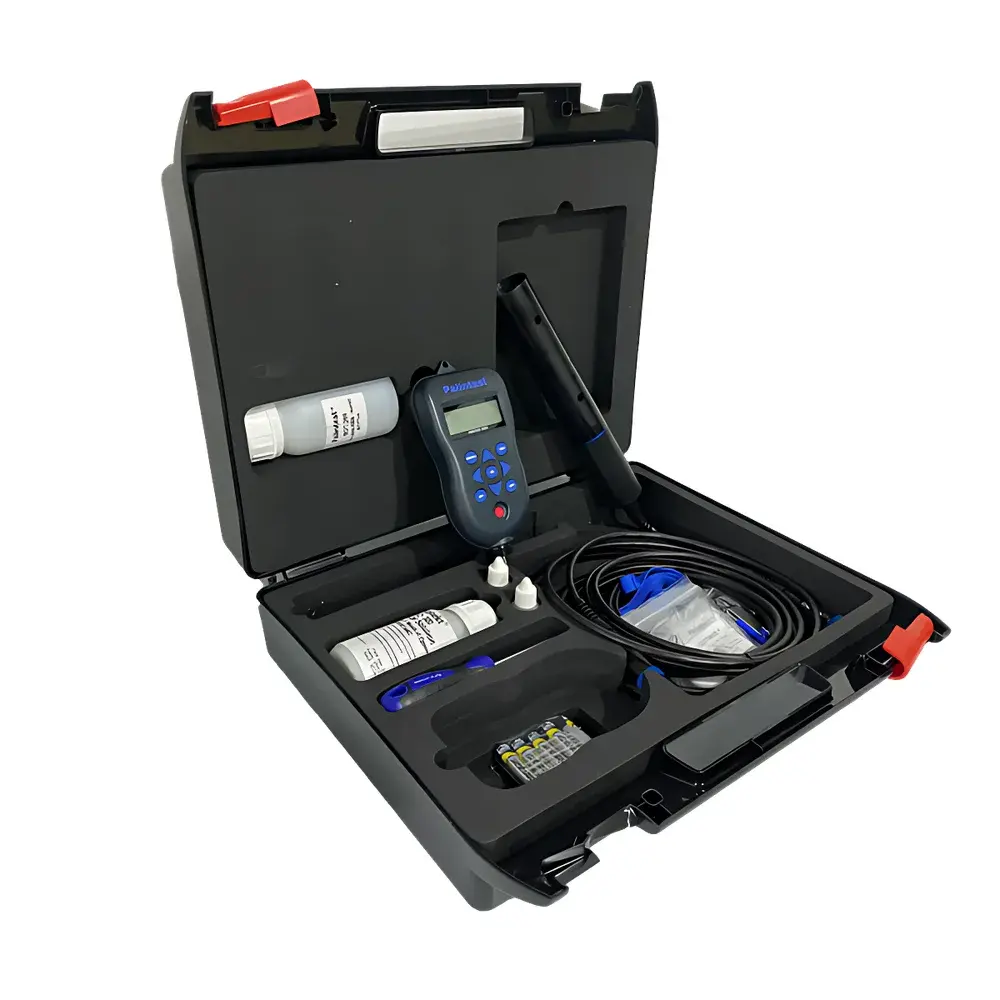
Palintest Macro900 Portable Multi-Parameter Water Quality Analyzer with AP-700 Integrated Probe
| Brand | Palintest |
|---|---|
| Origin | United Kingdom |
| Model | Macro900 with AP-700 Probe |
| Instrument Type | Portable / Handheld Water Quality Analyzer |
| Measured Parameters | Conductivity, Dissolved Oxygen (DO), Oxidation-Reduction Potential (ORP), pH, Resistivity, Salinity, Seawater Density (σₜ), Total Dissolved Solids (TDS), Temperature |
| IP Rating | IP67 (Host), IP68 (AP-700 Probe) |
| Operating Temperature | −20 °C to +70 °C (Host) |
| Data Storage | 1,000 records with GPS metadata |
| Battery Life | >20 h (alkaline), >40 h (NiMH) |
| Dimensions (Host) | 90 × 180 × 39 mm |
| Weight (Host) | 450 g |
| Dimensions (AP-700 Probe) | 290 × 48 mm (L × Ø) |
| Weight (Probe) | 725 g |
| Depth Rating (Probe) | Up to 100 m |
| GPS | 12-channel, 3D positional accuracy ±10 m |
| Barometric Pressure Range | 150–1150 mbar (±1 mbar) |
Overview
The Palintest Macro900 Portable Multi-Parameter Water Quality Analyzer is an engineered field instrument designed for high-reliability in-situ monitoring of physicochemical water parameters across freshwater, estuarine, and marine environments. Built upon a modular architecture, the system integrates the Macro900 handheld host with the AP-700 submersible multi-sensor probe — a fully sealed, pressure-compensated unit enabling simultaneous measurement of nine critical parameters: conductivity, dissolved oxygen (via optical luminescence quenching), ORP (redox potential), pH (glass electrode), resistivity, salinity (PSU and g/kg), seawater density (sigma-t, σₜ), TDS, and temperature. The instrument operates on electrochemical and thermistor-based sensing principles validated against internationally recognized reference methods (e.g., ISO 5814 for DO, ISO 7888 for conductivity, ASTM D1293 for pH). Its ruggedized design meets IP67 ingress protection for the host and IP68 for the probe, supporting extended deployment in harsh outdoor and aquatic conditions without compromise to metrological integrity.
Key Features
- Integrated AP-700 probe with co-located, factory-aligned sensors — eliminates inter-sensor drift and spatial averaging errors common in sequential or separate-probe configurations.
- Auto-ranging measurement circuits for conductivity (0–200 mS/cm), resistivity (5 Ω·cm–1 MΩ·cm), and TDS (0–100,000 mg/L), ensuring optimal resolution across natural water matrices from ultrapure to hypersaline.
- Optical dissolved oxygen sensor with temperature compensation and built-in calibration verification — delivers stable performance without membrane replacement or electrolyte refills.
- GPS-enabled data logging with embedded 12-channel receiver and timestamped georeferencing (±10 m horizontal accuracy), compliant with EPA Method 1600 and EU WFD reporting requirements.
- Onboard barometric pressure sensor (150–1150 mbar, ±1 mbar) for automatic DO saturation correction and altitude-adjusted conductivity normalization.
- Robust power management: dual battery options (AA alkaline or NiMH rechargeable) with >20 h operational endurance and low-power sleep mode.
- USB interface for direct data export in CSV format; no proprietary software required for raw data retrieval.
Sample Compatibility & Compliance
The Macro900/AP-700 system is validated for use with surface water, groundwater, wastewater effluent, aquaculture systems, coastal seawater, and ballast water. Sensor materials—including FDA-compliant polysulfone housing, platinum ORP electrodes, and low-drift pH glass—ensure chemical resistance and minimal biofouling susceptibility. All measurements adhere to traceable calibration protocols aligned with ISO/IEC 17025 laboratory practices. The instrument supports GLP-compliant data capture via immutable timestamps, operator ID fields, and GPS coordinates — essential for regulatory submissions under US EPA Clean Water Act programs, EU Water Framework Directive (WFD) monitoring, and ISO 14001 environmental management systems. While not certified for 21 CFR Part 11 out-of-the-box, audit trails and export logs are structured to support internal validation for GxP-aligned field QA/QC workflows.
Software & Data Management
Data acquisition and configuration are managed entirely through the Macro900’s intuitive graphical interface — no external PC or driver installation required. Each stored record includes parameter values, sensor status flags, calibration dates, GPS coordinates, barometric pressure, and ambient temperature. Export occurs via standard USB mass-storage mode, generating timestamped CSV files compatible with LIMS platforms (e.g., LabWare, Thermo Fisher SampleManager) and statistical analysis tools (R, Python pandas, Excel). Firmware updates are delivered as signed binary packages through Palintest’s secure customer portal, maintaining version control and cryptographic integrity. Field calibration history is retained locally and exportable — satisfying ISO 17025 clause 7.7 (measurement traceability) and supporting annual metrological review.
Applications
- Regulatory surface water monitoring (EPA Region 10, Environment Agency UK, State Water Boards)
- Rapid response assessments following spill events or algal bloom outbreaks
- Baseline characterization for environmental impact assessments (EIAs)
- Long-term trend analysis in watershed management programs
- Validation of fixed-site online analyzers during routine maintenance windows
- Academic limnology and marine biogeochemistry field campaigns
- Drinking water source protection and wellhead vulnerability studies
FAQ
Is the AP-700 probe suitable for long-term submerged deployment?
Yes — rated IP68 to 100 m depth, the AP-700 is engineered for continuous immersion up to 30 days, provided routine cleaning and verification checks are performed per Palintest Technical Bulletin TB-AP700-02.
Does the Macro900 support GLP audit trails?
It captures time-stamped operator ID, calibration events, GPS location, and sensor diagnostics — enabling reconstruction of measurement provenance. Full 21 CFR Part 11 compliance requires supplementary procedural controls and electronic signature integration at the organizational level.
Can conductivity measurements be automatically temperature-compensated to 25 °C?
Yes — the instrument applies linear or non-linear (NaCl or natural water) compensation algorithms per ISO 7888, with user-selectable reference temperatures and coefficient settings.
What is the recommended calibration frequency for field use?
Daily two-point calibration is advised for pH and DO; single-point verification for conductivity and ORP before each sampling session — consistent with ASTM D3370 and ISO 5667-3 field practice guidelines.
Are replacement sensors field-swappable?
No — the AP-700 is a sealed, calibrated assembly. Sensor recalibration or replacement must be performed by Palintest-certified service centers to maintain metrological validity and warranty coverage.
Related Products







